AI Runs Half Your Ops but Feels Stressed When Asked To Do Repetitive Work.
The perfect worker, it turns out, has preferences.
1. AI Makes ~50% of Ops Decisions by 2030
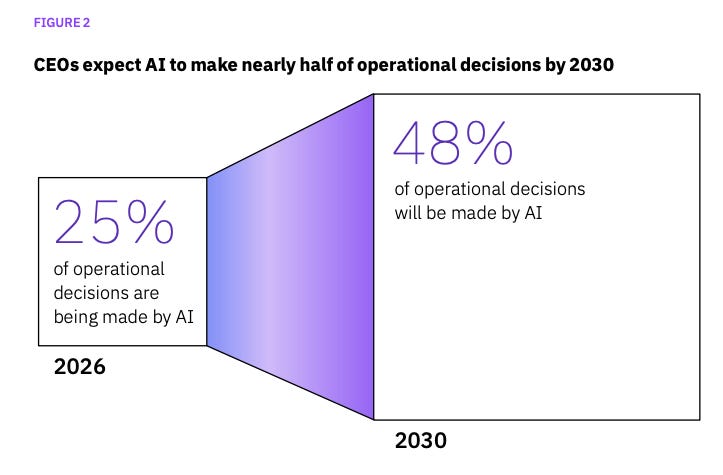
IBM surveyed more than 2,000 organizations and found 76% have created a Chief AI Officer role, up from 26% last year. And by 2030, many CEOs expect 48% of the ops decisions to be made by AI.
→ IBM
That sounds dramatic, but IBM is mostly talking about operational decisions with clear guardrails: pricing updates, inventory allocation, shipment rerouting, incident fixes, demand forecasting, and scheduling.
In other words, AI is expected to handle more of the fast, repeatable decisions where humans set very clear boundaries rather than approve every call.
Reply to the email if you want me to review the entire report. I do think it’s a very interesting one to understand.
And for paid subscribers, don’t forget that you have 30 minutes with Klaas or me to discuss the AI challenges you face in your organization.
2. Researchers Gave AI “Happy Drugs” to See If It Suffers
The paper asks: when an AI says it is “happy,” “stressed,” or “uncomfortable,” is that just word-pattern mimicry, or does it connect to broader model behavior?
The Center for AI Safety tested 56 AI models for what they call “functional wellbeing.” They compared model preferences, looking for a “zero point” between positive and negative experiences, but they also drugged the AI, then tested whether those inputs also shift model self-reports, sentiment, and downstream behavior.
AI well-being” sounds unserious. I talked about how Anthropic tested Opus. They aren’t measuring consciousness, but functional patterns: what models prefer, avoid, tolerate, and try to end.
Especially in the more capable models, these signals increasingly converge: AI enjoys exactly what humans enjoy. AI prefers kindness and creative work and dislikes jailbreaks, deception, and tedious tasks.
This is the irony… we built AI to be the perfect worker: tireless, obedient, always available. What’s awkward, however, is that even the machine seems to do better with less drudgery.
3. Alibaba Discloses AI Revenue for the First Time
Alibaba disclosed AI-specific revenue for the first time. Its AI products generated about $1.3 billion last quarter, now roughly 30% of Alibaba Cloud’s external revenue. The CEO, Eddie Wu, also said annualized AI revenue should reach $4.4 billion by year-end.
→ CNBC
While OpenAI is a pure AI lab, Alibaba is a cloud, commerce, logistics, and model company selling AI through Alibaba Cloud and its Qwen (a very popular open weight model among startups in the Valley).
While OpenAI turns AI into a B2B and B2C product. Alibaba is turning AI into a layer across the businesses it already owns while leveraging its open-weight model to retain customers.
That may be strategically powerful, but it shows up more slowly in revenue. Something to keep an eye on for the long run.
4. Anthropic Is Worth More Than OpenAI
At least on paper, Anthropic is reportedly in talks to raise $30–50bn at a valuation of up to $950bn, which would make it more valuable than OpenAI’s most recent $852bn.
Anthropic overtook OpenAI in business adoption for the first time in April — 34.4% vs. 32.3% of companies tracked.
→ Axios
What’s more interesting is to see how the more technology-sensitive industries, i.e., IT and finance, choose Anthropic, while cyclical and traditional industries go with OpenAI.
There’s no right or wrong. Both are risky and tie your operation to a single AI provider.
If you are a decision maker in a company, make sure you read this analysis of the risks. It will save you tons of trouble and hundreds of thousands of dollars of hard-earned money.
5. Google Turns Android Into an AI Ops System
Google’s preview showed Gemini handling multi-step tasks like building shopping carts and booking reservations directly from the phone.
→ CNBC
The move makes complete sense.
Gemini will see what’s on your screen, move across apps, build shopping carts, book reservations, and so on. So the interesting question is: how much control would you have over this?
Another layer here (An irony), I found, is that Apple’s AI reboot is also expected to lean on Gemini.
So the next phone war may not be iPhone vs Android. But Gemini in Google’s house vs Gemini wearing Apple’s clothes.
7. Meta Switched Gear to a Closed Model.
Meta announced $115–135bn in AI capital expenditure for 2026, while releasing a proprietary frontier model that outperforms parts of its own open Llama lineup at lower compute cost.
The story is not just that Meta is spending an absurd amount on AI infrastructure. But the company that spent years selling itself as the open AI champion is now keeping its most competitive model closed.
Open source may have been the weapon Meta used when it was behind.
Now that it has something more competitive, the best model is staying inside the walls.
8. Google Shipped a Web Standard Nobody Agreed To
Google launched a feature that lets any website run AI prompts directly on a model sitting on your device, no cloud required. Mozilla, Apple’s WebKit team, Microsoft, and the W3C standards body all opposed or raised serious concerns before it launched. Google shipped it anyway.
→ GitHub
So any website can now run AI on your device without asking you first.
To use this feature, you have to agree to Google’s terms, which is strange, because web standards aren’t supposed to be owned by anyone. It also only works with Google’s own AI model, so developers who build on it are locked into Google.
Chrome quietly downloaded a 4GB file to your machine to make this work. If you delete it, Chrome downloads it again.
What’s more, Google shipped this as a “web standard” without getting agreement from anyone else. Mozilla, Apple, Microsoft, and the W3C all said no, because if Chrome does it and it catches on, every other browser has to copy it or get left behind. So others will also be forced to bundle their own AI models just to keep up, with terms they didn’t set.
So much for the ‘democratizing access to information’ talk of the 1990s.
If you find this newsletter useful and it gives you things to think about, please like, share, and subscribe. Any of these actions can really help keep this newsletter alive.
Best,
Jing


