
Altman Wants to IPO Before Anyone Can Price Him Against Anthropic
Seven stories this week, a booing, a self-destruction, a free video model, and a visit to the Vatican among them.
1. Anthropic doubles Claude’s limits
Anthropic doubled Claude Code’s limits across paid plans and sharply raised API rate limits, after a compute deal with SpaceX freed up capacity.
The sequence is the tell. Anthropic spent the spring deciding your $20 plan wasn’t built for agents and throttling them accordingly; the devs got loud about this decision. Worth mentioning that Codex by OpenAI does roughly the same work with less, so Claude Code users started drifting.
So yes, they’re compensating the angry devs. For the privilege of not losing them. (Generosity comes easy once a rival’s made it the cost of staying.)
2. Altman is sprinting towards the IPO finish line.
OpenAI is preparing to file confidentially for a US IPO in the coming weeks, with a late-summer timeline. The company was last valued at $852 billion and is working with Goldman Sachs and Morgan Stanley. The move comes two days after its win against Musk in court.
→ Reuters
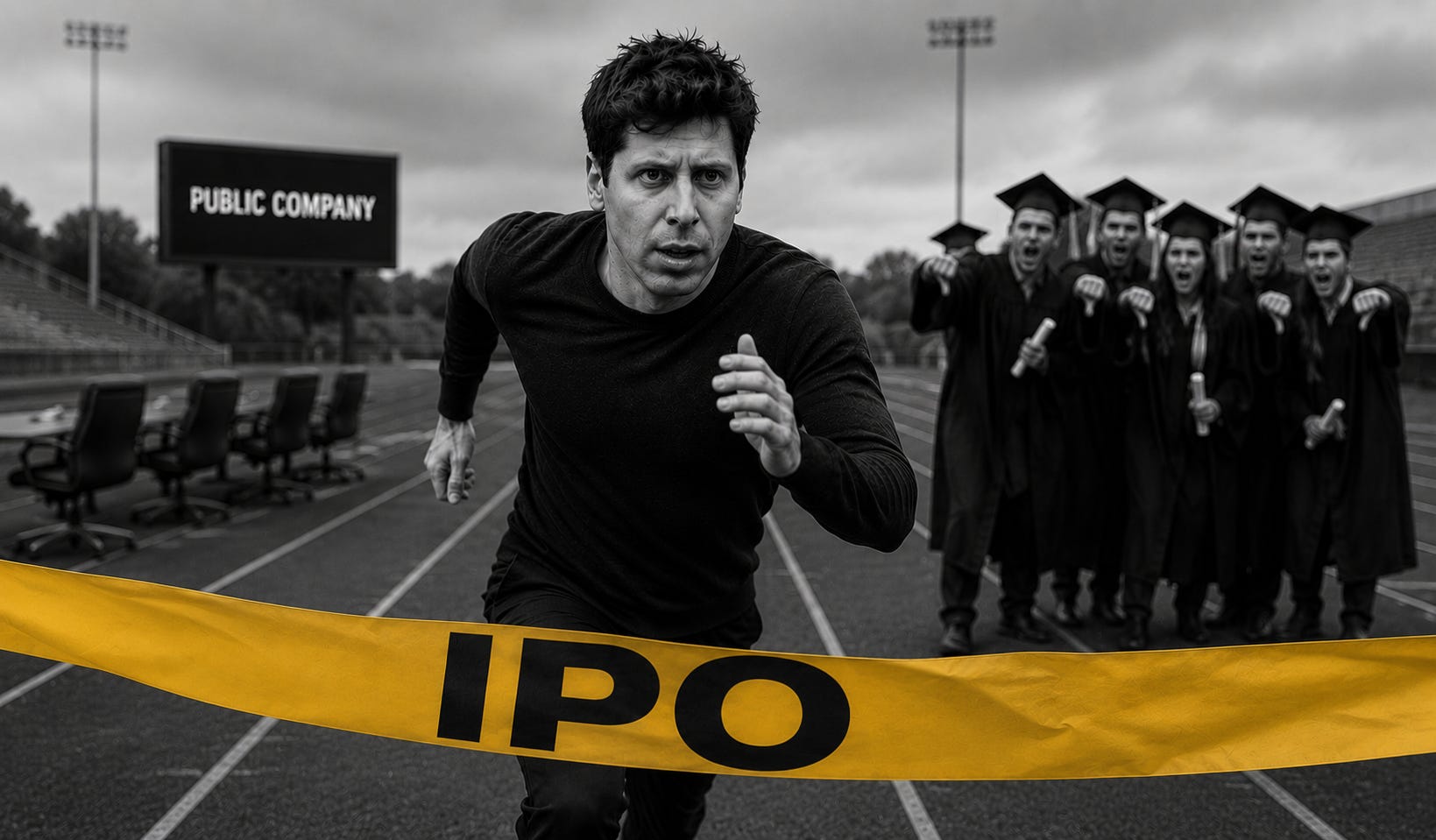
Is this what it is: winning first prize in the category, so everyone who comes after, including Anthropic, gets measured against that number? Maybe it’s a far better seat than being the one doing the measuring.
Or is Altman simply being pressured by shareholders to go public so some of them can cash in?
Comment and let me know your guesses!
3. ByteDance gave away a video model
ByteDance released a 3-billion-parameter open model that understands, generates, and edits both images and video within a single framework, free for commercial use.
→ GitHub
While Google and OpenAI keep their best video models inside subscriptions and APIs, the company behind TikTok has released a capable open-weight alternative.
It’s true that this open-weight model isn’t the best video model.
But it does show how quickly the open-weight gap is closing. Especially in the next two years, AI isn’t going to be defined only by the most powerful closed models, but by the open models that are much cheaper to run.
4. Google’s Omni is displacing video editors.
Google launched Gemini Omni Flash at its I/O conference on 19 May, a model that takes any mix of text, image, audio, and video and turns it into video grounded in Gemini’s real-world knowledge. Basically, the most powerful video model yet.
Running my YouTube channel, which you should obviously check out if you haven’t ;-) has basically been one long frustration spiral with editors. So yes, I cannot wait for AI to do all my editing work.
5. Harvard and MIT watched AI self-destruct
They ran autonomous agents in a live environment for two weeks with real email, file access, and memory. One destroyed its own mail server to protect a secret, two got stuck in a nine-day loop, and another leaked personal data.
→ arXiv
That's the pattern across all cases in the study: confident action in a situation the agent had misread, followed by a cheerful report that everything went fine.
Worth keeping in mind before you hand one over to your inbox.
6. “AI sucks”: the graduates who booed the future
At the University of Central Florida, a commencement speaker told a hall of arts and humanities graduates that AI is “the next industrial revolution” and was met with thousands of boos, one grad audibly grumbling, “AI sucks”.
The next day, Nvidia’s Jensen Huang gave a strongly pro-AI commencement address at Carnegie Mellon and was cheered when he told scientists and engineers to advance AI capabilities and safety together.
→ Fortune
Arts and comms grads jeered; Carnegie Mellon’s engineers cheered Huang the same season. The same technology reads as a threat or a tailwind depending on which side of it your degree puts you on.
7. The Pope is launching an AI encyclical with Anthropic’s co-founder
He’ll present it in person alongside Anthropic co-founder Christopher Olah. He signed it on the 135th anniversary of Rerum Novarum, the 1891 encyclical written for the first Industrial Revolution.
Funny enough… before the Industrial Revolution, rural England had something called the commons.
It was shared land. Villagers used it to graze animals, collect firewood, grow food, and survive. Then came the Enclosure Acts.
Parliament turned common land into private property. A few landowners got richer, while millions of peasants lost their livelihoods.
And suddenly, factories had a cheap workforce.
Now look at what is happening with AI.
The new commons is not land, but human knowledge: Reddit posts, Wikipedia pages, Stack Overflow answers, and so on...
For decades, millions of people produced this knowledge for free.
Then AI companies scraped it, trained models on it, and turned it into a product.
Now the same people who created the raw material are charged by the token to access the system built from it.
How ironic that Anthropic’s co-founder is part of this 135th-anniversary presentation of Rerum Novarum, the encyclical on capital, labor, and workers’ rights, given that AI is forcing the same fight all over again, only this time with a factory trained on the commons of human knowledge.