Any Sign of SaaS dying in 2026?
This week: Robinhood hands AI your portfolio, China bets on token futures, and OpenAI puts a number on humanity.
So SaaS Isn’t Dying?
Here’s the latest earnings
Salesforce revenue hit $11.1B, up 13% YoY.
Workday came in at $2.5B, up 14.5%.
Asana FY26 full-year revenue landed at $790.8M, up 9%.
If Salesforce, Workday, Asana, and Zoom are still growing, then the “AI kills SaaS” thesis looks too simplistic.
Maybe what’s actually going on is that weak, easily replicated software is under pressure, while incumbents with distribution, workflow lock-in, and unique data can leverage AI to deepen their moat; whether or not it's a genuine productivity boost for the clients is another topic.
But for now, AI isn’t killing SaaS.
Your AI Can Now Trade for You
Robinhood launched agentic trading, letting users create a separate account for AI agents and connect them to a dedicated wallet to execute stock trades. Until now, Robinhood has over 27 million users with $345 billion in assets on its platform.
What is the chance that 27 million retail investors all have the same thesis and concentrate their money on the 20 stocks that AI recommends?
That is where this gets structurally interesting. Because agentic trading does not just lower the friction of investing, it could also lower the diversity of thought behind trades.
Expect to see more crowding, more momentum chasing, and sharper unwinds.
Meta Delivered Its Reddit?
Meta quietly dropped Forum — a standalone iOS app that turns Facebook Groups into a dedicated Reddit-style discussion feed, topped with an AI “Ask” feature.
For a 2nd order take, think incentive. What’s in it for Meta? Are they really after Reddit, or something more valuable in 2026?
Every question asked in the Forum's Ask feature, every threaded debate, every recommendation thread becomes a training signal for Meta's AI. Meta doesn't need to pay Reddit for what it can generate itself.
Trump Pulled His Own AI Order
The White House postponed an executive order that would have established a voluntary review process requiring AI companies to share advanced models with the government before public release.
Of course, it shouldn’t surprise you that OpenAI and Anthropic had been negotiating with the administration.
→ CNN
According to Trump, here’s why he decided to postpone the order:
“I think it gets in the way of — we’re leading China, we’re leading everybody, and I don’t want to do anything to get in the way of that lead.”
In reality, we all know how much he dislikes regulations.
Zoom’s Doubled Down for AI in Meetings
Zoom raised its fiscal 2027 revenue forecast, now expecting $5.08–5.09B, citing strong demand for AI tools, including agents and companions integrated into its video meeting and communication services.
→ Reuters
Has your AI joined the meeting yet to listen to what your boss’s AI would have to say?
China Wants Futures Contracts for AI Thoughts
China is designing a futures market for AI tokens through the Shanghai Futures Exchange.
The US is building futures markets around compute (GPUs, hardware). China is building them around tokens (inference output).
Two different bets on where value accrues, hardware scarcity vs. usage volume.
My view is that compute is easier to turn into a market than tokens. Compute is like corn, oil, or electricity, ie, it’s an input with a measurable price, so it’s easier to build contracts around.
Tokens, on the other hand, are messier, given that a token from one AI model is not always equivalent to a token from another, just like one bag of corn is easier to compare than ‘one good idea’ from two different people. Not that AI has good ideas, though.
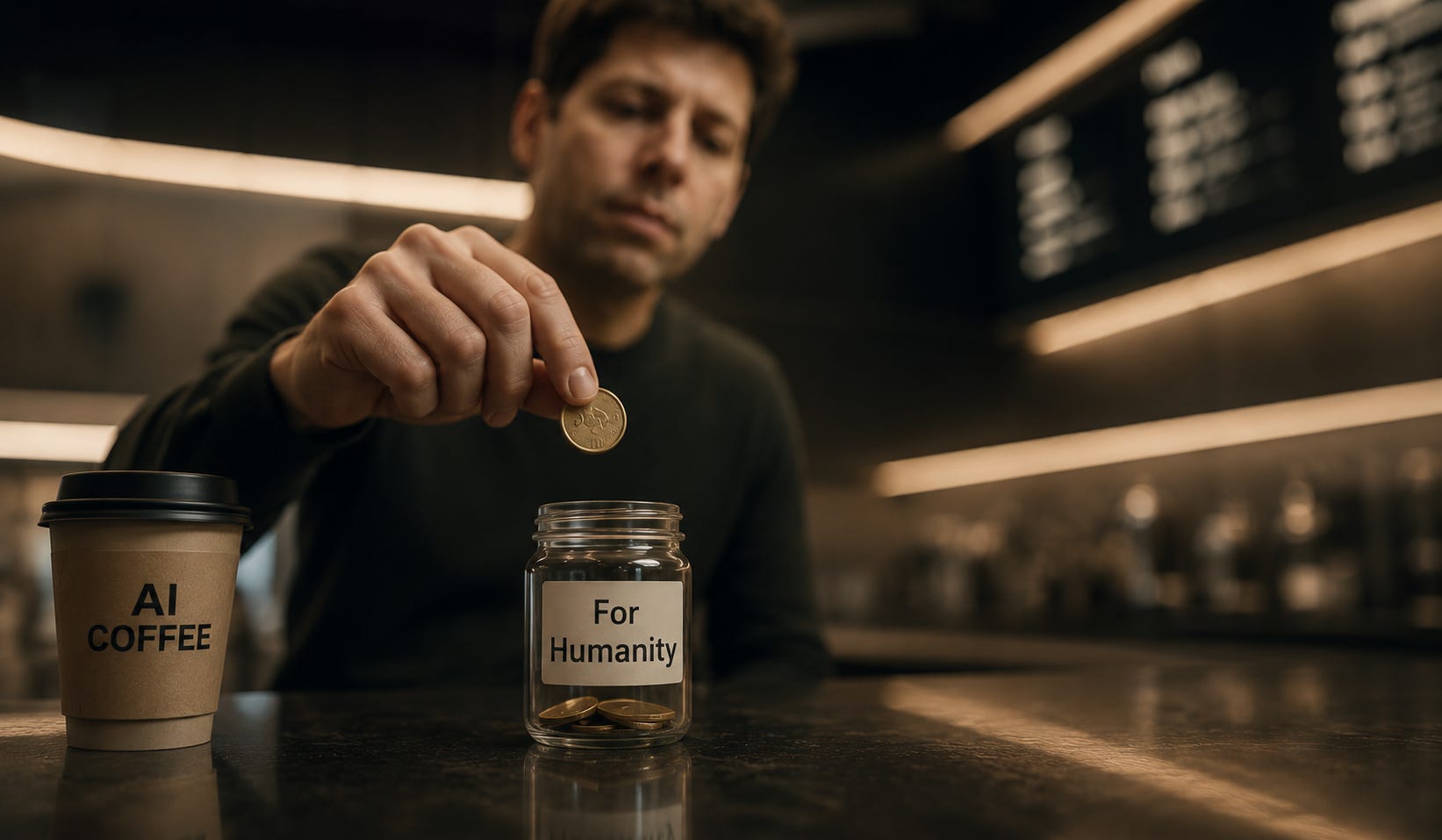
$250M for Humanity, $852B for the Shareholders
The OpenAI Foundation is committing an initial $250M to grants and partnerships aimed at building secure economic futures in the age of AI.
$250M for ‘economic futures in the age of AI’, just put this in context, this is 0.03% of its current valuation.
While it asks to be read as evidence of moral seriousness, when in practice it looks more like a low-cost hedge against criticism.
OpenAI is effectively saying: we may help destabilize the economic foundations of work, but here is 0.03% of our paper value to show we care.
The irony deepens if you compare this with OpenAI’s 2015 launch post:
Our goal is to advance digital intelligence in the way that is most likely to benefit humanity as a whole, unconstrained by a need to generate financial return… Our primary fiduciary duty is to humanity.