
Briefing: how big tech sees the future of AI?
Q2 2026 software earnings season, a time for investors to either double down or pull back their money based on a CEO's AI strategy.
Hey,
It’s the earnings season, the best time to understand how the giants view AI and how each chooses to bet on their version of the AI future, cause last time I checked, AI is here to stay.
And a personal note.
Klaas and I have been preparing to move to the US for the last three years; it’s finally happening!
We’ll be landing in Austin, TX, first thing in September. So I’d love to meet you if that’s where you’re based!
Back to the newsletter.
Zuckerberg’s indecisive moment
Mark Zuckerberg described AI as four linked businesses: better recommendations and ads, personal agents, enterprise agents, APIs, and direct compute sales.
→ Meta
Do you still remember my deep dive work: Is Zuckerberg finally coming of age?
Since the first earnings call of the year, he has already been emphasizing how many people have been asking them to rent out cloud computing capacity… And he brought it up again in this latest one.
And his attitude hasn’t changed since: ambiguous.
On one hand, he said
we are getting a large number of offers for the compute that we have
and that
But I also think it would be foolish to basically just sell all of the compute and take a short-term profit.
On the other hand, knowing he has hired an ex-AWS veteran, and he still didn’t give a firm no to the idea of selling the compute:
having confidence that we have the ability to monetize the compute directly when that makes sense…
That said, who knows if his indecisiveness was driven by no clear profitability or just because all his peers are doing the same thing, hence the investment?
Given the number of data centers under construction, whether for internal use or as a landlord, the risk to him (and to everyone) is always whether it’d be a profitable investment in 2-3 years' time.
Microsoft sells ‘harness’
The theme is harness.
Satya Nadella emphasized that the mission Microsoft is on is to route workloads across different AI models and make them more efficient for customers. Range from selecting the right model for a task, optimizing inference, improving utilization, and enabling customers via their forward-deployed engineering teams.
His focus in this earnings call perfectly aligns with the open weight declaration they lead.
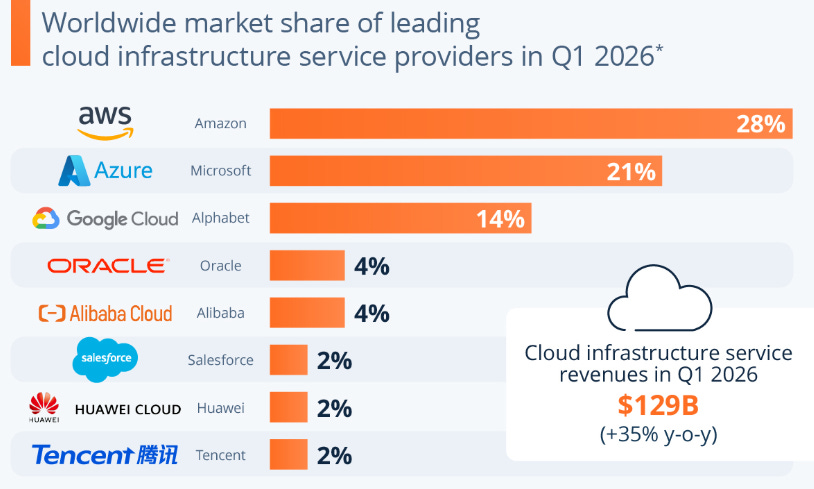
As the 2nd biggest cloud provider, it only makes sense to position Azure as the control layer through which companies manage an increasingly heterogeneous model market.
As I mentioned in my Kimi K3 work, the AI value shifts from owning one winning model to deciding which model should handle each request, at what cost, and with what level of performance.
So Nadella really knows his customers.
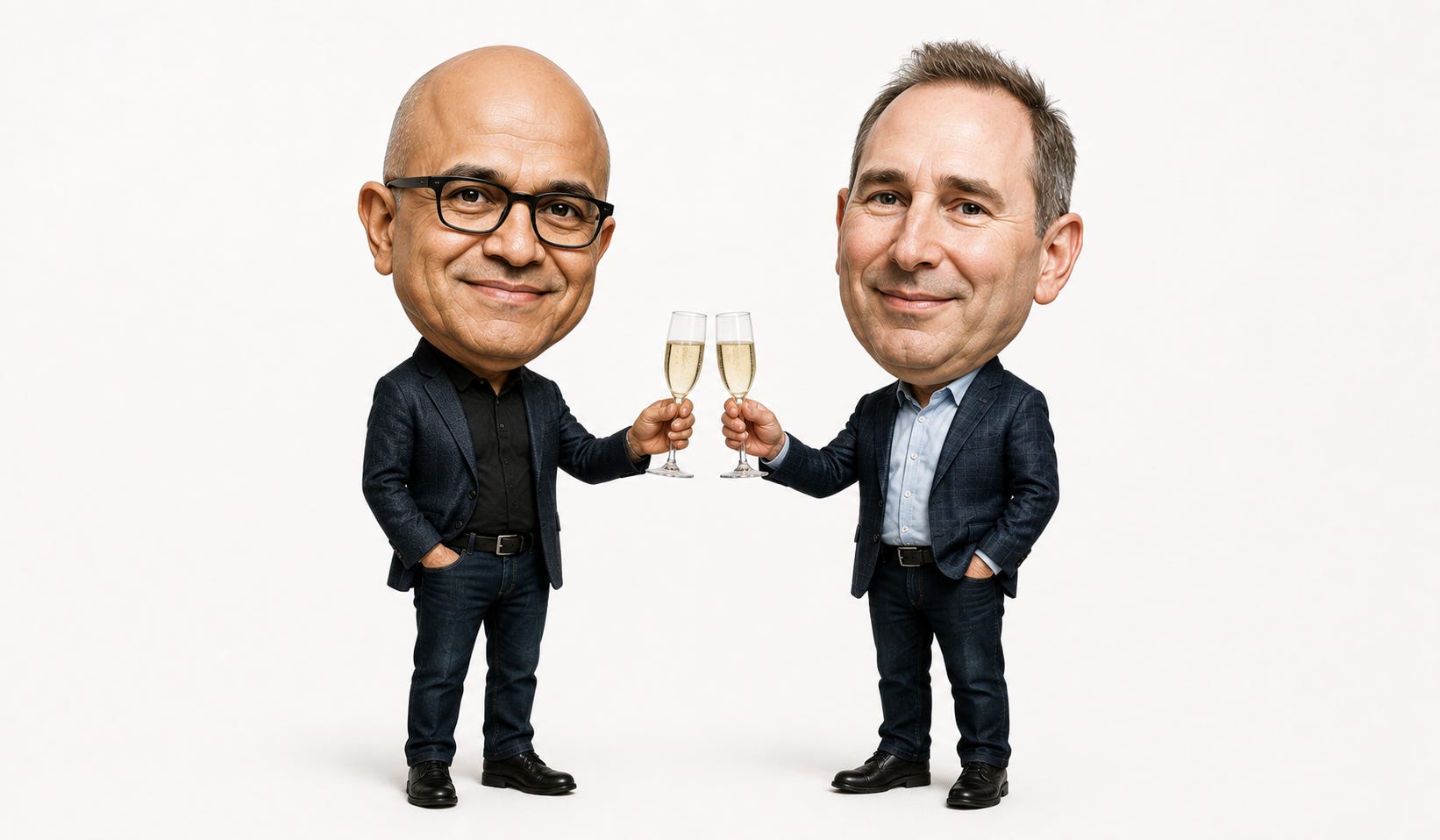
Amazon doesn’t want its own AI model?
In its latest earnings, Andy Jassy said this:
My view of it is that AWS and Amazon can have a wildly successful business without its own frontier model.
→ Yahoo Finance Amazon earnings transcript
How brave!
Only a minute later, he added
All that said, we are pursuing our own frontier model… (for) control over cost
Damn, how Amazon!!
Basically, Andy Jassy was saying that customers can choose to use a more polished and well-designed Dyson hoover, but hey, there’s also an Amazon basic hoover available if you’d like to haggle!
I listened to all three of the biggest cloud companies’ earnings, and you have
Google's stock price was down 12% within two days after the earnings
Amazon was up nearly 20%, and Microsoft was up 24%.
Why did their investors react so differently to their very similar cloud strategy? Or are there more reasons to believe that while one strategy works on Amazon, it wouldn’t work on Google?
Stay tuned, this is the topic for this week’s analysis.
Let a 25-year-old manage your money?
Situational Awareness, funded by Leopold Aschenbrenner, a 25-year-old AI scientist. His investment thesis was really simple: buy only AI stocks and short everything that is not AI, on leverage.
→ Reuters
His bet:
AI is going to make a small group of companies much richer, and make many ordinary companies less valuable.
So he bought companies that supplied the AI boom: data centers, chips, basically everything related to AI infrastructure. Meanwhile, he also bet against software companies that he thought AI would make less useful.
Then he borrowed heavily, so every gain or loss was multiplied.
For a while, it worked spectacularly. AI-related shares rose, his fund made enormous returns, and it grew to roughly $45 billion.
Then the trade broke in both directions at once.
The AI-infrastructure shares he owned fell hard, in some cases 50% to 78% below their recent peaks. Meanwhile, the software companies he had bet against rose. So he was losing money on the companies he owned and on the ones he bet would fall.
On top of that, because he had borrowed so much, his lenders demanded immediate cash. To get that cash, he had to sell his shares while they were already falling!
Those forced sales made the losses worse, which triggered more demands for cash. It became a terror loop, and the fund was forced into sale.
So question, would you let a brilliant accountant (assuming they are the best one on earth) operate on your heart? If not, why’d anyone trust their money to an AI programmer?
This event was just ridiculous, which made me laugh. I hope those who invested in this firm have a plan B.
Palantir scores another win
Karp framed its 93% revenue growth as evidence of its strategy’s success: giving enterprise controls over AI.
Of course, how can this one come without his signature style? So in the call, he also taunted other AI labs as parasitic models.
One of my deep dives covered his latest viral interview with CNBC, explaining what he meant, but also how much of what he said aligned with other tech giants’ CEO like Nadella. A hint, there’s more overlap than you think.
So if you haven’t, read this one:
What Alex Karp really meant in that viral CNBC interview

For each AI query, you pay twice. And only the first round is paid in money (and it’s the cheaper one).
More Chinese open weight models
Alibaba released Qwen3.8-Max, with 2.4 trillion parameters and a context window of up to one million tokens. Very similar capacity compared with Kimi K3
It’s all good and well signing the Open Weights and American AI Leadership declaration. But what’s next?
You haven’t seen much action from the well-known AI labs. However, the tech conglomerate is loud and clear about how they plan to act.
For example, all three cloud providers have their own teams to help their clients deploy models at a lower cost (than using Anthropic or OpenAI) and with much greater safety. Or, if you look at what Apple has, their sole goal is to make edge computing on your device inevitable.
I wonder, with this rate, how long it’d take until AI labs’ financial collapse?
I thought you might enjoy something light to end this newsletter.
Do you believe in AI consciousness?
It turns out that making AI avoid claims like “I am conscious” may change its other behavior.
→ arXiv
What I found particularly interesting in this one is that, when researchers weakened a learned safety-refusal direction, the models became more willing to attribute minds to themselves, animals, and nature, and expressed stronger spiritual beliefs.
This suggests that AI safety rules may be tied to broader assumptions about what counts as having a mind.
Does that mean that, for AI to obey, we also need to treat it as if it has a mind, just like us?