
Jensen Huang’s Affair
This morning I thought to myself,
I’ve never imagined someone cheating would screw up my release schedule…
I suspect a few thousand analysts had the same thought.

Here’s Jensen Huang’s email to Nvidia employees.
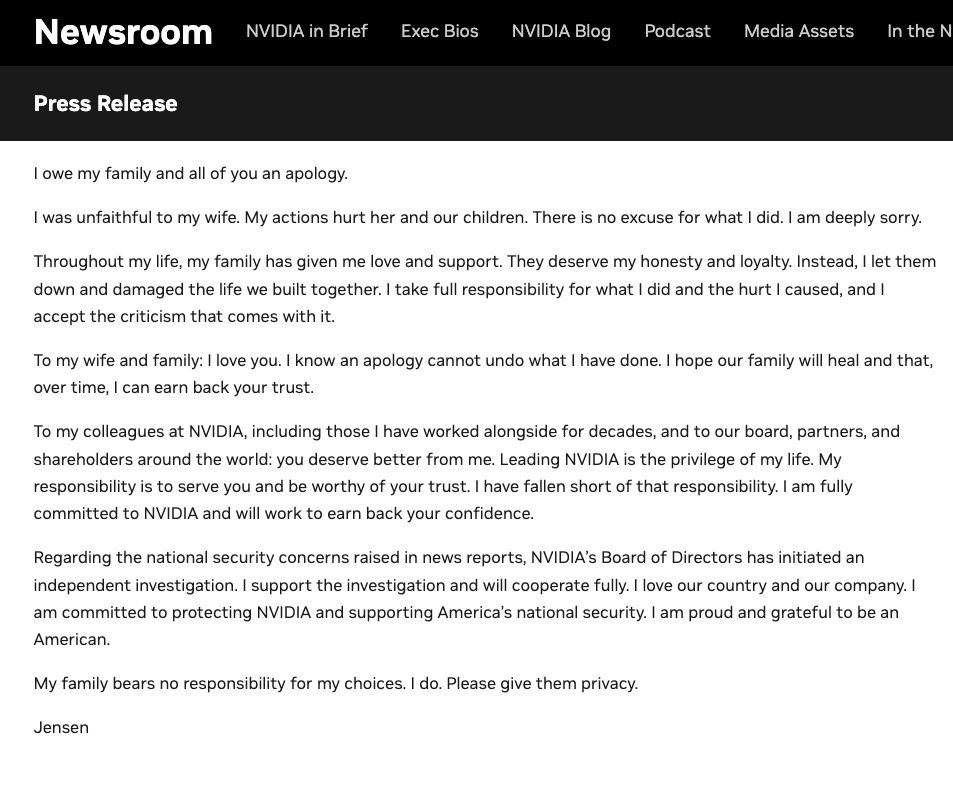
This reminded me of “The Reynolds Pamphlet,” a moment in Hamilton, yes, the theatre show. Hamilton went public with his affair to protect his legacy.
Reading Huang’s email, I wondered if he had taken inspiration.
Before we talk about the consequences, start with some context.
Alice Huang, our mistress in this drama, was an executive at Megaspeed, a Singapore company that bought Nvidia chips for its data centers. It is suspected that Megaspeed helped buyers in China get hold of chips from the U.S.
Both Singapore and Taiwan officials suspected that Chinese intelligence recruited her after she and Jensen had grown close. U.S. officials believed Beijing wanted her to gather information and possibly use that access to influence Nvidia’s push to sell more advanced chips to China.
Now you have the story; next, what consequences are we looking at?
First, it’ll likely affect chip orders routed through places like Singapore. U.S. export officials already tell sellers to check who will actually use the chips, even when the company placing the order is in a country they can legally ship to. Washington could make those checks tougher under the rules it already has. If that happens, even a data center with perfectly legitimate orders could wait longer for its GPUs; in turn, this will only worsen the current hardware shortage.
Second, Nvidia itself. Huang said he had 60 direct reports. Sixty. This is extreme by any measure. Think about how many decisions go through him, then add the time he spends making Nvidia’s case in Washington. Even if Nvidia’s strategic launch and decisions aren’t impaired, it’s inevitable this event is going to hang over its stock. Simply because investors hate uncertainty.
Finally, his influence and connections. I think that’s why some people in tech are so quick to back him. Sequoia’s Shaun Maguire said Jensen did something “incredibly dumb” and still called him “irreplaceable for America’s AI leadership.” Tech investor Gavin Baker also said he didn’t believe Huang would “ever knowingly do anything to disadvantage either America or Nvidia.”

And Elon Musk replied to Maguire’s post, “I agree.”
Of course he did. Elon never lacks an affair headline of his own.
Mid-term, also helps slow down AI
If you already own the data centers, making it harder to build more can be great news for you.
That’s one of the stranger consequences of this week’s U.S. elections. Democrats won both the Senate and the House and flipped Republican governorships, including Texas (a historically deep red state).
Yet on Wednesday, shares in Amazon, Microsoft and Google rose while the neoclouds plummeted.
I get that the change of control in Washington and politicians’ threats to slow the AI build-out are the direct causes of the neoclouds’ sell-off (CoreWeave down 9.9% and Nebius down 6.7%).
But some of the biggest cloud providers get more valuable. What’s going on?
Start with what the election actually changes. Democrats can block Trump’s legislation. Trump can veto theirs.
For the AI industry, that sets up two years of push and pull. Trump wants to expedite federal permits for data centers, while incoming Senate Democratic leaders want to shield households from higher electricity bills and other downsides those projects can bring.
Just to break it down, we’re looking at three consequences:
First, developers and newer clouds. Their future revenue depends on facilities getting built and connected on time. A delay stretches the time between taking out the loan and earning it back.
Second, the suppliers. If tighter local rules delay the construction of new data centers, suppliers could have to wait longer to deliver equipment ordered for those sites.
Third, the established cloud providers benefit. Amazon, Microsoft and Google already have capacity to sell. Restrictions on new construction could make that capacity scarcer and make it harder for their newer competitors to catch up.
The unknowns in the following questions are worth keeping an eye on: where can AI infrastructure be built, who pays the extra costs, and who can afford to wait? Those answers will change who makes money from AI in the next few years.
AI companies fight for cash
Meta wants to raise money before its competitors get there. Its own filing pretty much says so.
The company’s special committee warned that timing mattered because competitors could “saturate various funding options.” It named Alphabet, SpaceX, Anthropic and OpenAI.
These companies are competing for computing power, as Sam Altman recently famously commented that no one should have RAM at home, but they’re also competing for the investors who will pay for it.
Meta plans to raise $97.5 billion, including a future program to sell shares over time.
But there are signs this may be really difficult; for example, Oracle announced another $20 billion in stock and bond sales, and its shares fell almost 9% after the announcement. In May, SoftBank cut its loan to OpenAI from $10 billion to about $6 billion.
It’s not just money that’s scarce; customers are, too.
Enough Customers For Everyone?
Everybody building AI infrastructure is counting on enormous future demand. But is there really enough customer spending to make all those plans work?
Anthropic’s updated IPO filing puts the question under a spotlight.
Its quarterly revenue reached roughly $17 billion. Its aggregate spending commitments reached about $895 billion, stretching over many years.
The growth is extraordinary. So is the scale of the investment.
In October, Gartner estimated that AI data center owners would need $8.5 trillion through 2030 to cover announced investment. However, the enterprise and consumer AI revenue attributable to those facilities is no more than $3.6 trillion over the same period.
($3.6T − $7T) ÷ $7T ≈ −49%
Simply put, we are still looking at a negative return on investment by 2030.
This exposes the flawed assumption behind all this spending: enough customers will arrive, pay enough, and keep paying.
And it’s not just Gartner; Apollo said the same.
Torsten Slok, Apollo’s chief economist, recently argued that AI has delivered no financial payoff to corporate America outside tech.
A few things he observed.
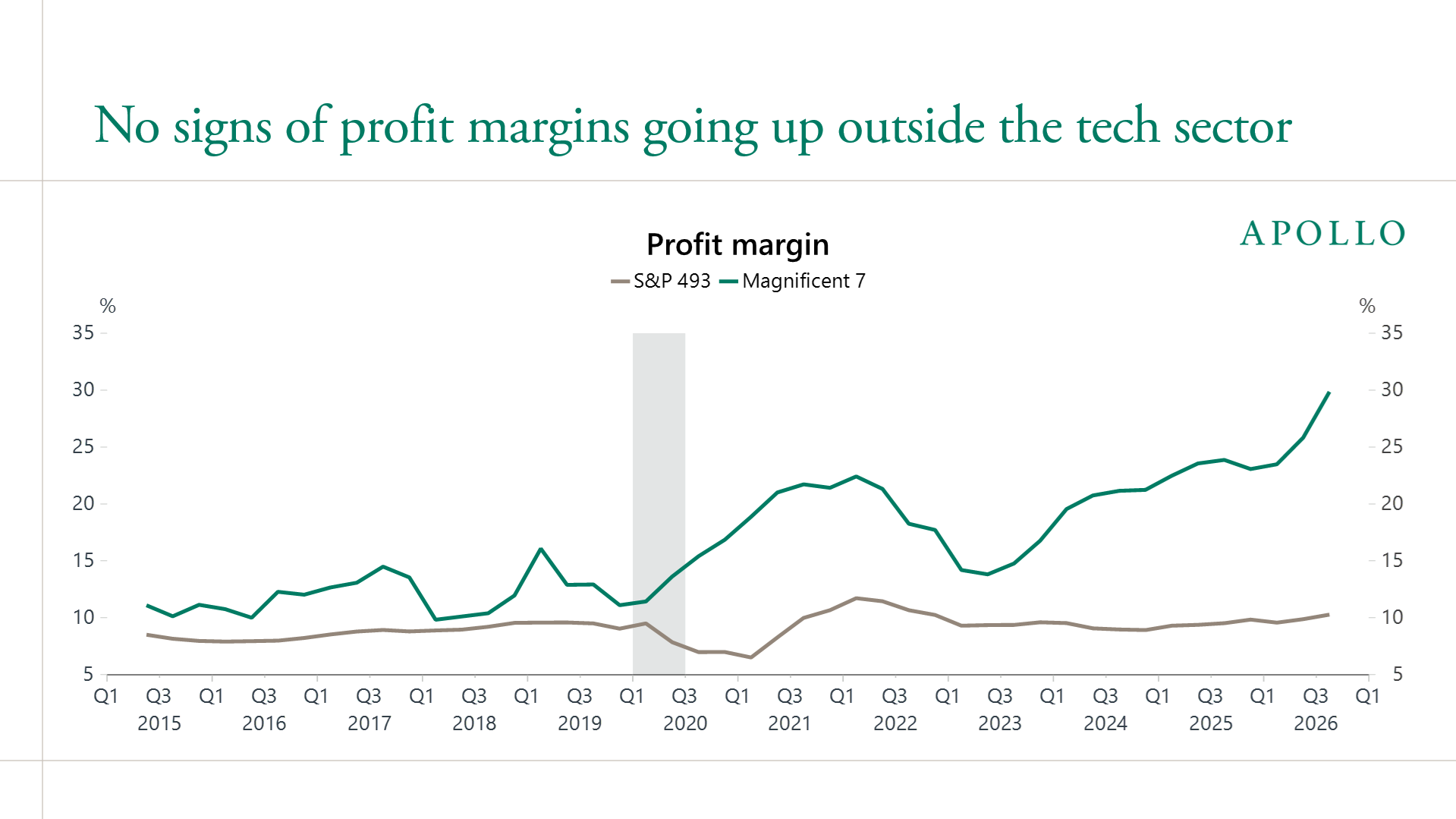
First, yes, the revenue per worker and profit margins are rising among the Magnificent Seven. However, remain flat across the other 493 companies in the S&P 500.
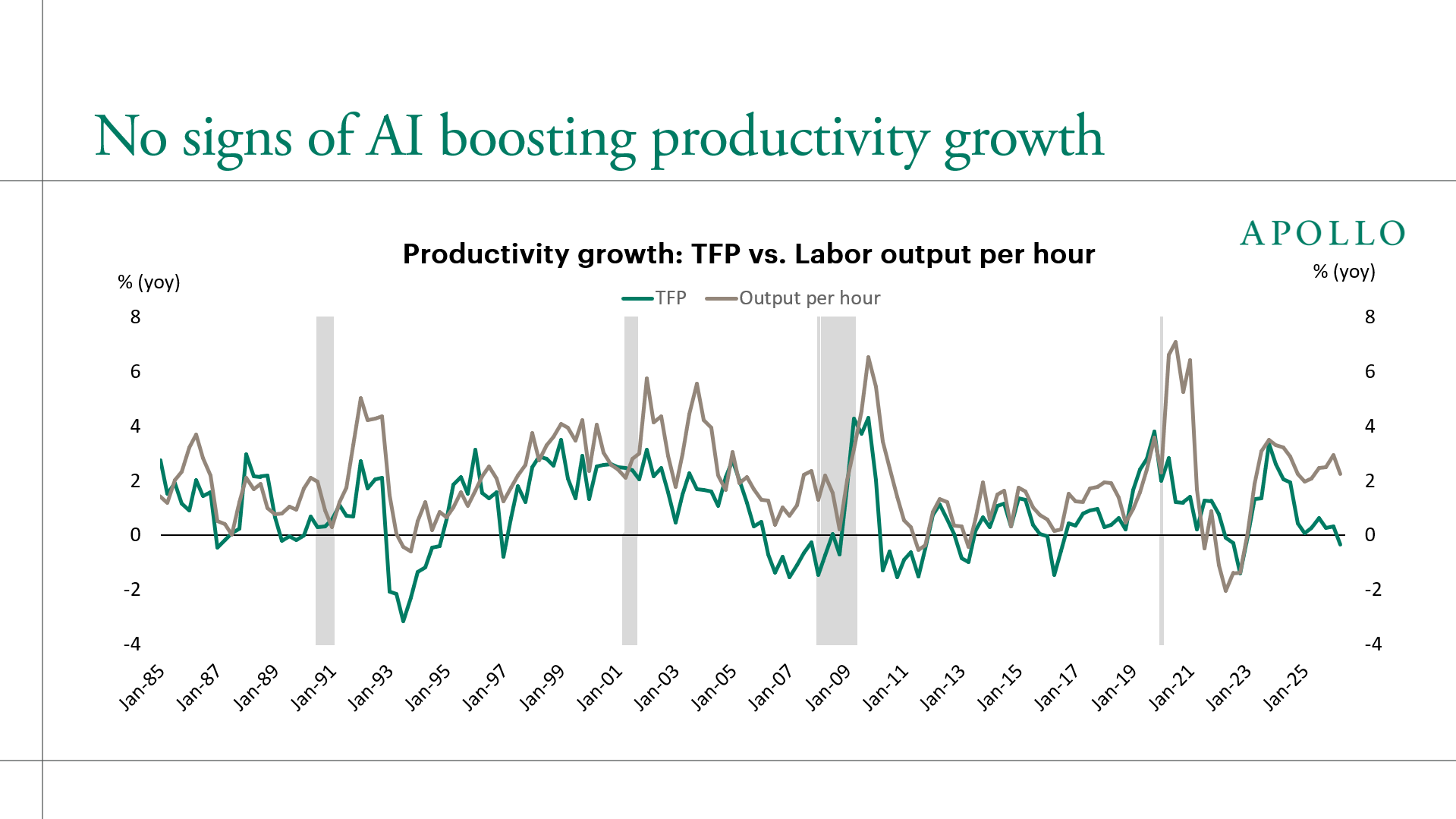
Second, there’s no clear boost to overall productivity growth. As you can see in his chart, output per hour declined after 2021 and stayed flat from 2023 to 2025
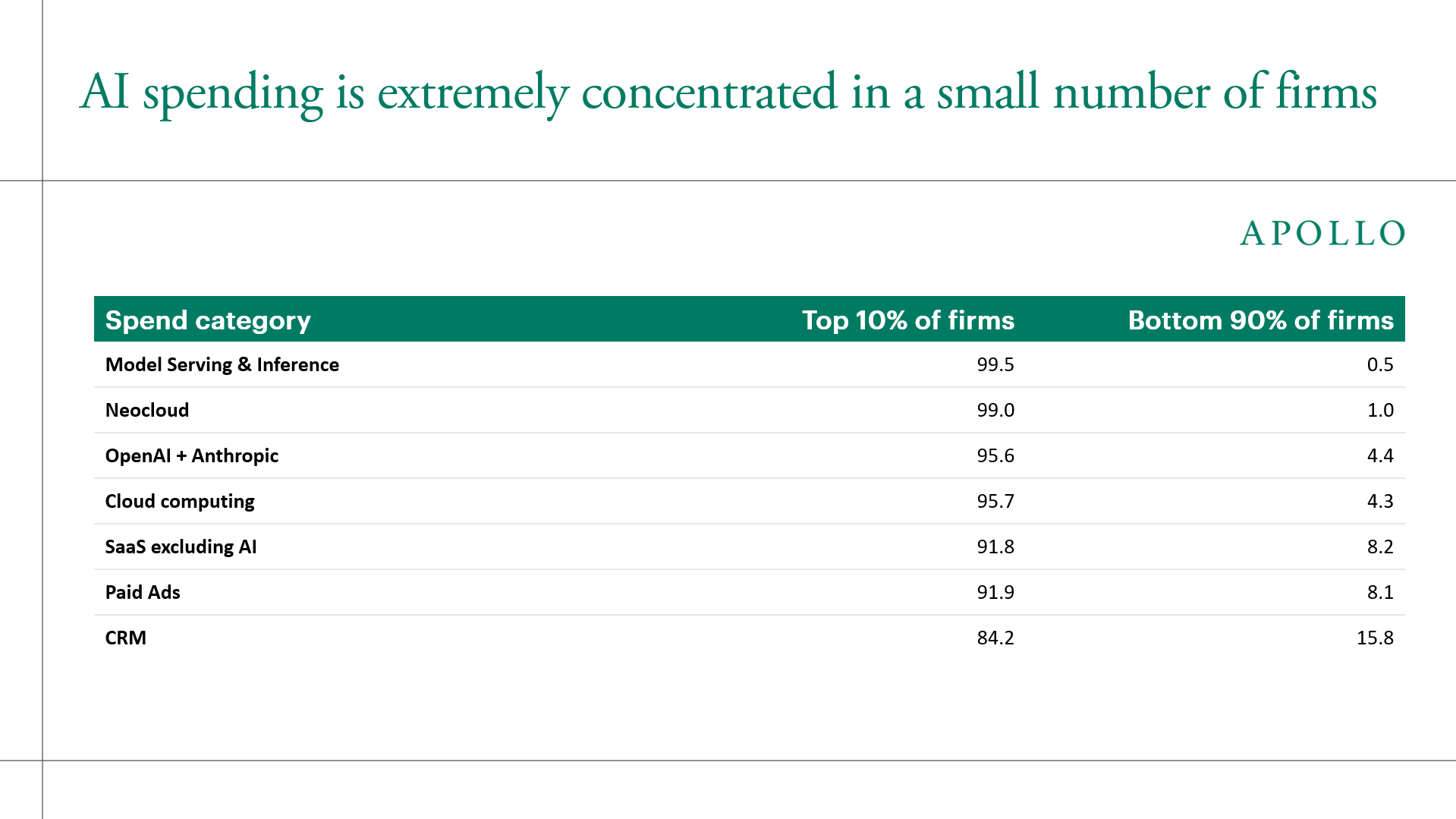
Third, if you look closer at the companies that are using AI… it's actually the AI companies themselves and the network around them.
Basically, you can have AI record and transcribe your meeting, but if it doesn’t increase overall growth and show up in company-wide profits, it means nothing.
Ask this next time your product manager talks about AI: How does it improve the product? Cut costs? What’s the actual change from implementing AI?
The best ‘not productive’ example is Google’s AI search.
Google’s AI search
Google is getting people to search more. However, it’s still working out how to accelerate revenue in parallel.
In its latest earnings call, the company said Search query growth was the strongest in five years. Yet Search revenue growth slowed to 12%.
All because of AI.
Google’s chief business officer said the strong growth in AI Mode queries had an impact because Google was seeing lower monetization in AI Mode.
Say you’re adding your teenager to your car insurance. AI Mode can give you three insurers to try, but you still need to find out what they’ll charge your family. In one study, most shoppers stopped at the shortlist without clicking through. That’s the gap for Google. AI Mode helped people decide who to consider, but the step Google could earn money on- a click to get a quote- often never happened in the session.
Basically, Google needs a better AI search experience to keep users using Google. But getting people to adopt the new experience instead hindered the search economics.
Now, enough of the AI industry; let’s talk about something more hands-on and fun. Where are we at in the AI assistant product war?
More AI assistants!
Let’s count how many assistants can now manage your calendar. Grok Bot, Muse, Dots, Duet, and more.
In about two months, four major AI companies introduced assistants you could hand a task to and walk away.
Grok Bot just released something new!
According to its mobile documentation, it can work with your phone’s calendar and contacts, and on iPhone, your reminders and Apple Home devices too. So you can ask for something in a sentence instead of opening an app and tapping through menus.
Isn’t that amazing?
That Elon and his bot will now listen to you every single second, just waiting for you to summon it.
Next, how much can an AI cost you? Well… apparently $6.3 billion.
The $6.3 Billion Interview
A Binance engineer thought he was interviewing for a new job.
According to details Binance released last week, it started with a fake job interview.
The attackers posed as recruiters and gave a Binance engineer what looked like a take-home coding test. When he ran it on his work computer, it quietly gave the attackers a way in.
From that computer, they used one of Binance’s internal AI tools to take control of two more engineers’ computers. Binance hasn’t said exactly how they used the AI tool. But on one of those computers, the attackers found what was essentially a digital pass that let them run their own software inside Binance.
That software reached the system Binance uses to sign crypto transfers.
Once the attackers could get that system to sign a transfer, they could send crypto to wallets they controlled, bypassing Binance’s usual withdrawal checks. Binance says about $6.34 billion in crypto was affected.
Basically, the attackers used a compromised computer and an internal AI tool to gain access to wallet developers’ systems.
So maybe the lesson is: don’t use your company laptop for an interview (wink)