
Is NVIDIA still NVIDIA w/o Jensen?
Yes, Jensen resigned.
In a Bloomberg interview, the reporter asked Jensen Huang if it was risky for so many AI companies to depend on NVIDIA. Here’s what he said:
Well, they don't depend on us. They choose us.
But do those companies really have a choice? I’m going to walk you through three moats that make Nvidia the inevitable choice, though how each one will eventually wane after Jensen.
Before that, a little bit of context here.
It’s quite a dramatic week for Jensen and his family. With three affairs and one of them potentially a sexpionage, he finally resigned. (I know… I said he wouldn’t resign like the kisscam CEO). That said, many AI tycoons, Nvidia staff, and other supporters- at least 175,000 people- are jointly signing a petition to get him back.
So you have it.
Even though the board says the operation and product roadmap will proceed, the moats are still there in theory.
However, the worries are brewing. The uncertainty sent Nvidia’s stock plunging by roughly a third from its early October peak, adding fuel to a wider rout in AI stocks.
I can see why people are having a hard time deciding what is coming.
Because NVIDIA has spent years giving customers reasons to stay, and some of those reasons have a lot more to do with Jensen than others.
Moat #1, CUDA
Think of the GPU as a pan. CUDA is the set of utensils everyone in the kitchen is so used to using.
NVIDIA launched the tools back in 2006. It was an expensive bet. Asked why he didn’t abandon it, Jensen said:
Turned out he was right.
Over the years, developers built libraries and wrote code around them.
So say a cheaper chip turns up. Some of your code might move over easily. For the parts that don’t, someone has to adapt them, check that the model still behaves the same way, and recalibrate the performance.
The chip from competitors like AMD might save you more than a few bucks: renting an MI300X on DigitalOcean costs about 40% less per hour than an Nvidia H100. Though you have to work out whether it’s worth it, taking into account the infrastructure and the performance.
Moat #2, everything around the chip.
Apart from CUDA, NVIDIA has spent years taking on more of the work involved in running those chips, vertically integrating its way from selling chips to supplying whole computing systems.
Because the GPU is only the beginning. Over the years, acquisitions have transformed NVIDIA from just a GPU company.
You need to connect the computers and keep them running. When everyone wants access at once, you also have to decide who gets how much computing power. NVIDIA acquired companies that helped it do those jobs, from connecting the computers to managing them and allocating their computing power.
Jensen personally backed some of the decisions that built these advantages, from investing in CUDA despite the cost to pursuing the acquisition that expanded Nvidia into networking.
So can NVIDIA keep improving its offerings fast enough to retain existing customers?
Customers’ needs will change, so someone has to decide which problems deserve the next investment- someone with vision- even before the customers know that’s what they need.
Or customers could eventually get a better product elsewhere.
Competitors like AMD, and even Microsoft and Google, come in here. If anyone wants to replace Nvidia in the near future, it’d be them. They already have their own chip programs and some of the infrastructure.
An Nvidia w/o Jensen may just open the door for competitors to approach the talent or the resources that were initially controlled by Jensen.
Third, the money behind its customers.
Nvidia has taken stakes in more than 300 companies. Some develop AI products. Others build the facilities where those products run, and some have much more complex deals that make your head hurt. More importantly, some of those deals help keep the money flowing and the data centers going up.
For example, CoreWeave.
NVIDIA → CoreWeave. NVIDIA invested in CoreWeave and gets shares in return.
CoreWeave → NVIDIA. CoreWeave buys NVIDIA chips for its data centers.
NVIDIA → CoreWeave again. For the computing time covered by their agreement, NVIDIA promises to pay for what other customers don’t rent. This gives lenders more confidence that CoreWeave will have money coming in to repay them.
Or a different deal structure with Anthropic.
NVIDIA → Anthropic. NVIDIA provides funds and gets a stake in Anthropic.
Anthropic → Microsoft. Anthropic pays to use Microsoft’s computers to train and run Claude.
Microsoft → NVIDIA. Those computers use NVIDIA hardware, creating business for NVIDIA.
Smart as you are, you’ve likely realized in both cases NVIDIA benefits twice.
The growth of CoreWeave and Anthropic makes NVIDIA’s investment more valuable, while running more Claude requests on these computers creates demand for data centers and, in turn, for NVIDIA chips.
But this doesn’t come w/o risk. It’s said that Colette Kress (the CFO) and her team had pushed back against his riskier financing deals. One venture investor commented, “I think it’s unlikely anyone, but Jensen is going to invest in his own customers as aggressively.”
A more cautious Nvidia means some projects will struggle to get funded, which would affect operators facing debt payments they can’t meet. To pay the bills, they may have to sell machines, a data center, or even the business. And if several operators need to sell at the same time, they’re competing for buyers. Prices could fall further, making the next project even harder to fund.
And that’s how one funding squeeze could quickly turn into a chain reaction.
Could Jensen leaving be the last straw for the AI bubble?

Now, Anthropic is getting ready to go public, and in any other week, that probably would’ve been the headline.
Then Jensen took the spotlight. I bet Dario Amodei’s thinking, of all the weeks, Jensen. You had to pick this one?
There’s a lot in that filing, including what Amazon stands to gain. And Anthropic had product news too. Companies can now run Claude’s agent software on their own servers. Then there’s Claude Sheets. Could it actually replace Excel, or would you end up exporting the thing back to Excel anyway?
Oh, and don't forget OpenAI; they have a new product that I'm sure you’d find intriguing.
Let’s start with the filing.
A fun fact in the Anthropic S1
80% of the revenue came from models released during the last six months.
This is both impressive and worrying for an AI lab.
While it makes 100% sense from the customers’ point of view.
Simply, people want the model that gets more done for their money.
But launching a better Claude to compete is hardly a sufficient strategy.
If OpenAI or Google improves faster, customers have another place to take that work, especially given how easy it can be to switch between models. And actually, we have seen this everywhere.
A report says when companies switched their go-to model, about three in four picked one from a different AI lab.
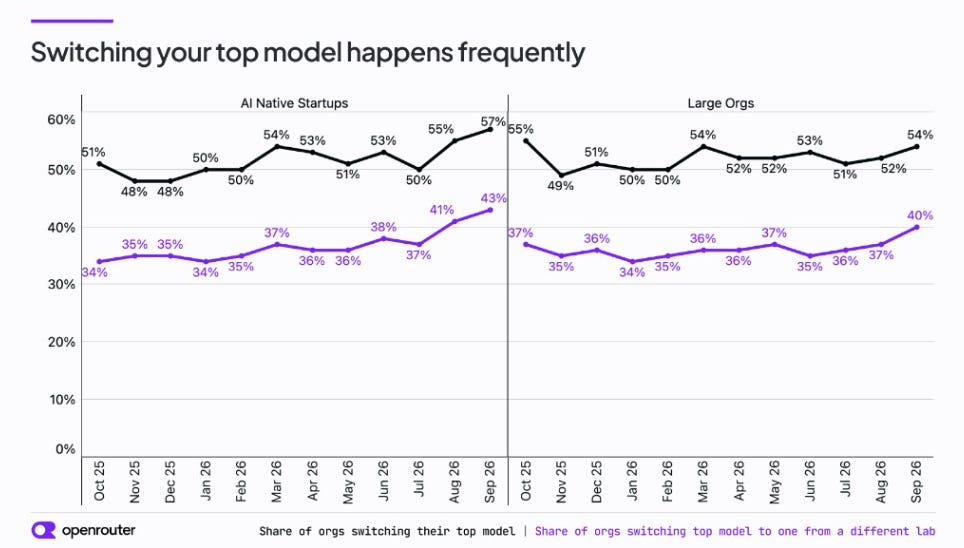
That’s why companies like OpenRouter exist.
Actually, in its S1, Anthropic warns that competitors offering adequate performance at lower cost could hurt its business. Essentially, a rival doesn’t even have to win on every capability; it just needs to be good enough and come with a lower price tag.
On top of that, most Anthropic contracts also allow the customers to reduce usage or terminate with limited or no notice.
Let’s say OpenAI gets better; why would you continue with Claude? You might leave the old projects where they are while OpenAI gets the new work.
As for older models, the filing warns that customers who have built them into their workflows may resist moving to newer versions. Because replacing a working model means changing something they already depend on, which can be a disaster, especially when you’re dealing with something that is nondeterministic.
That leaves Anthropic with two different jobs:
Improve fast enough to keep the customers.
Anthropic also has to support the older models its customers have built around. Something that no longer earns as much.
Want a smaller bet on Anthropic? Buy Amazon!
If you don't want to get overly exposed to Anthropic, maybe consider buying Amazon! ( This is not investment advice.)
This aligns with the strategy I discussed. Anthropic and OpenAI want you to use their models, while Amazon and Microsoft care less about their in-house models but want to keep your cloud business no matter which model you use.
Anthropic’s filing shows how important those platforms have become: cloud marketplaces accounted for 44% of its revenue in the first nine months of 2026. So as you can see, a substantial part of its business reaches customers through the cloud providers.
Anthropic also plans to invest more in compute power. It has committed at least $110 billion to Amazon over the next 10 years, and $47.2 billion to $49.2 billion to Microsoft over the next 7.
Amazon gets paid twice if Claude takes off. Anthropic pays for more computing power on AWS, and Amazon’s stake in Anthropic could rise in value.
At the proposed IPO midpoint, Amazon’s stake in Anthropic could be worth as much as $258 billion.
So Amazon has good reasons to be friendly with Anthropic.
Wait, you can now run Claude at home?
Anthropic wants you to use Claude; that’s no secret.
But if control is why you use open source, Anthropic now lets you run its agent software on your own servers.
A quick definition. Claude is the model that decides what to do next, the agent software runs the tools it asks for, and together they’re the agent that does the job.
So with this release, your company can now run the agent software and stores its working history, so strength the data privacy. This sounds much better than sending everything to Anthropic’s server, doesn’t it?
Not so fast, because whenever the agent needs Claude to work something out, it still sends a request to the model, just someothing you’ll pay for separately. So, no, you don’t host a Claude model. The model still runs at Anthropic.
That said, companies that want to run the agent themselves now have one fewer reason to choose an open-weight model over Claude.
That’s not it, say six months later, an open-weight model comes along that does the same job for much less. You’re already running the agent software on your own servers, so you can just swap out Claude, right?
Well, unless Anthropic’s license specifically allows it, otherwise, you’ve got to replace the agent software too.
The end of Excel?
The day Anthropic unveiled Claude Sheets, Microsoft shares fell as much as 3%.
So what is this exactly? Is it really going to replace Excel?
In Anthropic’s demo, a team plans a holiday pie launch. It all looks pretty smooth. And sure, if you’re in sales and you spend every Friday copying numbers from Salesforce into Excel just to make the same chart again, I get the appeal. Claude Data can pull those numbers for you.
So, for a campaign tracker, sure, Claude Sheets might be enough.
Where I have a harder time giving up Excel is the cash forecast and everything that comes with it, because it’s never about just updating numbers.
Now take that same sales report to the finance team. Say a big deal slips in December. In the sales meeting, you move a bar on a chart. Finance has to answer a different question: can we still afford the two people we planned to hire in January?
Because somewhere in that Excel workbook, someone’s already worked out when the customer would pay, when those salaries kick in, and how much cash that leaves at the end of each month.
Change the date on the deal and you can see what happens to the hiring plan.
So sure, I’d let Claude make my slide. But would I use it for my bookkeeping?
Not to mention that Anthropic itself tells users to export their sheet to Excel if they need more features.
I admit, Excel is ugly, yes, but it’s held up for decades with millions of accountants grinding away at it. You’ve got to give it some credit.
Why not give your bot a wallet?
Rain has announced an Agent Vault, which lets you fund a balance and set rules for an AI agent to spend it. OpenAI has also introduced ChatGPT Wallet, letting an agent complete purchases using an existing card.
I understand why they’re building this.
If an agent can research a purchase and arrange everything but stops when it needs to pay, you still have to finish the job yourself.
But since most people hesitate to link a bank account to AI, they took a step back and created a separate wallet for your AI.
So with these wallets, the AI labs are saying, “Give us the task, and we’ll handle it.”
For OpenAI, completing the purchase extends the shopping journey people already start in ChatGPT. A sensible solution.
However, AI misunderstanding you has a price.
Suppose I let an agent buy printer ink, with a $300 limit. It buys a $280 cartridge from an approved shop. The payment obeys the rules. Unfortunately, the average cartridge price is only $80.
Nothing had to be hacked. The agent simply doesn’t care about finding a good deal.
Of course, OpenAI's solution is to make sure you’re involved.
You get to review the items and total, then approve each purchase with a security check. The agent receives a payment token rather than your actual card details.
Ah, great. This hardly takes anything off your plate, does it?
Apart from a wrong purchase or buying something overpriced, there is also the possibility that someone is deliberately misleading the agent. Instructions planted in a website or document can try to redirect an agent away from the task. That’s an additional risk when the same agent reads sellers’ pages and prepares purchases.
So, have you let AI buy something for you yet, or do you plan to open a wallet for your AI?