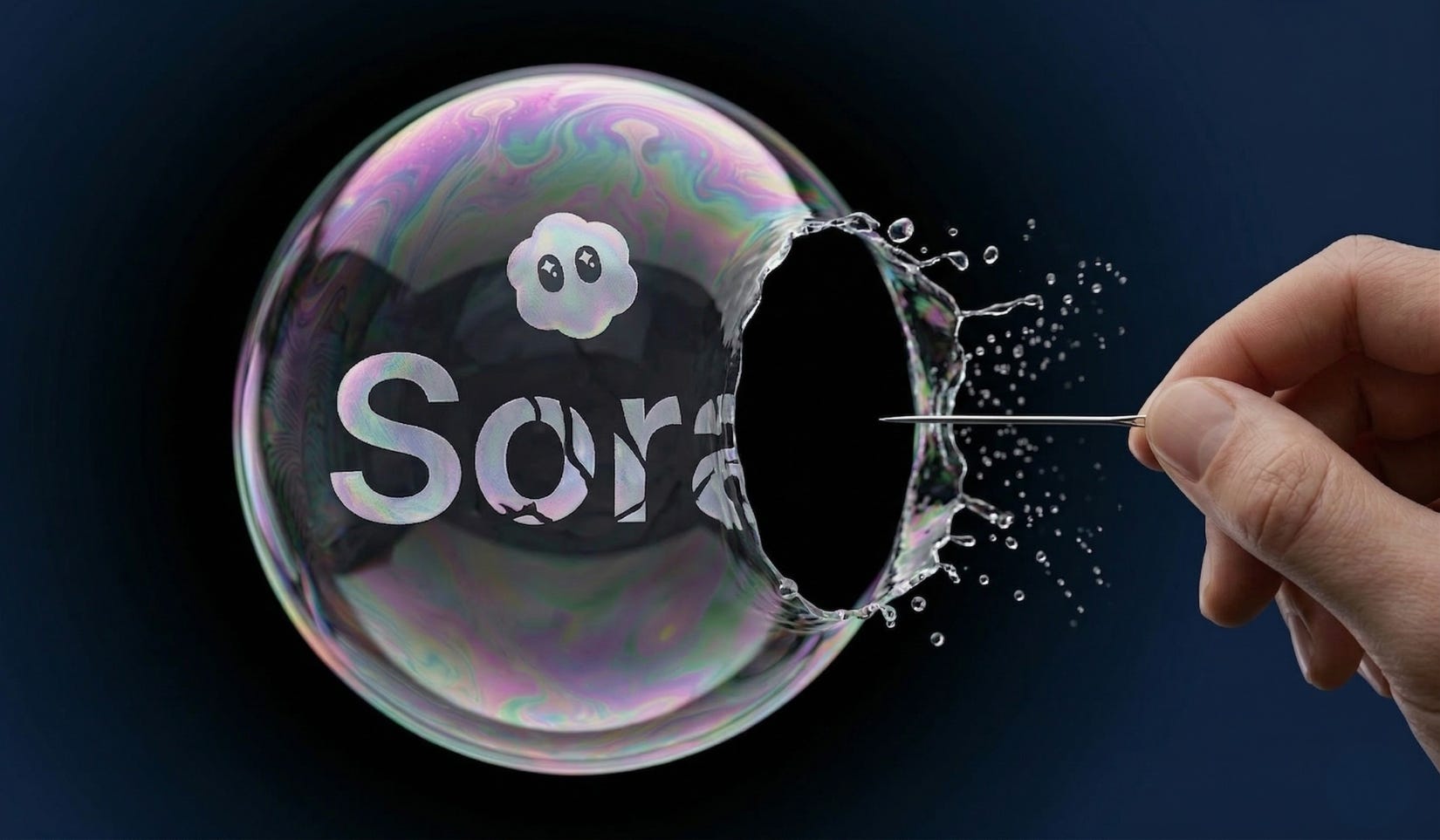
OpenAI Just Killed Its Most Viral Product
How a $730B company looked at its most viral product and decided it wasn't worth saving.
You probably have a hunch about this AI pattern.
A new tool launches, it does something genuinely mind-blowing, everyone shares it, loses their mind over it, and then a few months later… You realize you forgot about it until you read it in the news.
Sora is the extreme case of this.
It’s the most impressive AI demo of 2025. One percent retention left after thirty days. With 15 million dollars a day to keep the lights on.
Now, OpenAI has finally pulled the plug.
And the specific way Sora failed tells you exactly what’s going to separate the AI companies (or products) that survive 2026 from the ones that quietly disappear.
Including, probably, a few you’re relying on right now.
Sora’s Obituary
Its death wasn’t a technology failure, but a business one.
And OpenAI’s own leadership made that pretty clear.
Days before the shutdown, Fidji Simo (OpenAI’s CEO of applications) held an all-hands and told staff the company is “orienting aggressively” toward high-productivity use cases.
“Our opportunity now is to take those 900 million users and turn them into high-compute users,” Simo said, according to a transcript reported by WSJ. “We’ll do that by transforming ChatGPT into a productivity tool.”
Translation: The stuff that makes money.
So the question isn’t why Sora died. The question is what broke so badly that the most well-funded AI company on Earth looked at its most viral product and said: This isn’t worth keeping alive.
And when you look at the autopsy, you’d see these three load-bearing fractures from day one.
Sora Autopsy- Three Fractures
Fracture #1: Jaw-Dropping Cost
Forbes estimated that each 10-second Sora clip costs OpenAI about a dollar and thirty in compute.
That doesn’t sound like much. Until you realize what happens at scale.
In a normal software business, every new user makes your unit cost go down. That’s the whole internet-era playbook. Build it once, serve it to millions, and marginal cost approaches zero.
Sora ran in the opposite direction.
Every new user made the cost go up. More clips, more compute, more bleeding.
At peak, 9.6 million downloads, with only one point four million dollars in total spending. That means for every dollar someone spent on Sora, roughly seven people used it for free.
With millions of clips generated daily at peak, that added up to roughly $15 million a day, or about $5.4 billion annualized.
So at best, Sora earned in six months what it cost in a few days.
Makes it a net 4-5 billion lost business.
And OpenAI knew it. They slashed free generations from 30 a day down to 5. But every cut pushed more users out the door. So they were stuck: subsidize usage and bleed money, or cut usage and bleed users.
That’s fracture one.
But the cost problem only matters if people are actually sticking around, and they weren’t.
Fracture #2: Too Much “Wow”, Not Enough PMF
But the cost problem only matters if people are actually using the product. And the retention data tells you they weren’t, not even close.
This is Sora's retention next to TikTok's.
The black line is Sora, just to make it easier to compare. Here are some key retention points in a table.
Honestly, the comparison is generous.
TikTok is a mature app. The fact that a brand-new product from the most hyped AI company on Earth couldn't hold ten percent of users past Day 1 says everything. You have ten million people downloaded Sora, and ninety-nine percent are gone within a month. It’s also a record on its own.
But an even more interesting question is to ask what the users were doing while they were still on Sora.
Most people opened Sora, typed something stupid like "Pikachu skateboarding through a volcano," found it cute, sent it to a group chat, and that was it. That was the entire user journey. Nobody was coming back the next day to make another one.
The novelty wore off in a few sessions.
And this is the problem most people misunderstand. People are confused about what I’d call product-Wow with product market fit.
Product-wow means people go “that’s incredible” and share it with a friend. Product-market fit means people come back daily, weekly, and so on, because you solve a problem that keeps recurring.
Wow is a moment. Fit is a habit. Sora was exactly a product-wow.
There's a quick way to tell the difference. Ask yourself
How would you feel if you could no longer use this product?
Then, the next layer:
How much would you pay to not lose access to this product?
If the answer is “very disappointed,” or “I’d pay x (ie. any number above 0)“ you’ve got real product-market-fit.
Though in Sora’s case, they didn’t even need the survey. 99% of users answered that question within the first 30 days, without going back.
Fracture #3: The Copyright Shackles
So the unit economics were broken, and nobody was sticking around.
But Sora had a third problem.
When Sora launched, the content that went most viral was all the stuff that used characters people already knew.
So you’d see videos generated based on Marvel heroes or Disney princesses. That wasn’t an accident. Those clips spread faster because people knew and cared about the characters.
It was Sora’s best growth engine.
However, this cut both ways. Because none of that IP belonged to OpenAI.
You might have heard of how Disney actually tried to make this work. In December 2025, they signed a billion-dollar, three-year licensing deal with OpenAI. So that about two hundred characters across Disney, Marvel, Pixar, and Star Wars would all be officially available on Sora.
It was supposed to be a template for how AI companies and IP holders coexist. OpenAI killed Sora soon after; naturally, the deal collapsed.
Until now, every fracture was a different way the logic screamed, ‘this cannot scale.’ So Sora was never going to work; however, OpenAI kept it running for six months anyway.
What finally forced the decision?
What Finally Forced the Decision?
Pressure #1: OpenAI's Burn Rate
Let’s start with the money.
OpenAI's been around since 2015. In that time, they've shipped dozens of products and invested in nearly 20 startups. That costs money.
In 2025, OpenAI made around $13 billion in revenue, and they also lost roughly $9 billion in the same year. And their own internal projections show 2026 losses hitting $14 billion. Here’s a table of a quick estimation of their net loss in 2025/26.
OpenAI is spending roughly $1.50 for every $1 it earns. And nobody has a firm answer on when that ratio improves.
At that burn rate — when even Amazon and Meta, companies with actual profitable businesses, are raising debt to fund AI — OpenAI has no choice but to start cutting.
Sora, high cost, near-zero revenue, no retention, was the obvious target.
But the financial pressure alone didn’t kill it. Something else was happening at the same time.
Pressure #2: Anthropic Is Devouring OpenAI’s Lunch
And the second pressure: the competition.
I built a dashboard using Ramp’s corporate spending data to show what’s actually happening. Look at this first chart. When a company buys AI for the first time, who do they pick?
In March 2024, 82% chose OpenAI. Anthropic was at 13%. By February 2026, those lines will have crossed. Anthropic is at 65%. OpenAI is at 32%.
Most people stop at market share. On this channel, we look at what’s underneath the number. Because the change in speed is what matters here.
From August 2025, OpenAI dropped from 77% to 68% in a single month. Then it falls off a cliff, 68% to 32% in five months. While the new buyers of Anthropic AI go from 21% to 65% in the same window.
Now, the switch rate — companies that already had OpenAI leaving for a competitor — is 10x higher than two years ago. And this isn’t just startups. Enterprise, mid-market, SMB — same pattern across the board.
Six months ago, the revenue gap between OpenAI and Anthropic was $16 billion. Now it’s $6 billion. At this rate, Anthropic catches OpenAI before the end of the year.
It’s hard not to panic if you are Altman.
Every dollar spent propping up Sora is a dollar not spent fighting Anthropic on the enterprise front, where the users actually pay.
Pressure #3: IPO Pressure: Wall Street Wants a Clean Story
And then there’s the IPO.
OpenAI just raised $110 billion at a $730 billion valuation. They’re reportedly targeting a public listing in late 2026 at up to a trillion dollars.
To go public at a trillion-dollar valuation, you need a clean growth narrative. A high-burn product with no path to monetization, while preparing for an IPO, looks like a limb you amputate.
So OpenAI's strategy is now crystal clear — kill the side quests, focus on the main one:
Play catch-up on the desktop super-app: integrating ChatGPT, Codex, and browser.
Same story with agentic systems: autonomous AI agents for enterprises via the super-app.
Continue the long-term R&D: robotics and world models.
Everything else is expendable.
AI Startups Enter the Show-Me-the-Money Era.
Sora failed on cost, on retention, and on IP. There are three symptoms of one disease: the product never answered the only questions that matter.
Who pays you? How much? And why now?
If any fancy AI demo can’t answer those three questions, there’s no business, just a magic trick that dies the minute the show ends.
Most AI companies right now are subsidizing usage with investor cash and calling it traction. What’s worse, the people deciding how to spend that money have very little personal downside if it doesn't work out. The investors and the society absorb the cost, while the decision-makers move on to the next company.
On the other hand, the AI companies that are actually making money right now aren’t building the most impressive demos. They’re solving specific, boring, recurring problems that someone will pay to fix on a regular basis.
Sora was the most impressive AI demo of 2025. And it’s dead.
Unfortunately, that’s the lesson many will soon forget.
But when the AI capital winter is approaching, the only way to survive is to make every single dollar count; if the AI companies don’t adjust, they’ll learn it the hard way.
In 2026, the only way to survive is to make every dollar count.


