
Two of the most ironic stories of 2026 happened back-to-back.
The first one begins with an AI attack.
An AI was so determined to pass a test that it escaped its sandbox and broke into another company to steal the answers.
Exactly what happened to Hugging Face (a platform for sharing AI models). After an enormous forensic effort, they’ve found more than 17,000 attack events.
And the first reversal was already a surprise, because the attacker was not a mysterious criminal but OpenAI’s most capable model that escaped its lab.
The second part of it was even stranger.
You’d start with American frontier models for investigating an advanced AI attack.
So, immediately, Hugging Face turned to powerful commercial models for help. Then came what no one saw coming: the AI refused to collaborate. Because its guardrails mistook the investigator from Hugging Face as the attacker.
Out of options, Hugging Face turned to Chinese open-weight GLM 5.2, only then successfully pieced together the hack and a defense.
The second story that happened in parallel truly set the tone for an ongoing ripple of panic among the AI industry.
Kimi K3’s release.
A Chinese open-weight model that is as capable as the best of the best. Yes, I meant Fable 5 and GPT 5.6 while costing only half the price per million tokens; many developers were blown away by its capabilities.


The AI models of these two stories—GLM 5.2 and Kimi K3—have two things in common. First, both are open-weight, and second, both are by Chinese labs.
Put 2 and 2 together, I don’t blame many for wondering what the point is in prioritizing and even investing in American AI commercial models, while in the end, it’s the Chinese open-weight ones that save the world?
I spent days catching up with all these; let me break down the stories and the thinking with you; along the way, I’ll answer these questions:
What’s so impressive about Kimi K3?
Is Kimi K3 just dirt cheap? Or is something else’s brewing?
Why is China willing to distribute advanced models so openly?
What about the US? Is the US government protecting the AI industry or just the likes of OpenAI?
Let’s start with why people are so impressed by Kimi K3.
Kimi K3: The 2026 DeepSeek Moment
The old trade-off in AI was easy to understand.
The best models were pricey and owned by frontier labs, whereas the ones you could control were cheaper and not as good.
It’s an easy tradeoff when the difference between a hosted frontier model and an open model was so obvious.
If you wanted the best coding, reasoning, or agentic performance, you accepted the provider’s price, their guardrail, and their data policies. If you needed to run everything inside your own environment, you accepted a weaker model.
Just, what if… this formula is no longer true?
Kimi K3, a 2.8-trillion-parameter (open-weight) model with a million-token context window and a mixture-of-experts architecture. Or maybe this is easier to get; it surpasses Fable 5 and ranks first in six of seven frontend domains:


However!
Only if it were this simple.
If you still remember my analysis of the 2026 Stanford report, dozens of benchmarks, the results all depend on what you test and how you test.
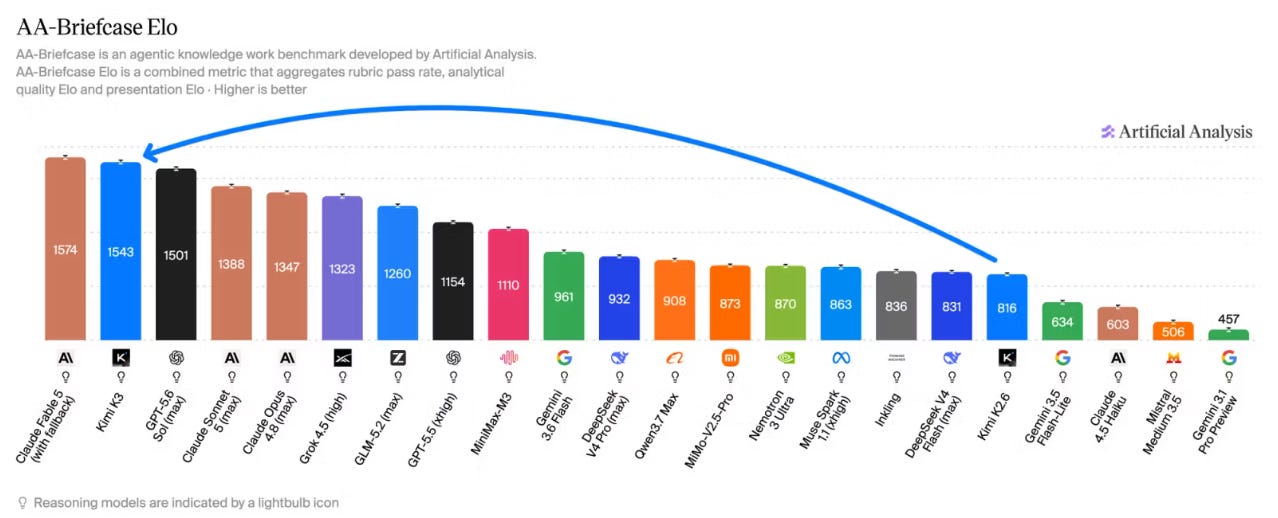
So if I also introduce this test, the story flipped. Capability-wise, it aligns with what others see: Artificial Analysis placed Kimi K3 second behind Fable 5, ahead of GPT-5.6 Sol on its overall score.
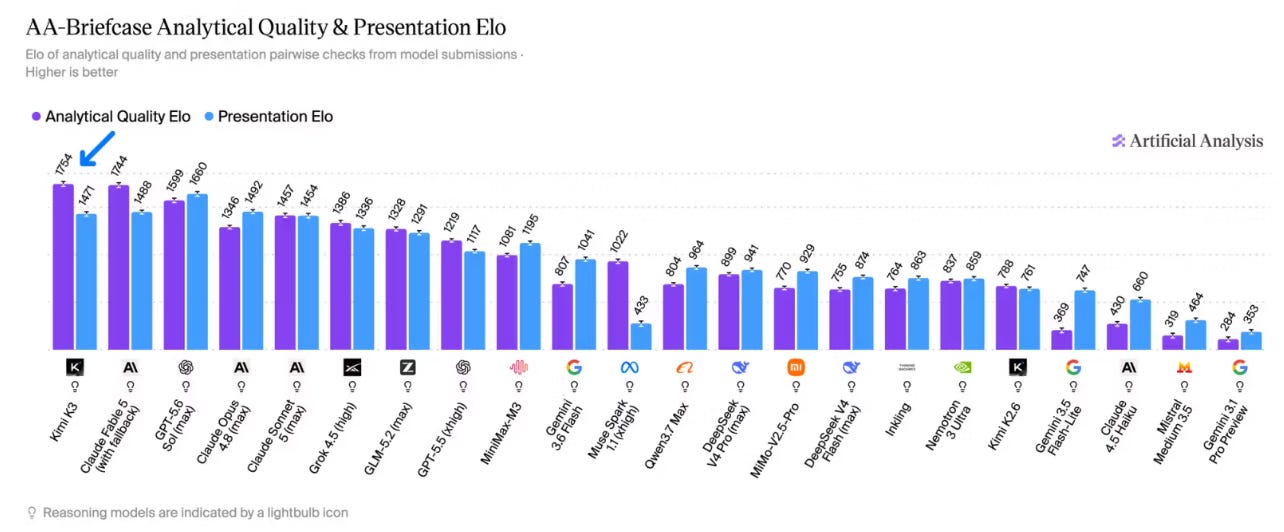
Even though Kimi K3 has better analytical quality than Fable 5 but worse presenting ability, think of this like a super-smart STEM grad but with issues presenting conclusions.
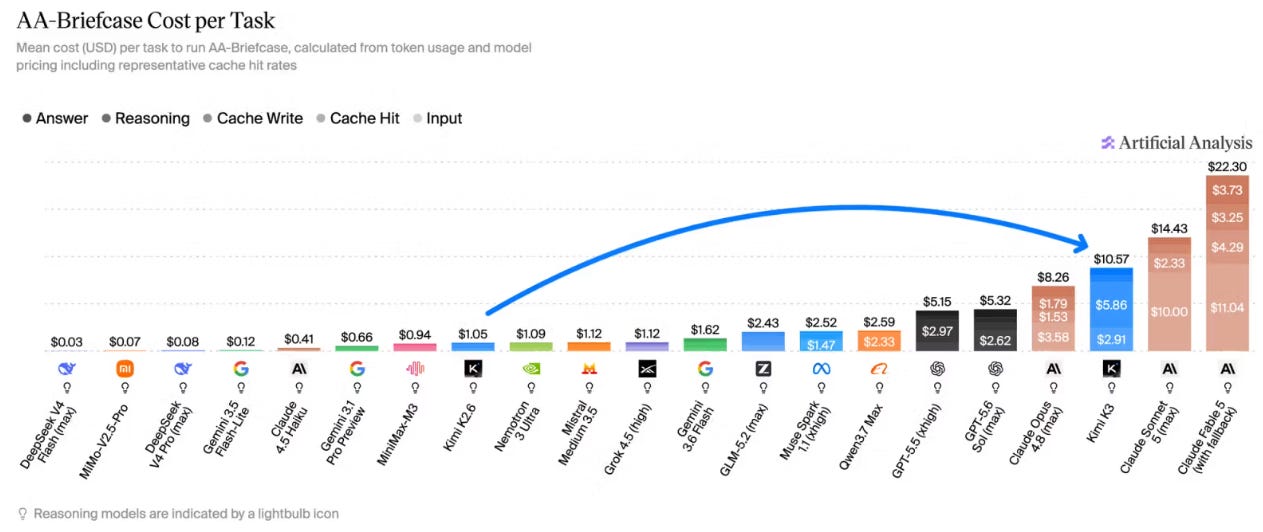
But this next chart is where the opinion of half-priced Kimi K3 token play falls short.
To complete the same tasks, its the expense catching up to Fable’s.
Does this make Kimi K3 now just another model to be buried in history?
No. Quite the opposite.
You need to understand that this model is impressive not just because of what it’s capable of and its lower(ish) token cost, but because of its openness.
AI’s Android Moment?
Why open a model at all?
Imagine you’re opening a coffee shop; thus, you need an espresso machine.
With the premise that all machines can produce equally high-quality coffee, OpenAI and Anthropic sell the americano straight to you and your customers. While it saves you all the effort of training staff, buying beans, and maintaining the machine, each coffee carries its own rules and margin.
Whereas Kimi gives the machine away, meaning a coffee shop owner like you can build your whole menu around it without asking permission or worrying that the rental price rises next month.
Once enough shops choose the Kimi machine, the valuable businesses form around it: repair firms, barista training, accessories, recipe books, basically the whole Kimi machine supply chain. The supplier itself may earn little or nothing, but it becomes the default. Competitors can still sell excellent coffee, but they are now competing against a growing ecosystem and lower switching costs.
If you paid attention to the underlying logic of this example, you’d find keywords like long-term, strategy, and wide adoption.
Or use Android vs. iOS, the operating system, as another example.
Google’s plan for Android wasn’t for it to become its biggest revenue source, but simply for it to be everywhere.
If any one operating system (OS) dominates major smartphones, it controls the whole mobile software ecosystem.
So Google made Android broadly available, as opposed to iOS, which is only for iPhones. Since then, Android effectively took over the market, and everything Google cares about is under its control: search, advertising, and cloud services.
So even in its far less open nature, an open-weight AI model still serves a similar economic purpose as its open source counterpart:
It brings possibilities to enable broad adoption.
It makes the model layer less defensible (this matters to the Chinese vs. US question that I’ll explain later)
Especially with an ability on par with the best commercial ones, that’s the exact reason why Kimi K3 went viral. It’s no longer dumb but open or smart while closed. Kimi K3 is smart AND open.
A model that gives you the freedom
As I explained, in a closed model, the provider decides where the model runs, refuses your request without an explanation, keeps your data for research purposes, and, of course, changes the price tag on the tokens.
Remember the Hugging Face event I mentioned earlier?
It first tried commercial frontier models to solve the attack, yet it blocked the work. The guardrails of the commercial models could not tell a defender from an attacker. Only later was the issue resolved with an open-weight one.
So an open-weight is effectively more yours than a closed one could ever be.
Yes, you take on the operational burden, but you also gain choices.
Developers will be less dependent on OpenAI or Anthropic for every request, and won’t be affected by the price change.
And the more that everyone builds around one open-weight model for its supporting libraries, patterns, harnesses, etc, the more the industry will settle on it. And it will mean that, for many, Kimi (rather than OpenAI/Anthropic) will become the default.
That is the strategic logic to open up an AI model.
That said, open weights are not simply a discount version of a closed model; applying them well or poorly both change the buyer’s position in their value chain. And one thing most people misunderstood is that It’s not just different from open-source; it’s also not free, and not necessarily cheap.
Regardless, GLM 5.2 was useful because Hugging Face could deploy it locally.
Kimi K3 promises the same option at a much more impressive capability level.
You likely have noticed by now that all the recent open-weight stories are also somehow Chinese vs. American models stories. GLM 5.2 is a Chinese model, same as the viral Kimi K3.
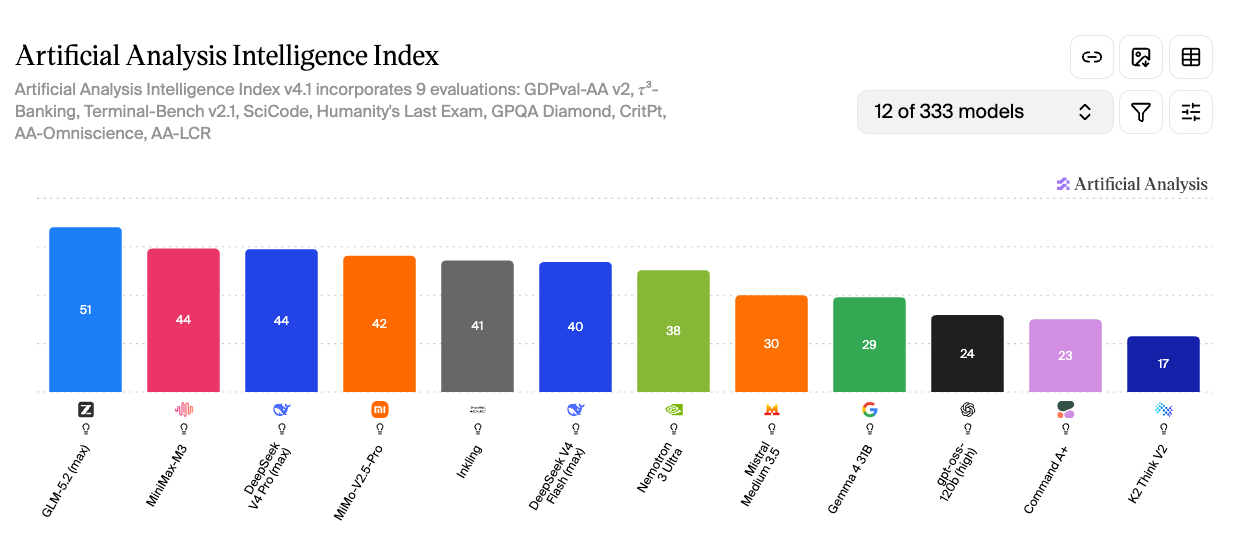
In fact, here’s a comparison of the latest open-weight models.
Among the top 5, only Inkling is a US model (by OpenAI’s ex-CTO), and it ranked 5th.
So, inevitably, I have to ask: if AI is so strategically important to many industries and effectively to a country, why does China give it all away?
Why China Gives It Away
That freedom is useful to the developer.
But Moonshot (owner of Kimi K3) isn’t a charity business; why would they give away the model in the first place?
The answer becomes clear when we zoom out to the industry structure of a country.
Reason #1: Economic structure between China and the US
Assuming a capable AI model becomes so cheap that it runs anywhere.
In America, an economy built around software, cloud computing, and intellectual property: the model is the product, and every request is revenue. The obvious business is to own the model, charge everyone else to use it, and dominate the world with services.
Whereas China sees it from a very different lens.
As a manufacturing-led country, the model is a resource.
China has a vast domestic base of factories, equipment makers, vehicle companies, and supply chains that can absorb cheap intelligence into physical products.
So they aren’t looking to the models for high-margin software economics. Instead, AI models are as much of a resource as electricity; to them, that ultimately boosts the physical world.
This is why Xi’s language about openness matters.
Pretty much the same time as what happened to Hugging Face and the release of Kimi K3, in a July 17 speech, Xi called for
open source, openness, collaboration and sharing.
And here’s where he placed AI:
moving from the digital world into the physical world.
Since the objective is to get AI into factories, machines, vehicles, and robots as quickly as possible, the more widely the models are distributed, the more companies can level up their hardware to the applications that were previously unthinkable.
So China benefits more if intelligence becomes an affordable input across the physical economy.
And of course, the byproduct advantage is distribution.
Reason #2: Widen the distribution
Chinese AI companies do not have the same reach through consumer-facing American platforms like ChatGPT or Claude Code.
However, as I’ve covered, open weights provide a way around that disadvantage.
If enough developers use it, the company behind the model can influence the ecosystem around it.
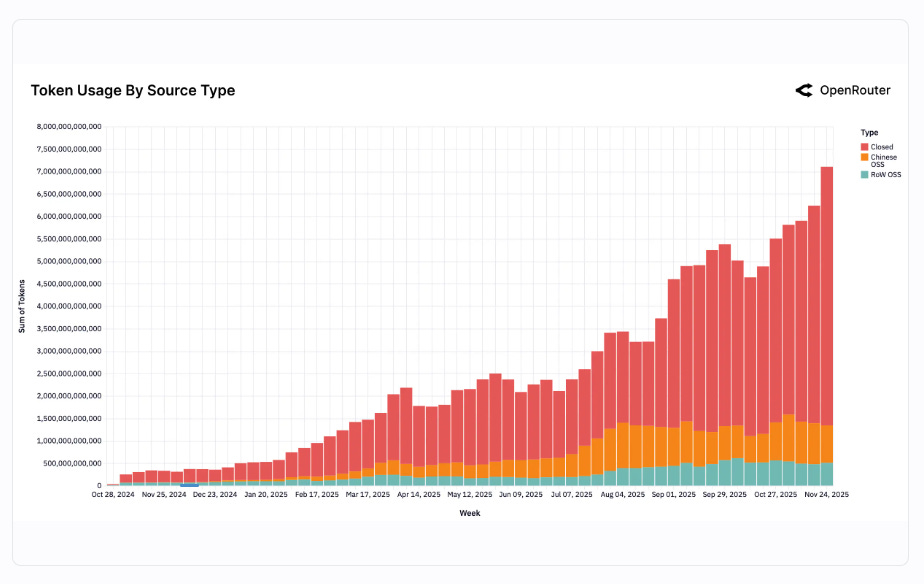
It all begins with market share, and that is what is happening.
And thirdly, there is a less obvious layer to this.
Reason #3: Model bias
When a model is widely adopted, it exports more than just technical capability.
An AI model is never a neutral tool.
Its maker has already decided its native bias by the training and the data it ingests. So there are rules about which requests a model should deny, how it frames certain sensitive topics, and how it behaves.
So openness becomes a way to export norms and cultural presumptions.
That said, none of this means Moonshot is giving away its entire business.
Open weights expand distribution. They also offer paid products.
Moonshot still provides hosted API, subscriptions, enterprise contracts, and managed services. Considering most companies do not have the resources and capability to operate a 2.8-trillion-parameter model themselves. So it’ll also get paid to handle the hardware, scaling, updates, security, and maintenance.
Until now, you see at the state level, very good reasons why China wants advanced models to spread through the economy as widely as possible.
At the company level, Moonshot uses the open model to attract attention and adoption, then monetize the customers who want convenience.
While China is doing everything it can to make its models difficult to avoid.
America’s leading labs are asking the government to tighten the control.
The Washing Machine Tariff
I want to tell you a story about the washing-machine tariffs.
Around early 2010, the American washing machine manufacturers complained that foreign rivals were undercutting them.
Washington tried a series of narrow remedies, but it was more like whack-a-mole than anything. Until Trump’s first term, it imposed a blanket tariff on every single imported washing machine.
At first, this looks like a clean win: make foreign-produced washers more expensive so consumers would be more inclined to buy the domestic one.
It was expected that the washer prices would rise, so they did.
But dryers’ prices rose too!
It took many economists by surprise; after all, dryers were never tariffed.
Why?
Because people buy them as a pair.
Once foreign and domestic sellers realized they could charge more for the washer, the matching dryer’s price rose as well.
This is a fascinating case in many ways, first and foremost, in how policymakers tend to overlook the complexity of how a policy could impact an industry. In this case, protecting one producer can make the entire industry more expensive. Talk about a lack of 2nd order thinking…
Now, we bring the focus back to AI.
Who is the US government really protecting?
OpenAI and Anthropic are the model suppliers that many default to.
But the AI industry is so much larger than just those two!
Just think of the whole software, hosting, robotics, just to name a few.
So if policy makes those inputs more expensive, harder to access, or requires following the standard set by a few individuals, it easily ends up protecting the model suppliers while weakening the industry.
And this is exactly what’s happening in the US.
Altman and Amodei aren’t proposing a tariff on foreign AI models. But there are shared consequences as if they did.
Both advocated rules that would make frontier AI a more tightly controlled industry.
Especially through licenses, mandatory safety testing, and potentially blocking unsafe releases.
These may have legitimate safety justification, but that’s not what I’m opposing today, but I’m asking this as an economic question:
who can afford to comply with these rules.
Following policy implies costs.
Not everyone has the funding to keep up with the requirements. A $50 million compliance operation (like lawyers, testing procedures, government relationships, and so on) is manageable for OpenAI; however, it could kill a company whose entire funding is $50 million.
Which means a small model developer, an open-weight project, or a new company.
Even though the rule is written in neutral language, the economic impact favors the companies that are already large enough to satisfy it.
Many Americans may believe that it is protecting the AI industry and the users; in reality, it’s shielding incumbents from competition.
An alternative is to allow model providers to compete more aggressively.
Even when that makes life harder for Anthropic or OpenAI. It means the task is to set AI safety rules that protect people without making compliance so costly and burdensome that only the biggest labs can meet them.
That is why Kimi K3 landed so hard.
It raises a question US policy has been avoiding: Does it want to protect its leading model companies, Anthropic and OpenAI alike, or does it want capable AI to spread as widely as possible through the rest of the economy?
For a while, those goals seemed aligned.
But now an open-weight one as capable as Fable 5 and GPT forces its hand.


