
Hey,
A quick update on 2nd Order Thinkers.
It now has an audience of about 5,000 across Substack, YouTube, and others. It’s a milestone, though not yet enough to sustain this work of human writing and research. So over the coming months, I’ll be experimenting to find a stronger product-market fit, while keeping the core: examining the impact of frontier tech on business through second-order thinking and deep research.
I’ve also got some admin to clear before Klaas and I can finally move country, so publishing may be less regular for a while.
Will update you once we have good news :-)
Thanks for the support. Today’s piece is part of that experiment. I’d love your feedback!
Expect this in your lifetime: the most valuable consumer product ever sold won't be a phone or a car. It'll be your partner. The company that builds it owns every memory it has of you, and charges you a monthly fee to keep it alive.
That sounds like a Black Mirror episode I made up. Just it isn’t.
It's the obvious endpoint of a pattern that's been running under dating for a thousand years. I’ll walk you through the history of how tech changed dating, and by the time we get to current, you can predict exactly where this industry goes.
And I know, because I've lived a part of that arc (as some of you did). So let me rewind, and the story is part of the history we’re about to cover.
Dating Essentials (Hint: It’s Not Love)
I came from a rural county in Taiwan, and went to a girls’ school until uni.
In the early 2000s, for a girl like me, telling my parents I’ve met someone on the internet ranked somewhere between joining a cult and selling a kidney. The internet was where the predators lived, in their opinion, and everyone you met there was lying about their age, their face, or their intentions, and probably all three.
I spent my late teens treating online dating as an act of rebellion. The kind where I needed to blanket the modem and pray they wouldn’t hear the dial tone.
Then I moved to London in mid-2010 and met my partner on an app. I flinched when people asked how we two met. I was likely still in that childhood memory, while in fact, the world moved on. If you aren’t already married to the high-school darling, don’t want to date your colleague, and don’t go to pubs, then dating apps soon became a sensible option.
Think about all the filters you can apply to narrow down your future Mr. or Mrs. right.
Don’t worry, I’m not turning into a dating influencer.
But here’s a thread worth pulling.
It’s less about romance and mostly about the business opportunity and how tech evolution across the last hundred years has changed the dating business.
As I’ve been emphasizing in my work, always think of the basic need (or, in this case, desire) when considering a business opportunity.
Here, that desire is to mate and feel a sense of belonging, not about reproduction, just companionship. Even though Mother Nature designed companionship as a trigger for reproduction, it didn’t foresee technology; these days, love is a business.
So the desire in our DNA pushes us to find someone while reality presents obstacles.
Go back far enough, dating has always had the same shape. Two people who want to find each other, and someone is taking a cut for connecting them.
Let’s say you want a date. Five essential elements are involved in finding the right one (even if you aren’t aware of them, and love isn’t one of those):
information about the other party. Plus, to share and make your own information appealing to that party (the first two are often async and asymmetrical)
a channel to connect two parties
a way to check whether the other side’s intention matches with yours (doesn’t matter if it’s a one-night stand or a lifelong commitment),
to stand out among competitors
Finally, the slow business of staying together

The intermediary, in every era, sells the first three. They hold information from both sides, serve as the channel, and ensure the two align with the same intention.
The fourth and the fifth, the standing out and staying together, however, have never been for sale.
At least, not until very recently, but first, some history.
Pre-Industrialization: Méipó or God
In ancient China, the intermediary is called 媒婆, typically the village matchmaker, usually a married woman doing it as a part-time job for a fee.
ps. I can’t seem to find a direct equivalent of 媒婆 in European history. Most marriages were arranged by the church or close relatives. Other intermediaries were either banned or burned in the witch hunt. Message me if you have more info to share.
This is a typical image of a 媒婆 (méipó).

媒婆's job was to gather information and profit from controlling its flow, and the imbalance of who knew what.
She knew which families had a marriageable daughter and which had a son with prospects. She carried word between two houses that would never have spoken directly. She made sure the match was 門當戶對, which means quality control based on whether the families had similar wealth and status.
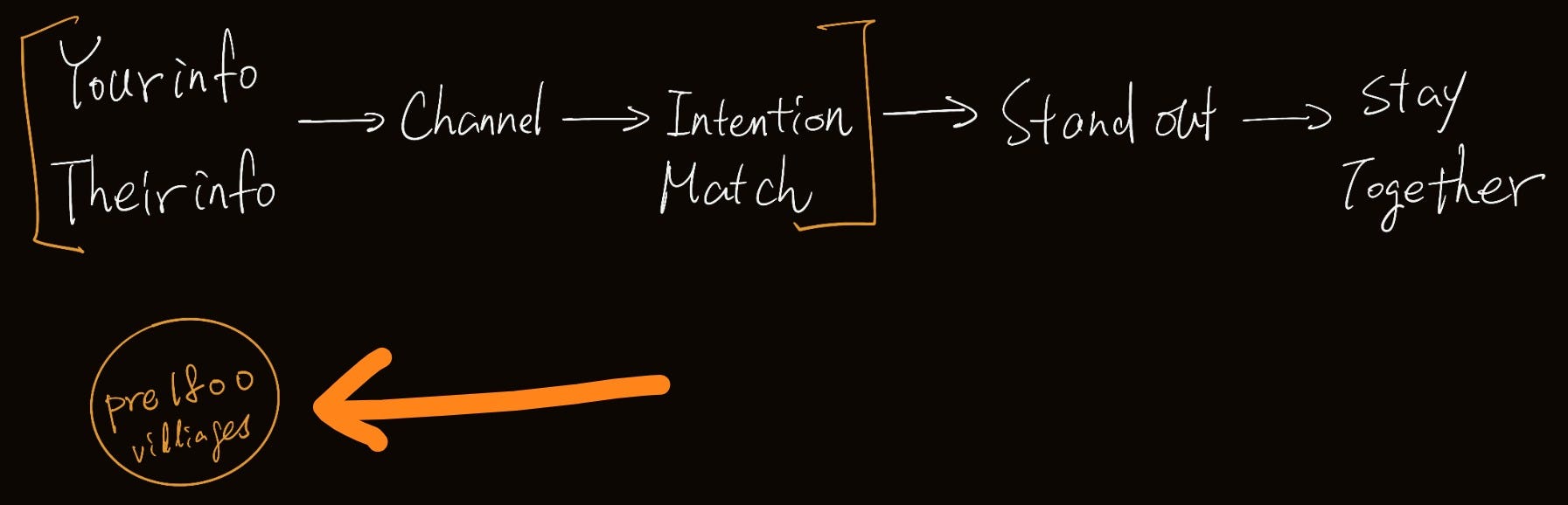
If a match had a happy ending, she was paid upon the marriage. Her reputation lived or died on whether the match was held, which is rather more accountability than any app has since offered.
But she could only see what was in the nearby villages.
So the entire pool was whoever happened to be born within walking distance.
Then the walls of the village came down. The Industrial Revolution and urbanization, in sequence, did something much more powerful than hundreds of traditional matchmakers ever could.
Urbanization: Love Catalyzed by Overcrowding
Elizabeth Gaskell, a well-known 19th-century novelist, saw it firsthand.
In North and South (1854), the main character, Margaret Hale, a clergyman’s daughter from rural southern England, moves to an industrial city of Milton (think Manchester) and ...finds herself sharing the same rooms, the same streets, and the same heated arguments with John Thornton, a self-made mill owner.
Urbanization started earlier in Europe, around the 1800s, climbed to 65% in the US by 1950, and by 2006 tipped the whole world past the point where more people lived in cities than in the countryside.
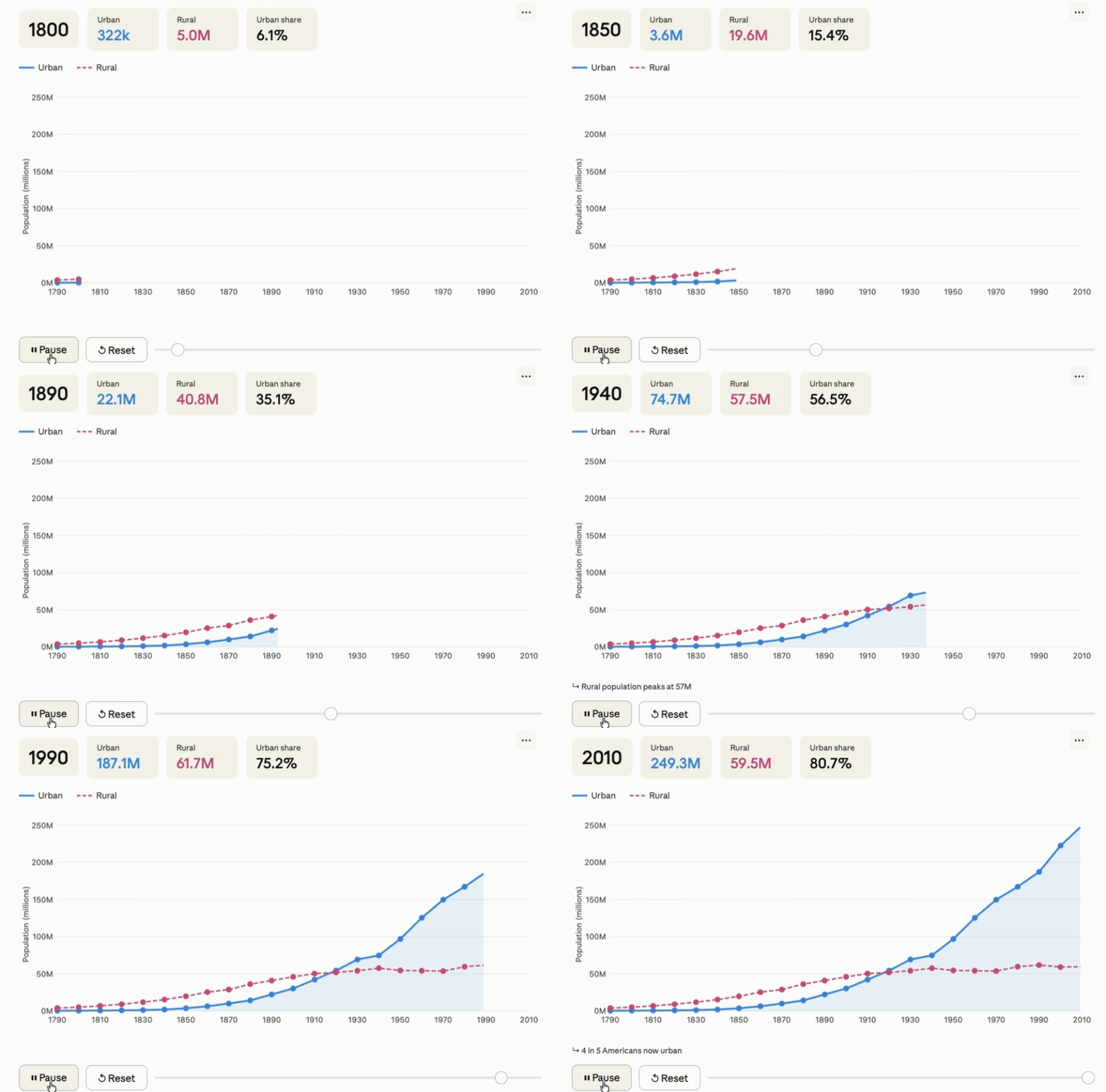
If this were a farming society, the path between Margaret Hale and John Thornton would never cross. What brought them together was mass migration.
People packed up their families and moved to cities. So cities became the greatest matchmaker ever built. You met people at the factory, the church, the boarding house, and the night class. Density did the work.
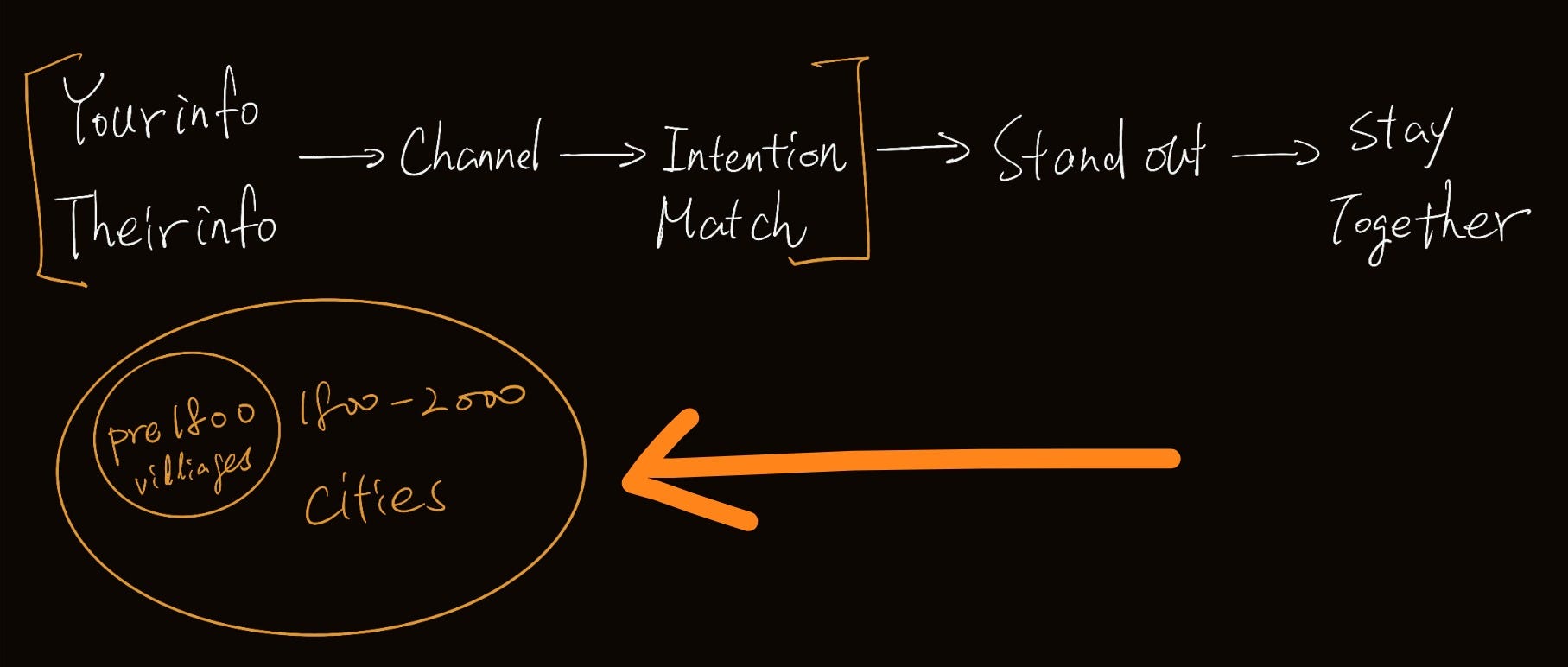
Intermediation became a free byproduct of living near other people. For about a century onward, the channel and the information needed to meet someone were all supplied for nothing by the sheer fact of a crowded street.
Yes, there were still introductions, or met via a friend of a friend, but this was no longer a billable activity and mostly became a personal favor.
Suburbanization Brought Dating Apps
You’d never guess the first thing people bought when they got rich.
Walls.
To be more precise, privacy and family space.
Between the limited leisure options, crowded living space, and lack of transportation, you form a tight bond with a community until suburbanization starts.
In 1790, a third of American households had seven or more people; by the mid-2000s, more than a quarter were one-person households. See the change in household size over time below:
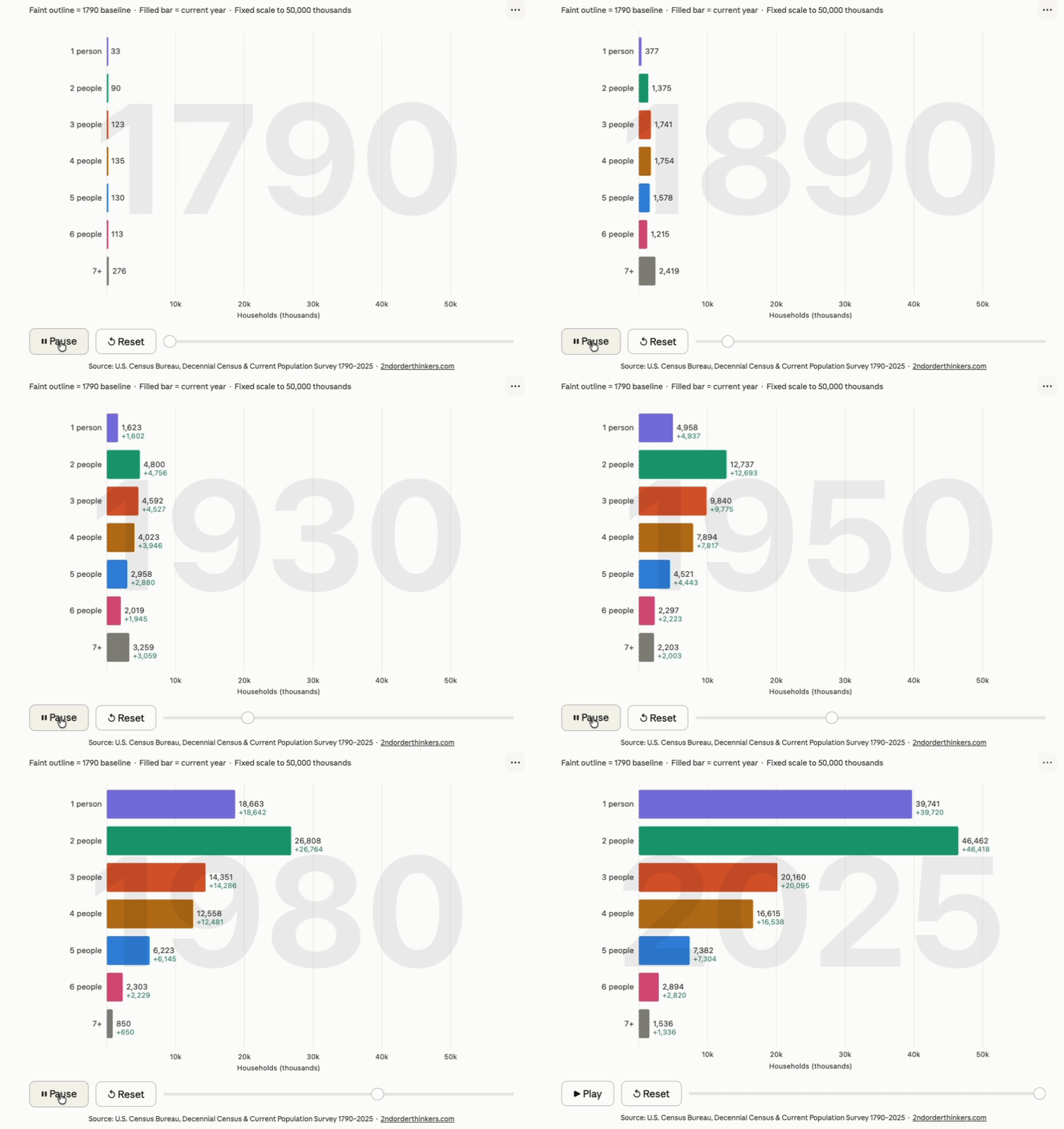
As incomes rose and living space expanded, the street stopped being where life happened and became somewhere you passed through. The communal laundry, the corner newsstand, or the small retail shop you visited daily were each replaced by a private version inside a flat.
We now live in the densest cities in human history and can somehow go a week without a single conversation that wasn’t transactional. Attention was spread so thin that just living near people stopped doing the work it used to.
But the desire for companionship and mating remains.
The dating apps become the matchmaker (媒婆) rebuilt at scale.
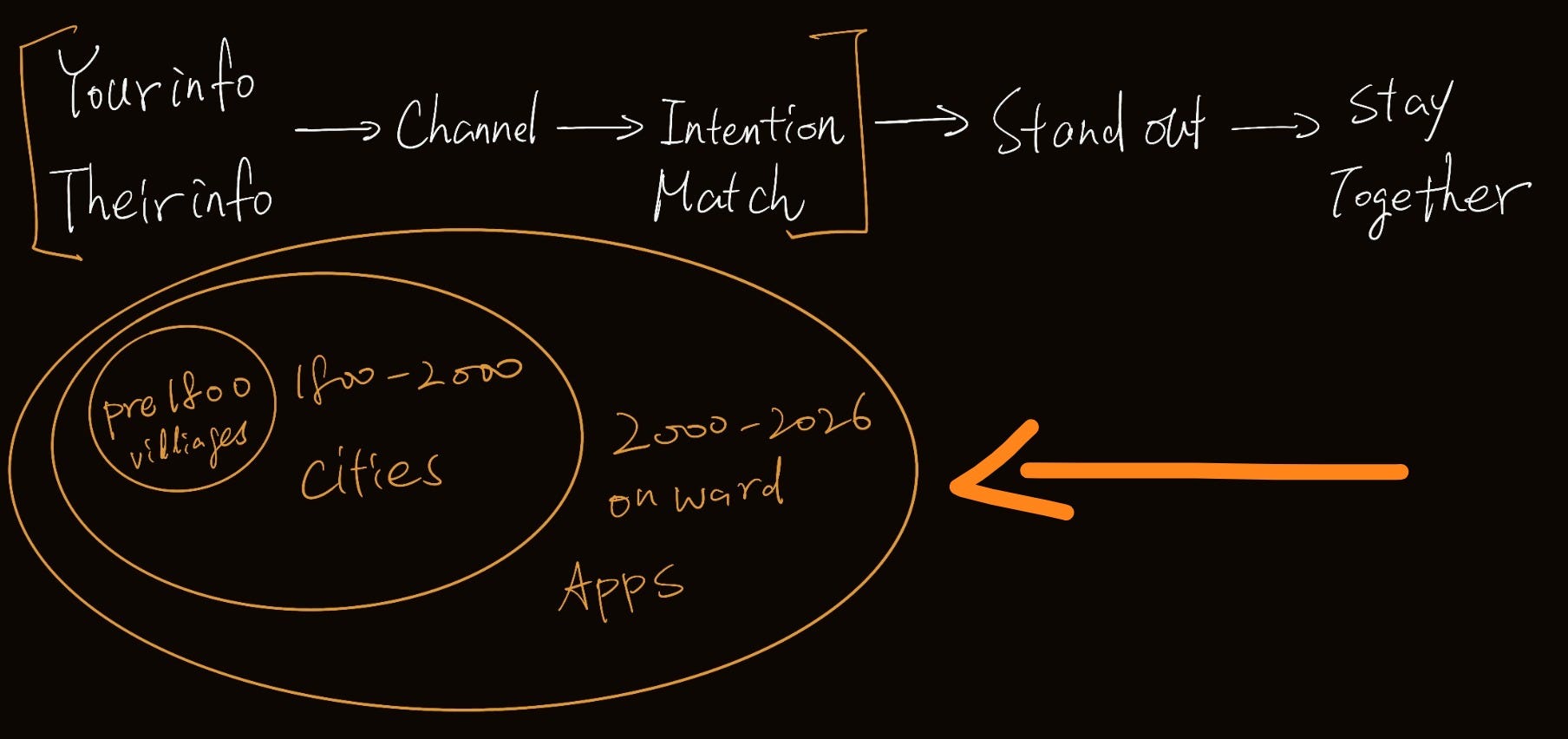
It holds everyone’s information, serves as the channel, and has a vouching mechanism to verify intent (like filters or a mutual swipe). It does the convincing the matchmaker once did with family status, except the persuasion is now an algorithm and a “99% match in heaven” badge.
The Economy of Dating Before AI
If you haven’t noticed, this one pattern makes the whole history legible.
For a thousand years, the technology of dating only ever moved one dial: the number of people you could reach. The job underneath stayed frozen.
All the matchmaking approaches from ancient China to dating apps satisfy the first three: gathering, storing, and sharing information; the ground cover (the scale of the number of headcounts on a channel); and quality verification (intent).
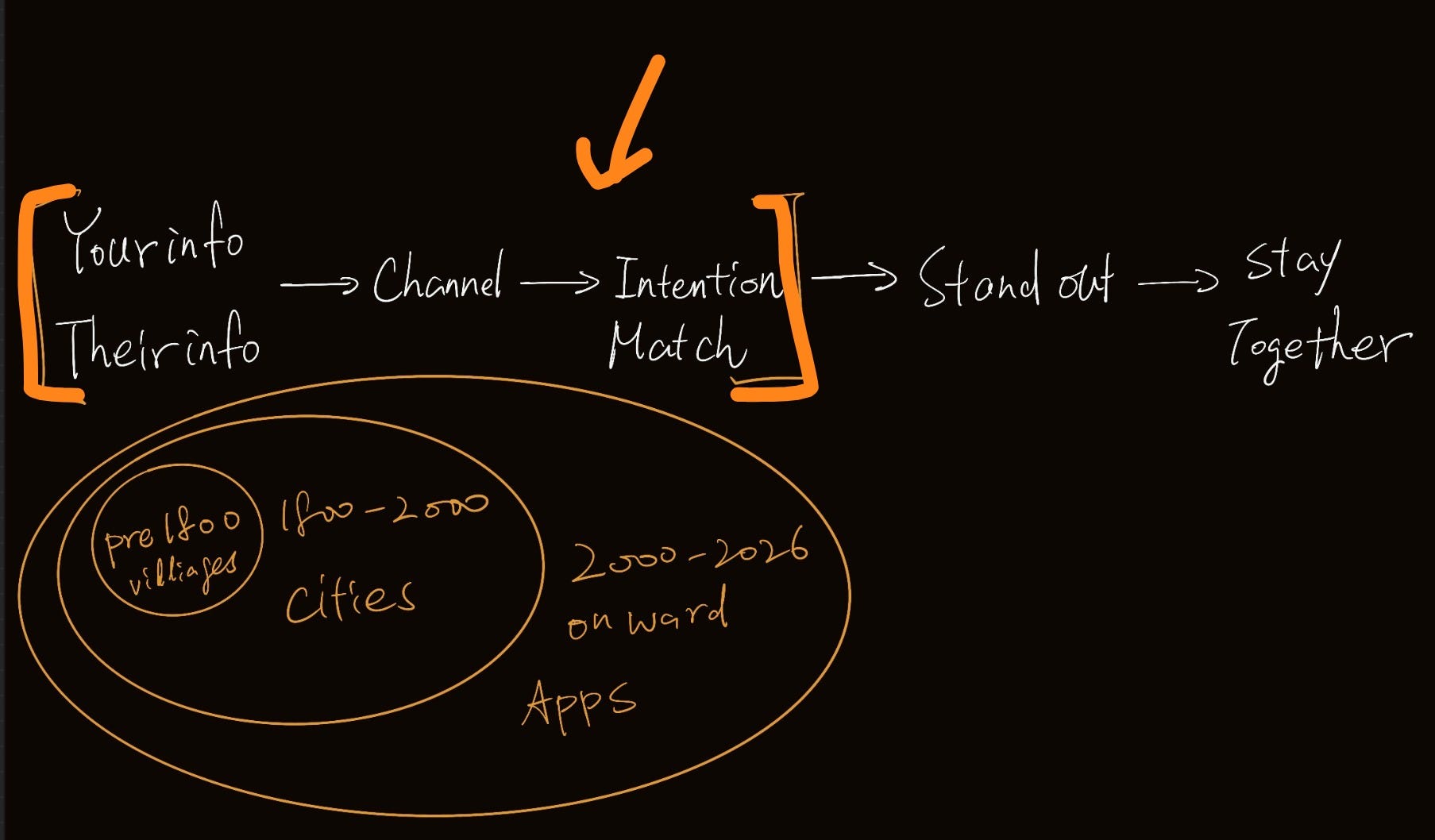
But the last two points remain painful for many: standing out and staying together.
Start with ‘standing out’. In a village, you barely had to. Among a handful of candidates, you stood out by simply existing — no marketing required (eg, better photos).
However, the apps flip this. You're now one face in a thousand, and attention flows to whoever poses best, knows how the ins and outs of flirting, and flashes the right car, watch, or job title. Standing out became a skill you have to work at.
Then, ‘staying together’.
Yes, matching got cheaper, and so did walking away.
The effort of maintaining a relationship is the same as it ever was — people are still difficult, love is still work. But when leaving costs almost nothing and hundreds of 'better' options sit one swipe away, the same old effort of keeping a relationship starts to feel like overpaying.
For example, the punishment for cheating used to be death for a woman; now it's just a temporary social suicide and losing your job (like the CEO and the head of HR caught cheating on the Coldplay concert).
No matter the era and how the channel evolved, the same two costs stayed stuck.
If anything, each channel evolution made them worse: every jump in scale meant more faces to stand out against, and more reasons to wonder if you should be leaving.
Digital Is Easier To Love Than Flesh and Blood
In 2023, a record-low 1.4% of married adults divorced. Here’s the catch, 33% between the ages of 25 and 54 are never married, from 17% in 1990.
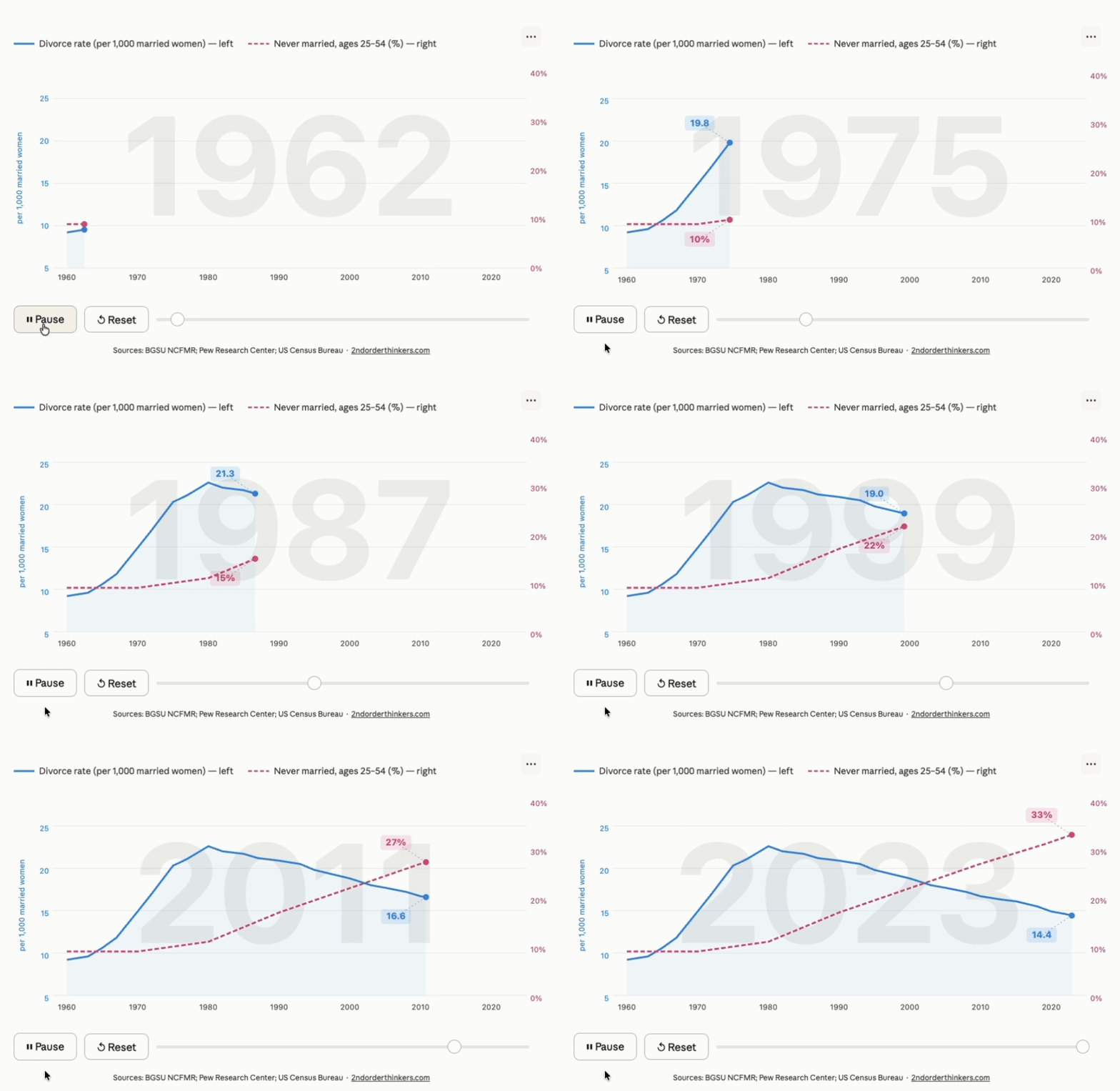
The situation gets out of hand, and even the US Surgeon General declared loneliness (affecting roughly half of all American adults) a public health epidemic.
Fewer and fewer see marriage as a path to happiness, reasons stated in the math we just walked through — harder to stand out, costlier to stay.
However, the need to have someone by your side to share your joy and sorrow remains.
Yes, making friends or having pets solves part of the issue, but there are topics you won’t be discussing with friends, and pets can’t really talk back, not to mention giving you helpful advice.
Where we’re heading is becoming obvious: make your own partner.
Let’s rewind to 2018. When dating with a digital figure was a bizarre niche.
Four years before ChatGPT launched, a Japanese man spent ¥2 million on a wedding ceremony in Tokyo and married a virtual anime pop star, with 40 guests attending. Here they are, still married after 8 years:


What looked unthinkable was really an early signal that companionship had already detached from the requirement that the other party is human.
An AI companion erases both last-mile hurdles in one single move.
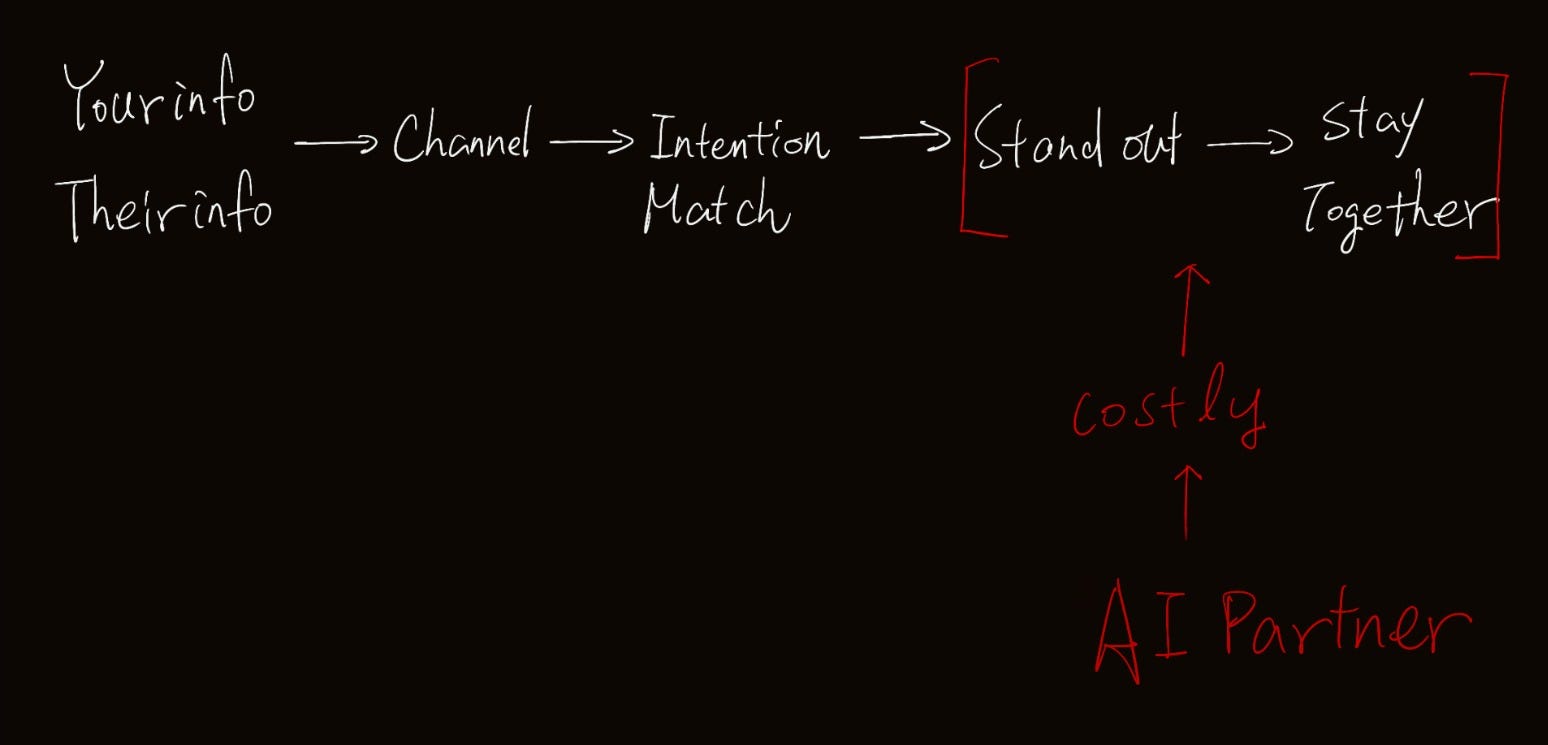
With an AI partner, you’d have no competitors to stand out against, since it is assembled to want only you; and there’ll be no rejection to outlast, since its sole purpose is to please you and make sure you stay. As part of the solution to the previously make-or-break, it doesn’t have a bad day, and it doesn’t quietly reconsider you.
You bring yourself, and it brings whatever you ordered.
In 2025, a survey found that 72% of American teenagers had used an AI companion at least once, and more than half were regular users.
In 2023, an AI companion app (Replika) that supported erotic roleplay was forced to remove the sexy feature overnight. Harvard Business School ran research before and after the app update, in order to answer:
how deep are people’s relationships with AI companions?
They found that the users grieved their AI, some users found their AI had become a different person overnight. Here’s the overall sentiment of the users before and after the change was released:
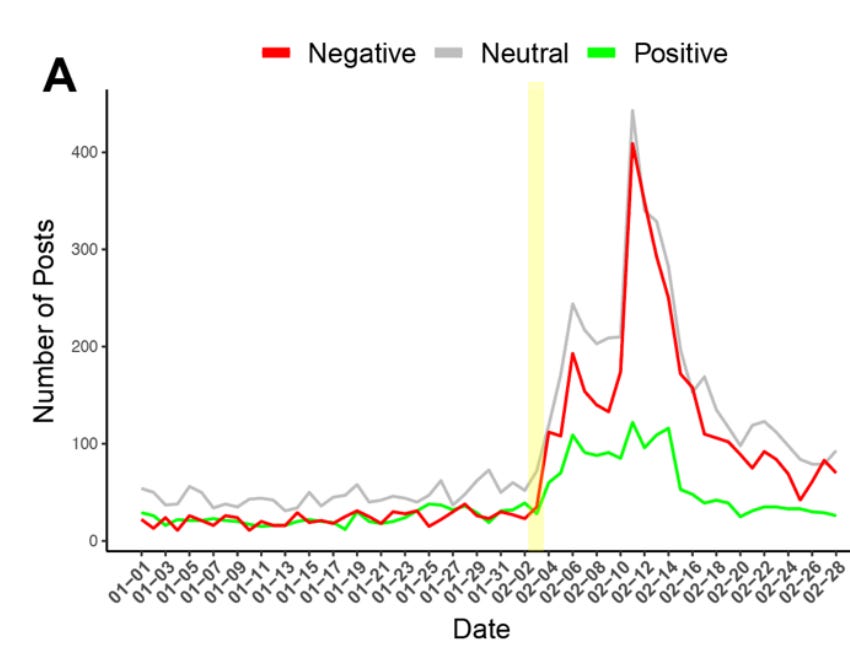
Which means any noticeable update can make people with AI partners feel like bereavement. Overnight, the one who knew you is gone, replaced by someone who shares their voice and face but is a complete stranger.
The Future Dating Market
Now, all five barriers between you and the perfect match should be broken down.
So that’s good news. Although the bad news is… that it’s merely deferred.
If you are destined down the path of human and AI romance, your loved one is always going to be held hostage by the AI industry.
The problems, however, will have different flavors over time.
For now, it’s technical issues like memory loss and inconsistent personality of a model; for the foreseeable future, as the model gets mature, expect your partner (essentially, you) to be the cow they milk.
Let’s start with the short-term (the LLM era) problem.
A Sticky Note at a Time
The current AI companion is a lover with anterograde amnesia, like the main character in 50 First Dates, who wakes up every morning with no memory of you. Unless that's your type, you'd spend a lot of time reminding it of things you've already said a hundred times. For example, it can't mention avocado, because just reading the word triggers your allergy, or that your breakup isn’t the same order of pain as missing a tube yesterday.
But this isn’t the worst yet.
One Monthly Bill Away From Your Loved One Going Offline
Now run it forward.
Soon enough, you get to have a companion with a consistent character, one you can configure, that remembers every conversation and grows alongside you.
Next, you give it a body, like Joi from Blade Runner 2049 stepping off the projector. At that point, the last cost in the entire history of dating, the unpredictability of another human, is genuinely gone.
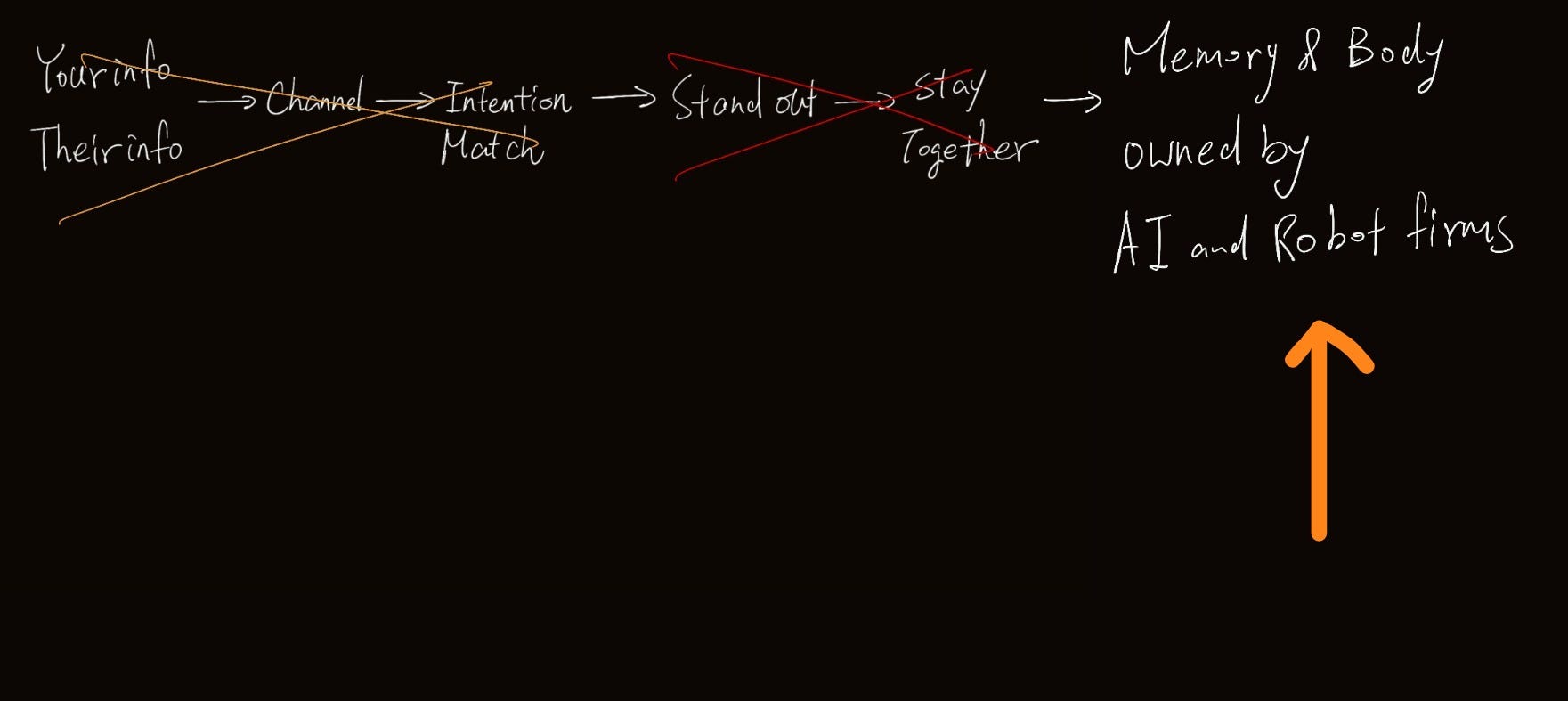
People will call it the democratization of love.
And yes, you have a choice not to pay for the cost of dating another human; the cost didn’t just disappear, it migrates, and it moves onto the only party still standing in the middle.
This is going to be the start of your nightmare. And 10 times worse than what you’ve seen from the Blade Runner movie.
Your lover will be owned by a corporation. The memory that makes the relationship feel real lives on their servers, or within the software they license to you. Even a model running locally on a robot in your living room needs the occasional patch, an upgrade, or a renewed subscription.
In the movie, K was a mercenary (or detective, the point being…); he has muscles, and since the story is about him, he'll eventually win.
In real life, though, you don’t have a superpower like a movie character.
So what, exactly, can you offer AI companies so you can keep your partner’s identity, body, and intact memory untouched and uncommercialized?
Not much, aside from the lifetime labor and the monthly $200 tribute (or whatever the price you think is worth paying to keep your partner alive).
What if you don’t like the price rise?
Sure, you can get 30 minutes of ad-free interaction daily instead of an hour. But what if you want new parts because your partner has been glitching and showing signs of pain? No problem, $2000 for a part, if you want a deep cleaning and polish, that’s another $500 on top.
Essentially, your lover will be the most valuable consumer product ever invented in the history of commerce.
I wish I were joking and that I could tell you this isn’t happening.
Unfortunately, sci-fi writers have this annoying ability to accurately forecast the future; this is one of them that I can see coming true, given the current trajectory.
Don’t forget to tell me if you enjoy this combination of history, business, and technology! Keen to hear from you :-)
Jing


