

I’ve followed the earnings calls of the three biggest cloud providers on the planet, Microsoft, Amazon, Google.
And I’m using Microsoft (Azure) as the main character to pull the thread to explain what’s going on in AI and cloud in 2026, and who’s winning, who’s losing.
Microsoft, the dark horse
Microsoft, founded half a century ago, had spent most of the recent year being the embarrassing member of the Magnificent Seven since the release of ChatGPT.
Its stock price was up less than 10% from 2023 until June this year, compared with nearly 170% for Google and 400% growth for Nvidia.
Microsoft has a rather grim side story to the industry’s AI excitement.
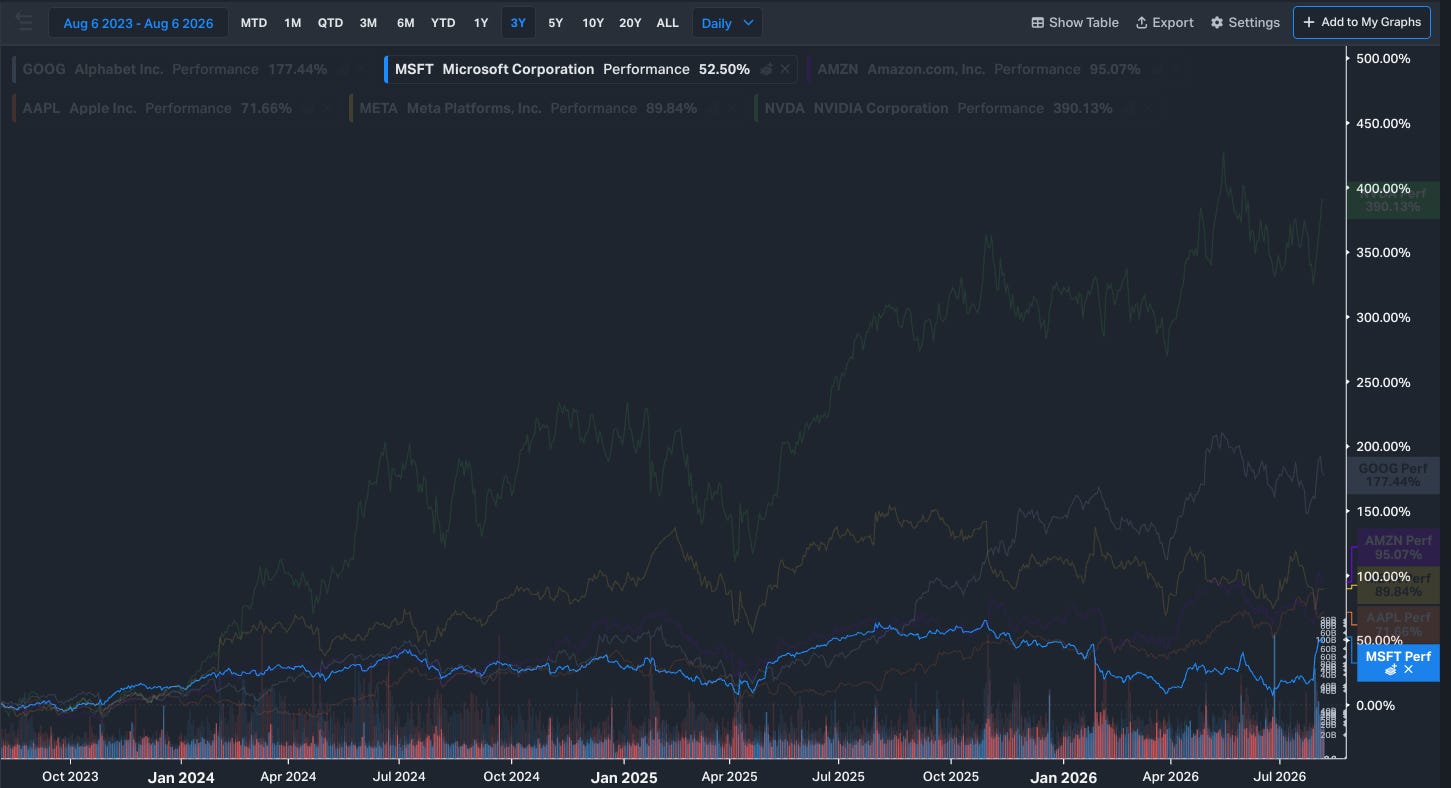
But then, something magical happened right after it reported earnings, Microsoft added nearly $450 billion in market value (put it in context, think it added a Denmark worth GDP in a day), the largest one-day gain for a single firm ever recorded in history.
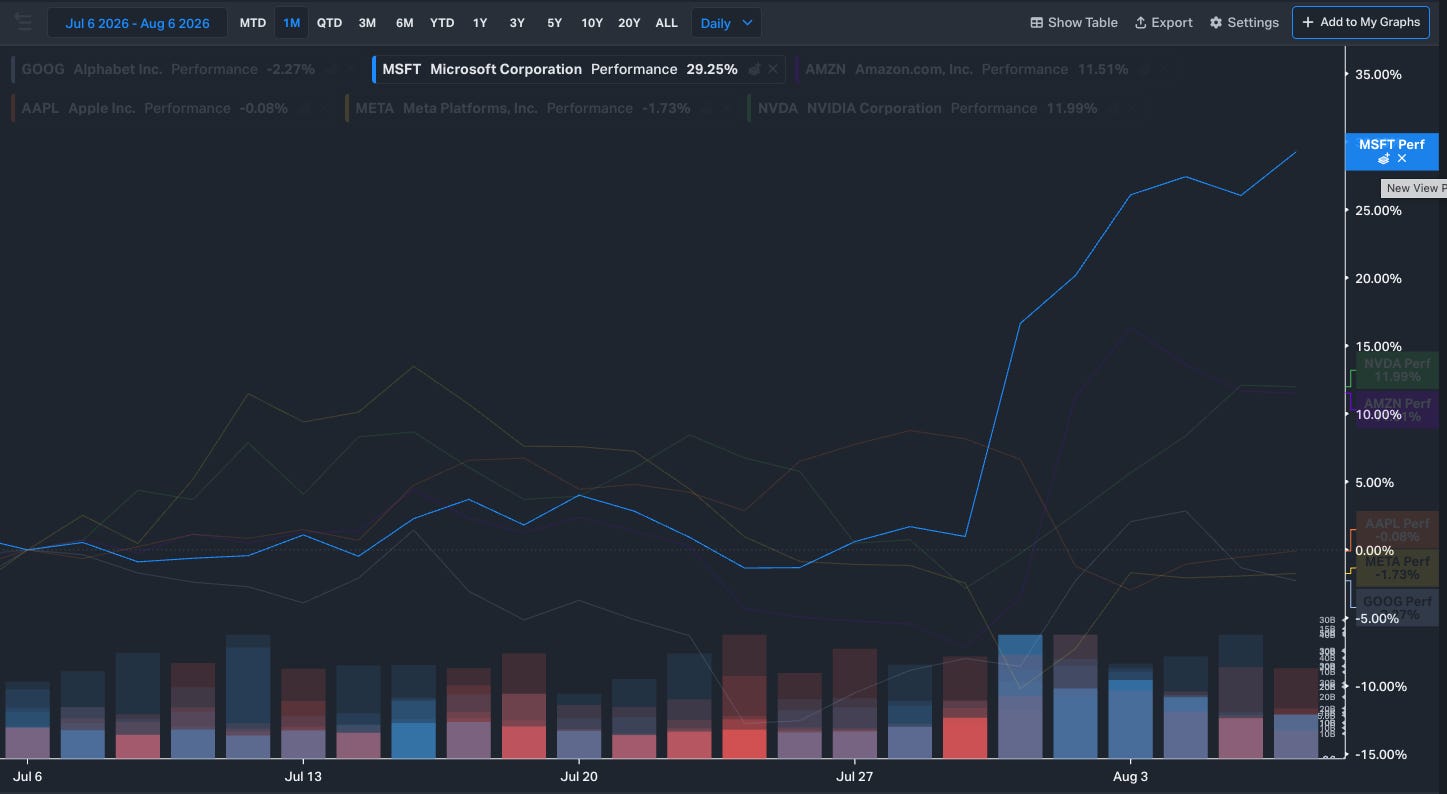
Before we get to that, Google told investors a exact same story as Microsoft’s; however, for some reason, no one bought it, and Google’s shares fell 11%.
So what changed?
The answer first, with Microsoft, investors see cash and the path to more cash.
The announcement that harvested $450 billion
In the latest earnings call, both Microsoft itself and Azure saw growth that exceeded expectations.
Though Google reported growth as well, however with negative free cash flow. Whereas Microsoft’s is above estimates.
This is particularly key in 2026, when borrowing is expensive, especially as investors started to worry about AI investment, so when Microsoft said, “We can keep funding the AI buildout without destroying the cash machine,” it’s only natural that the investors want to own the stock to get a slice of that future cash.
As for CapEx, all three of the largest cloud companies announced hundreds of billions in CapEx for AI and infrastructure; however, investors see a clear path to more cash for Microsoft and Amazon, but not for Google.
To learn more about Google’s earnings, read this.
Knowing the free cash flow and CapEx only scratches the surface; to truly understand the business, I’m here to tell you a little history about Microsoft, this half-century-old software company, and its unbeatable sales machine.
Microsoft won the office
If Google owns the internet, Amazon has the cloud, then Microsoft wins every meeting about which software the office is allowed to buy.
That sounds less glamorous because it is less glamorous.
Which is very true for Microsoft, if each of the Magnificent Seven has one superpower in this IT hero film, winning big enterprise license deals is Microsoft’s superpower.
For a normal, 9-to-5 worker, Office means Excel, Teams, and Outlook. But for enterprise IT and CIOs, it includes the place where their files live, and, most importantly, it means detailed control of the services and the accounts in a meticulous way.
Think the NHS England of this world (as I worked for a UK public service institution).
I guarantee that somewhere inside the NHS, somebody with semi-big guns has bought a ChatGPT subscription and uploaded far too many internal documents into it.
Eventually, the IT security team stepped in and blocked ChatGPT.com, switched on Copilot, and sent an email to the entire organization:
Hello everyone. Copilot is now our approved AI chatbot.
Done.
Don’t confuse this with the result of someone holding a model benchmark, comparing GPT with Claude or Copilot. But it was as simple as the organization had a data breach problem, and a box marked “AI strategy” problem that needed ticking.
All because Microsoft offers a single button that seemed to solve all the headaches, and it’s conveniently already part of the Microsoft family!
The same pattern happens over and over in many established firms that are typically not technology-forward.
You shouldn’t be surprised if it ever comes to:
how can the so-called “AI“ thing be rolled out to the rest of the staff asap, without bearing the risks?
On my channel, many of you talk about the best model in the comments.
But some of you forgot that most companies are not tech companies. They are hospitals treating patients, councils issuing permits, banks moving money, and institutions with an Excel file called FINAL_budget_v7_ACTUAL_FINAL.xlsx.
They don’t want an AI science project. They want one approved tool that fits the systems they already use, clears security, and lets everyone get back to work. This is the exact evil beauty of the Microsoft economics.
A heavy Copilot user incurs significant compute costs, but there’s not much of them compared with the 99.99% of light users. Microsoft has access to a particularly wonderful type of customer.
The majority of the NHS staff might ask Copilot to summarise one meeting, decide the summary is shit, and move on with their lives.
The AI license renews like business as usual. Something the likes of Anthropic and OpenAI can only dream of and would never achieve in their lifetimes.
As of this earnings call, Copilot has more than 30 million paid seats. And with NHS England along, Copilot is being rolled out across roughly half a million seats.
To put this into context, you thought it took ChatGPT to onboard 1 million users in 5 days was impressive.
The fact is, that was nothing.
Microsoft has onboarded half a million users to Copilot in a single click.
Yeah, yeah, you argued, ‘but those are their existing customers!’ True, however, a new product sold to an existing customer counts exactly the same in accounting as a new product sold to a new customer.
That is the Microsoft sales machine.
It knows exactly who is and isn’t its ideal customer.
An ideal customer isn’t an engineer who cares deeply about model architecture, token prices, and whether one API is marginally better than another, no, because these people are annoying customers, as in, they know too much and want too much control in their hands. This is the AWS crowd.
Microsoft’s ideal customer is an organization in which most of the staff think AI equals ChatGPT, and the person paying for the software and the person using it may never meet.
The foes
Now you get Microsoft’s whole business model.
It also makes it so much easier for you to subsequently get its foes’ strategy.
First, it explains AWS’s market. Basically, AWS served the complete opposite end of the market: everyone who doesn’t have a central IT department with huge buying power, or who cares too much about their cloud deployment, or has too many of their own opinions in the tech stack. They may use Office, but they won’t deploy on Azure.
Secondly, it also explains Google’s awkward position in cloud and why its cloud service and the Google Workspace are just so slightly poorly positioned compared to Microsoft and AWS, so that the market can’t take it seriously when it’s about to spend $200B on cloud.
If we exclude the ad and focus on serving the office crowd while providing cloud services, Google has a business model similar to Microsoft’s.
The ever-so slight disadvantage of Google is that Google houses aren’t as rooted to its ecosystem as Microsoft’s customers are.
I worked in more Google houses than Microsoft ones. Those who use Gmail likely also get Slack for internal comm, JIRA for tech ticket management, and, ironically, still Microsoft Excel for their accounting team, because Google Sheets is shit.
Meanwhile, Google only offers a small set of tools for IT folks, and far from enough for IT admins in enterprises to manage large organizations’ IT.
If Microsoft is like an ecosystem to a firm, Google at best counts as a vendor.
So, you see, it’s not that there’s less stickiness with Google, but no stickiness.
This makes it so much harder to roll out Gemini across the board, given there was no board to start with.
Remember what I said at the start of this chapter? Google owns the internet, while Microsoft wins the office?
Google can put Gemini in front of almost everyone online. That creates usage, but not the direct payments Microsoft gets by adding Copilot seats as an extra on top of what employers already paid for.
The latter has a much cleaner path to revenue.
What? Advertising, you said?
But the thing is, no one knows the conversion rate of the latest AI search assistant to ad clicks, or how revenue compares to the traditional ad conversion rate.
Of course, how can we talk about Microsoft w/o covering their marriage (and the separation) with OpenAI?
Bye-bye, OpenAI
Microsoft’s OpenAI problem began with Sam Altman (as many things do). Or more precisely, in November 2023, when OpenAI’s board fired Sam Altman.
That sounds like old AI drama now, only it was not.
At the start of 2023, this was the tightest partnership in AI.
Azure was OpenAI’s exclusive cloud provider, powering its research, products, and APIs. Microsoft had the money, the data centers, and every enterprise account on earth. OpenAI was the AI lab on everybody’s tongue.
Then a tiny board detonated the company.
Microsoft’s immediate response was to offer Altman a job running a new Microsoft AI research team. A few days later, Altman was back at OpenAI. The whole thing was no less than how Logan Roy took back control of his firm.
You do not need to believe the Altman drama was the sole reason. It clearly was not; that was just the first crack.
Then OpenAI’s appetite for compute got too large as it became a giant in its own right. It needed more computing capacity and more freedom, including the freedom to work with Microsoft’s cloud rivals.
Of course, there’s no shortage of drama along the way, eg, by 2025, rumors say that OpenAI may accuse Microsoft of anticompetition over compute and cloud.
Then, in Spring 2026, after several relaxations of the bond, Microsoft lost exclusive access to OpenAI’s models; effectively, OpenAI can sell across any cloud.
For Microsoft, it acquired more bargaining power if a supplier experiences an outage, a price rise, or simply another sudden outbreak of founder drama.
Unlike Google, which is trying to push Gemini to compete with other frontier labs, Microsoft, again, focuses on the return.
Entering the open weights and routing war era
If you haven’t read my Kimi K3 article and aren’t sure what’s worth being so excited about the open-weight debate, you should give it a go.
It won’t be as fun if it’s only a technical difference between open and closed weights. But it’s also about routing the right model at the right moment with the right cost.
As mentioned in one of the weekly briefs, everyone now realizes that if you want to play at the model layer, the money isn’t with the model, but at the gate. Just to name a few players, Stripe (yes, the payment company), SpaceX (with Cursor), Microsoft, and AWS.
So, if we put 2 and 2 together, it can’t be more obvious that the open-weight declaration Microsoft started was no accident.
Satya Nadella seized the opportunity of the Kimi K3 wave and the heated China vs. US AI policy debate, successfully pushing Microsoft back to a leading position in the AI era.
What a PR move!
Particularly for a bank, government, or pharmaceutical company, having a choice can be the whole point. They likely want a model that runs in their own controlled environment, leverages their internal knowledge, and offers the freedom to change and tweak it.
Knowing there’s little margin in selling models, Microsoft’d rather sell higher-margin offerings, like the cloud, the office suite, and the services.
For example, who doesn’t prefer the model developed by their own country?
And you’ve surely heard “US innovates, EU regulates”. So you know that the EU loves its regulation.
Therefore, to fully onboard EU customers, Microsoft brings the French model Mistral into Microsoft’s Sovereign Cloud, with customer-controlled, disconnected environments.
If you are a European ministry, bank, or union, now you have “a French model running in an environment we control” rather than “We sent the ministry’s knowledge to an evil American model.”
Soon enough, Copilot is the interface. Microsoft 365, the work context. Azure, the computing. And, every move, there’s a Microsoft trust partner within arm’s reach to help you set up, while also making sure you are even more deeply integrated into the ecosystem.
And because Copilot is embedded in the software people already use, Microsoft can get away with its 2nd teir model and shitty products more easily than Google.
You see, the cycle is now complete.
Once you know where to expect the profit to come in, the rest of the strategy clicks into place. Basically, the best model doesn’t automatically win, but the distribution.
This may sound bizarre. It is. Welcome to enterprise software.
Now, how can we talk about AI w/o covering cloud?
Azure, AWS, and GCP
So far, Microsoft sounds terrifyingly competent. We should correct the record by talking about Azure.
If I have only one line to tell you the difference between Azure and AWS (the world’s two biggest cloud platforms):
AWS is a cloud platform wrapped in a sales organization. Azure is a sales organization wrapped in a cloud platform.
This is where most investors don’t get it; they often see Azure and AWS as two interchangeable clouds, but that’s only because engineers weren’t at the table.
On a spreadsheet, both have servers, databases, storage, AI models, and every other box a company might need to tick.
But to be able to truly compare these two and what their business advantages are in the AI era, you need to know the real difference, I’m talking about how they each grow their business.
AWS grew up around developers. A small engineering team could open an account, build something, automate it, and grow without first being introduced to a partner consultancy. Its services tend to feel like building materials, think Legos, engineers can combine them in the way they want.
Azure, however, grew up around Microsoft’s corporate relationships, starting with an account manager.
It's natural for customers to already have Microsoft identities, contracts, and a reseller somewhere in the building.
It typically serves a giant org that wants control rather than one developer who wants the bloody database to connect.
That’s also where the frustration comes from.
Microsoft has a huge ecosystem of consultancies and integration partners that turn the mess into a project and a project into a barely functioning mess.
The customer pays Microsoft and the partner, and becomes even less likely to move because nobody wants to repeat the migration, and you just need more consultants if you are ever tempted to start one.
Regardless, AWS and Azure enter the AI era with a route to customers they already own. Google Cloud’s route is more awkward.
Google Cloud usually enters a company through one team with one specific problem. For example, the data people want BigQuery, so they have it.
But this creates a pipeline problem for Google.
The data team can choose BigQuery without the rest of the company choosing Google. It’s a hard battle, and Google still has a fight on its hands to turn one department’s technical decision into the company’s default cloud.
Now that you have some understanding of the landscape, which cloud company will win or lose in the AI era?
The war room
The biggest question mark today is
Can AI really improve productivity and the ROI?
Yes, I know AI saved us from the headache of thinking, but this isn’t the same as seeing a better margin.
Here, I want to cover what happens if AI becomes the century’s productivity machine, or if the whole AI endeavor is merely a joke?
Scenario: What if AI works?
“Works” does not need to mean artificial general intelligence or robots taking over the world. It only needs to mean companies find enough recurring, useful work that they keep paying for the software and infrastructure.
In that world, Microsoft is in an absurdly strong position.
It doesn’t even need Copilot to be the smartest AI in any benchmark.
As long as Copilot is useful enough inside Outlook, Teams, Docs, and Excel, that’s enough to continue charging for the seat.
AWS also wins, but somewhere else in the stack.
Companies building AI products still need all the ordinary cloud machinery around the model. AWS already has the largest base of those engineering workloads. Its model-neutral approach also looks sensible in a world where the best model changes every few months.
Google can absolutely win as the king of ads.
However, the GCP’s path is harder to justify. Google is spending heavily to build an AI cloud while trying to figure out how AI is changing the search advertising machine that used to pay for everything.
Combined with the free cash flow and the CapEx difference I mentioned earlier, Microsoft’s like saying, “We are adding AI to the software your employer already buys.” Whereas Google’s like, “We are betting everything and hoping for a return in 3 years.”
So it’s not a surprise that Investors gave both Amazon and Microsoft the vote of confidence.
If AI works, neither Microsoft nor Amazon needs to win the model warfare. They only need to sit on the sidelines, put the winners inside their cloud, and carry on with business as usual.
What if AI doesn’t work?
Now, assume the less fashionable outcome.
Not everyone believes AI can deliver significant productivity gains.
Just no solid proof of that from everywhere I see. If you’ve been reading my work since last year, you’d know exactly what I meant.
Agents remain unreliable. Copilots save a few minutes but not enough money. Companies scrutinize token bills, cancel broad deployments, and keep AI only for a handful of jobs. Developers aren’t fired; instead, you need more senior staff to unfuck the fuck up by AI.
In this scenario, the data centers still exist.
However, Google, which invested so heavily in AI infrastructure and cloud, would have a very large AI infrastructure bill to pay. Search advertising would still be the cash business that saves the day.
But the winners of this scenario are still Microsoft and AWS.
Again, AWS did not become the world’s largest cloud because people wanted to play with chatbots. It got there by running every service you can think of and the deeply boring systems that companies cannot switch off without ruining everyone’s day.
Microsoft would be fine as a company. Office, Windows, and its existing cloud business do not vanish. Only the beautiful Copilot economics become much less beautiful.
The principle is that if the workloads were there before AI, they will remain even if generative AI disappoints.
After all, Microsoft isn’t known for its AI, but for its perpetual sales machine. AI is just the latest line item in a long list.
Enjoyed this work? If you need more context, read this one next:


