
For each AI query, you pay twice. And only the first round is paid in money (and it’s the cheaper one).
But this isn’t the worst of it; this one interview with Karp, Palantir’s CEO, went viral:
I’m going to get no value, and they’re (the likes of Anthropic and OpenAI) going to get my IP. (02:17-02:21)
About the same time, Nadella, Microsoft’s CEO, published this (a calm version of essentially the same statement)
The buyer is giving away knowledge, just in order to use what they bought.
Basically, both CEOs are saying the same thing: The number on your invoice isn’t what you actually paid. You might even have already overpaid for what a model could realistically achieve, bringing your ROI into doubt.
With these CEOs starting to voice the ‘truth’ (certainly not because it aligns with their incentives), I’ll answer these five questions:
What does AI actually cost? Imagine there are no subsidies.
Apart from money, what else are you paying the labs (such as OpenAI and Anthropic) for?
How does AI rewrite competition? Do you stand a chance against your vendor-turned-competitor?
What do the hyperscalers' CEOs recommend the world do?
What does it all mean to the AI industry?
To start with, the true token cost.
The Price Isn’t Real
Karp’s rant went on:
The reason why everyone is chillaxing with bad financials and growth with losing money is the client refuses to pay the true cost. (05:18)
What does he mean by true cost?
Before I answer this one, one follow-up question I want to ask you:
how does a company build its AI ROI case?
Most people calculate their AI ROI by simply comparing monthly token usage and costs to employee wages, then dust off their hands and declare the job done.
Is it this simple, though?
Take OpenAI, for example, how much does it cost to let you chat on your £15 / month subscription?
People worked out that when you max out the monthly token usage, especially with the frontier reasoning model, for every dollar you spent, AI labs spent $10 to supply you. The estimates vary, but they’re all in this order of magnitude. It’s something we can hopefully verify once there’s a public S-1 to read before either OpenAI's or Anthropic’s IPO.
Or, if we only consider API usage, the most expensive reasoning model, GPT-5.6 Sol, is currently charging $ 2.5/1 M tokens for input and $ 15/1 M tokens for output.
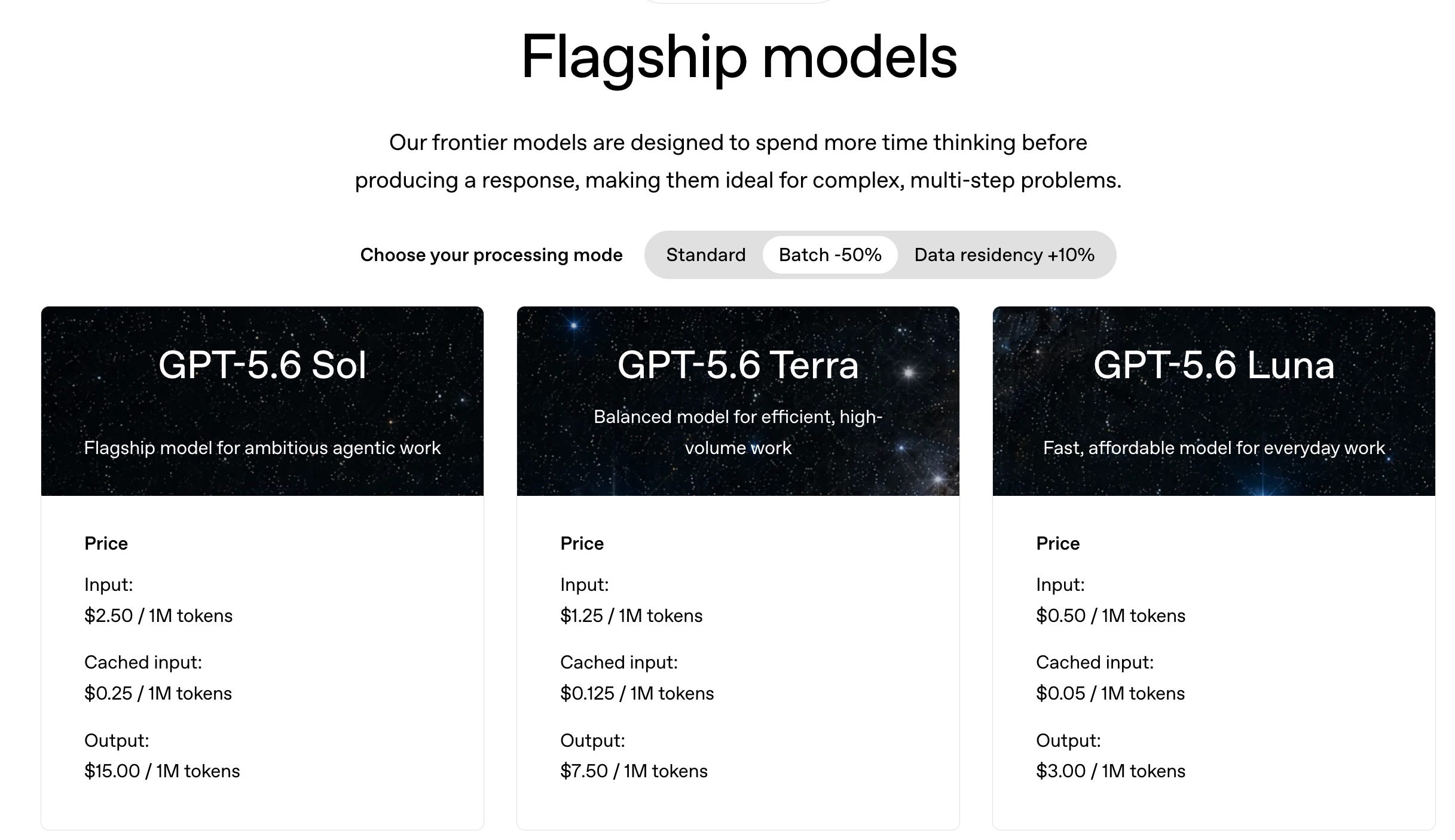
Even assuming the labs charge for API tokens at a small profit margin, they are still losing money overall. Because for the models to run, they need more than compute, there’s also salary, developing future models, the hardware cost, and so on.
It’s known that the current business model is a money-losing pit, but no one has an accurate estimation of how deep it goes. Bloomberg estimated that in 4 years' time, we’ll see an $800 billion gap to fill.
Not sure how big $800 billion is? That’s McDonald's + Starbucks + Procter & Gamble + PepsiCo, just a bit over $800 billion.
Now, let’s pull our heads out of the sand for a moment and think about what it would be like if the labs are now forced to make a profit, or at least break even, in the next 2 years? They’d need to charge the commercially sustainable rate, enough to make up the $800 billion hole.
I’m being extremely conservative if I tell you this would merely double the cost in your ROI formula.
So, would the AI projects you run still justify the cost? Forget about it, that’s when you’d rather have humans do the work, and also the time you’d realize you've stepped into this trap all along, while throwing away the workers who know how to do the job.
But this isn’t the worst news for the token economy.
Because the token cost isn’t the priciest part you've paid for yet.
The Second Bill: Your Data and Know-how
Karp went on about how AI labs are ‘stealing the weights and alpha’ (06:42) from clients.
Let me explain.
Start with what Kenneth Arrow (a Nobel-winning economist) described as a paradox in the market for information:
Its value for the purchaser is not known until he has the information, but then he has in effect acquired it without cost.
Think of this so-called Arrow’s Information Paradox like trying to sell someone a useful secret. They will not pay for it unless they know it is valuable… but if you tell them the secret to judging its usefulness, they already have what you were selling!
In AI, the paradox works in reverse.
As an AI consumer, you risk giving away your trade secrets just to use the AI you bought.
A general model is impressive because it has generic information about almost everything. However, if you want the AI to be commercially useful in your context, you do need to supply what it doesn’t know, but on a need-to-know basis. The information you need to disclose can include internal definitions, operational history, preferences, and the trade information between you and thousands of your customers.
This is the point where you’ve paid twice for using this intelligence.
First with money, then with proprietary knowledge. But again, you have no choice here, since you want the model to perform, so you need to provide that knowledge.
And sure, it’s proprietary information. In an office setup, it’s obvious that a document you uploaded is your property. What about the prompts the staff write, and the corrections they make? These are less obvious but just as valuable and confidential to your business. And what about the AI's responses, which you then refine with further prompts? Do you own that entire chain?
All these should matter significantly.
Because these capture the judgment: what it notices, what it prioritizes, and what it considers a good answer. And it’d only benefit you further if you can feed them back and improve your AI. The only logical conclusion is that you want to own the loop.
At this point, you might ask, so what? The AI labs can have it all, not that they can replicate my business overnight!
Are you so sure about that?
How AI Rewrites Competition
In a pre-AI competition environment, your competitor could copy your products, use the same tools, and even recruit your staff.
For example, Amazon Basic. As a platform, Amazon always sees which third-party products are viral and profitable. For instance, after Peak Design’s Everyday Sling became a popular camera bag on Amazon. Amazon later launched a cheaper Amazon Basics sling.
Of course, their spokesperson said, ‘Data on individual sellers is not used to improve Amazon's business.’ But cases like this are far from isolated.
Once a coincidence, twice a pattern, three times a copycat behavior.
If Amazon’s move looks like copying, AI takes the same logic several steps further. Amazon Basic might have the shape of those products, but the AI labs have everything.
Nowadays, the vendor who is supposed to help you can quickly become the one replacing you.
This is exactly what happened to Stack Overflow. It’s now an underdog after going head-to-head with AI chatbots; the answers the community spent years writing are now delivered straight into the coding interface via OpenAI’s Codex or Anthropic's Claude Code. Or how Figma ended up as a complementary app next to Claude Design.
So yes, in theory, whatever from your firm should be yours to keep. Paraphrasing Hayek:
Effective decisions rely on dispersed, local knowledge of time, place, and circumstance that centralized outsiders cannot fully possess.
But do ask yourself: which of the mentioned knowledge is off-limits to your AI agent or chatbot?
Again, as a customer of the AI labs, you supply the proprietary context that makes their product commercially useful. As the vendor, they gain a privileged view of that context.
You’re fine, in the short term.
Over time, however, the information asymmetry becomes more skewed. The vendor learns more about you each time you use the AI, while you get nothing but tokens in return.
The irony is two-fold.
One, most people ignored what’s already written in the T&Cs.
Here’s AWS’s current documentation for Anthropic Claude, which says that customers must enable a data-sharing command before invoking the model.
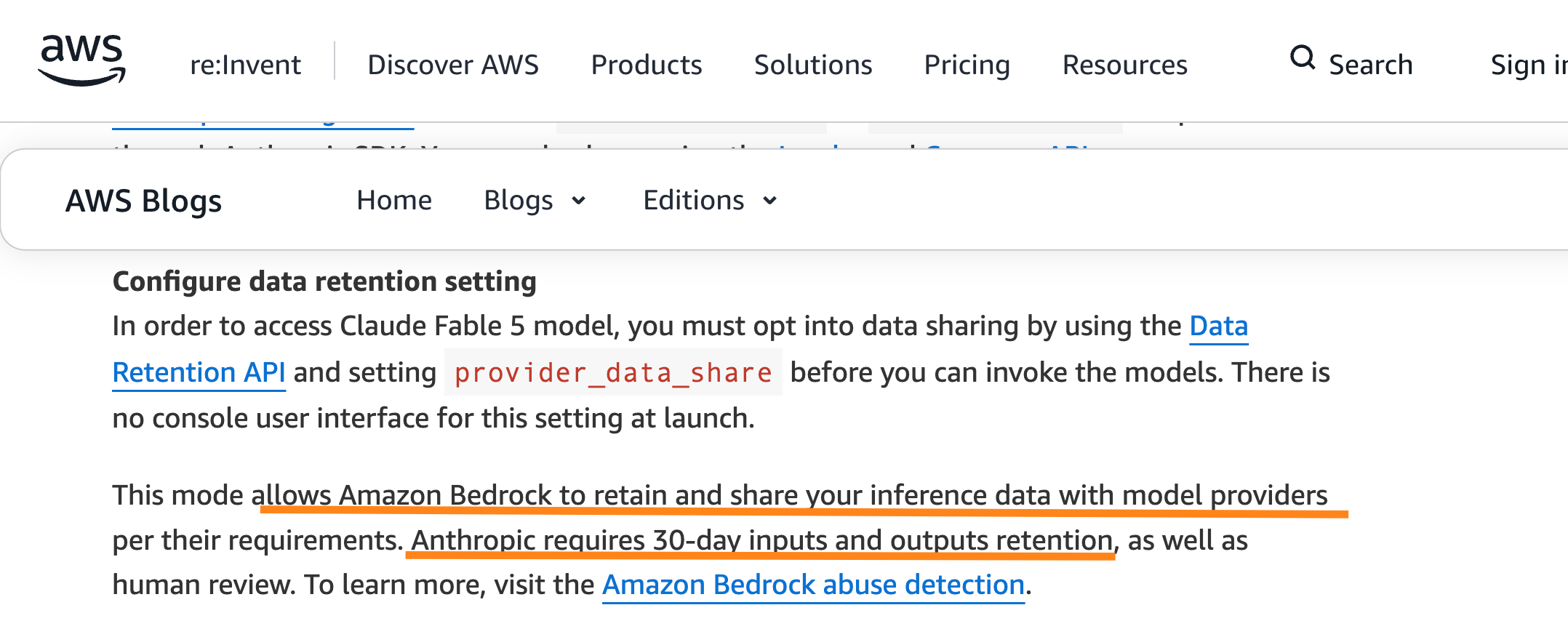
That setting permits Amazon to retain and share inference data with the model provider. Anthropic requires up to 30 days of retention, even possibly with human review.
Second, most people are aware of the legal debate between the labs and the content owners, but not for a minute do they think it’ll happen with their content.
Now you’re warned, you should seriously consider this matter.
But how?
How Do You Self-Defend in 2026?
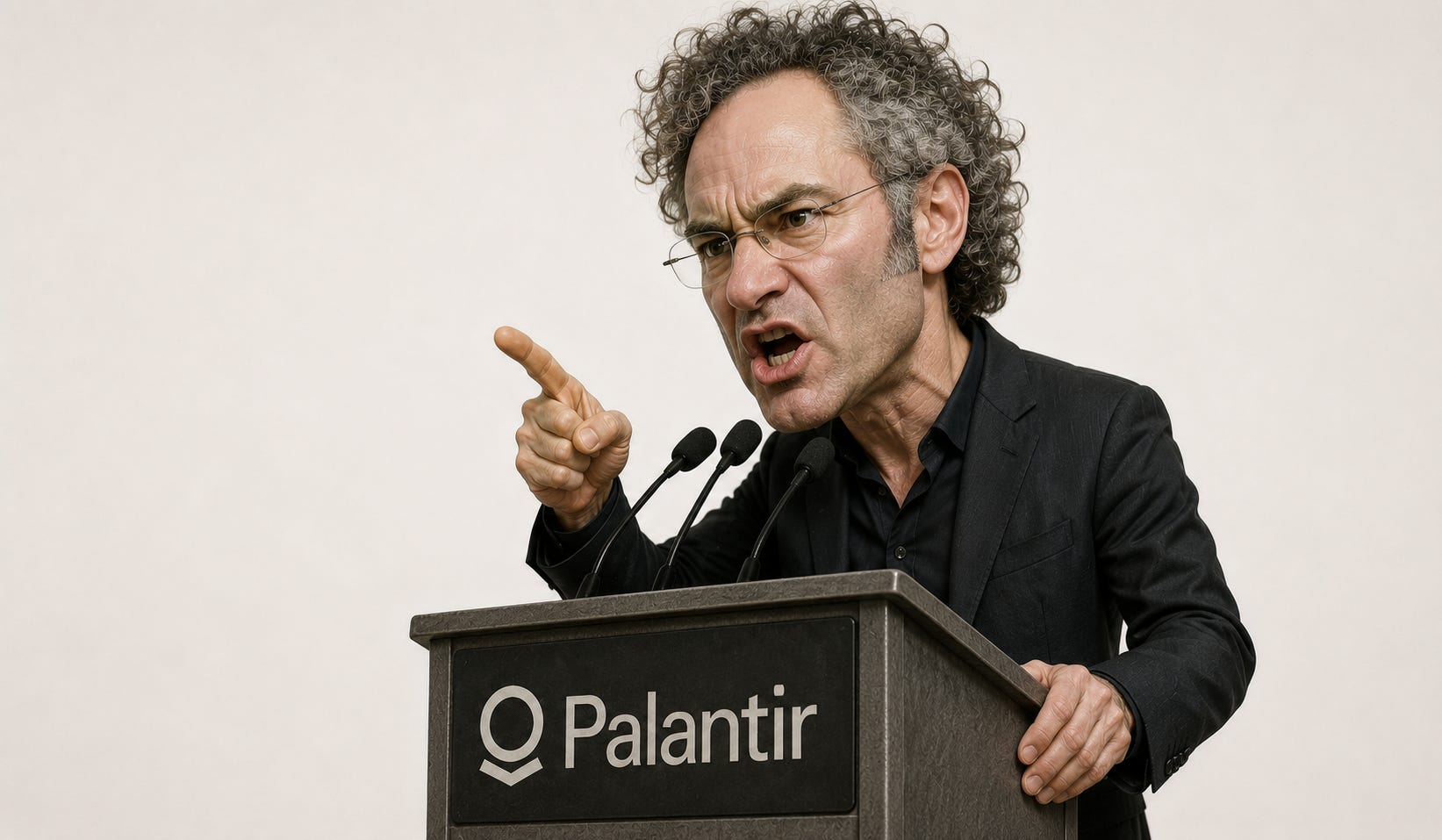
Karp’s recommendation was quite straightforward (03:38):
What the technical customers want is control over their compute, their models, their data stack, and their alpha. They want to know they own the means of production, and it’s not being transferred to someone else.
In other words, you want to own a tool rather than be owned by one.
This does not necessarily mean building your own model, buying a warehouse of GPUs, or turning every company into an AI lab. It does mean, however, that the model should remain a tool of the business, rather than becoming the center of a business.
Though this distinction was somehow lost after 2022, a mistake that many astute CEOs made.
It was like they were suddenly charmed by AI demos; the outcome-based metrics were forgotten; in return, you got the insane, unthinkable culture like tokenmaxxing. Because, for some reason, they believe maxxing the token spend equals maxxing innovation and, subsequently, productivity.
Instead, a sensible company would think of tokens like electricity. Both are utilities.
No CEO boasts about how much electricity the company consumed last quarter. More electricity may mean that the factories are busier. But it may also mean that the machines were inefficient, someone left the lights on, or you spent a fortune producing something nobody wanted.
Tokens tell you just as little.
A clear conflict of interest in the token economy is that your AI vendor gets paid whether the model generates a good or bad answer. You, on the other hand, only get paid once a product is checked by your staff, shipped, and creates value for your customer.
So when Karp talks about controlling the means of production, he is not merely talking about where a model runs. He is talking about whether the capability remains with you after the model is removed.
A very similar comment from Satya Nadella: that a company should accumulate learning, like the prompts staff write, the evaluations that define a good answer, and the decisions that emerge from its workflows, so on and so forth.
Even though Karp and Nadella aren’t entirely neutral—both sell the infrastructure that supposedly gives companies this control—their incentives are almost beside the point.
What matters is that they are saying it publicly.
And with time, if this view becomes common, it changes the business of the AI labs.
What does this new consensus mean for the likes of OpenAI?
Keep in mind that the labs have spent billions trying to make their models the center of everyone else’s system. And they still need to pay for inference, researchers, data centers, and a newer model that costs even more than the last one.
When more and more companies avoid paying with their own data and knowledge, their second payment diminishes. There is only the first payment, the actual token cost, left.
So the only way for the labs is to charge the true token cost, ie, more expensive tokens. Or any method that’d lead to higher margins and bigger sales, such as smaller usage allowances or enterprise contracts with enough seats, hoping some use less than the others.
Except, can you charge a monopoly price for electricity when the customer can change suppliers without rewiring the building?
That is exactly what Karp and Nadella are encouraging the CEOs to do. Keep the data, workflows, corrections, and institutional memory on your side. Make sure the model is replaceable.
With more companies doing that, the labs will be forced to change the pricing; every price increase gives them another reason to replace it.
This is partly why the labs have refused to remain just an AI lab.
They are building coding products, workplace software, and even entering the physical world.
Take OpenAI, for example, its first hardware product has not even shipped, yet Apple is already suing the company, alleging that former Apple employees brought trade secrets into OpenAI. And of course, OpenAI denies it. Or OpenAI’s custom-chip partnership with Broadcom is meant to secure dedicated AI compute capacity.
So the AI labs are heading for vertical control, the application, the device, and the power station behind it.
You can see why. Owning the application gives them the customer relationship and the corrections that make the product better. Owning more of the infrastructure provides control over their largest expense.
There is just one small issue: all of this is ruinously expensive.
Worse, the moment an AI supplier builds the software or device that performs their clients’ work, it has unofficially declared ugly commercial warfare.
And there, the cycle closes: the less knowledge companies give the labs, the more the labs must adjust their prices or own more of the surrounding business; the more they try to claim both the money and the data, the more customers treat them as competitors and pull their knowledge back.
The only sensible question left is, Where does this end?
What to Watch
My guess is that some labs eventually run out of other people’s money.
The largest ones may survive, though perhaps not in the way their current investors expect. A formal acquisition may not even be necessary. A hyperscaler can finance the lab, supply its compute, take an equity position, negotiate a share of the revenue, and make it economically impossible for the lab to leave.
Microsoft does not need every AI query to make money, as long as it ties its model to Azure and Office. Or Apple, though not quite a hyperscaler in the same sense, can subsidize AI by keeping people buying devices and staying within its ecosystem.
They can tolerate a loss-making model because the model protects something else that already makes money.
The labs cannot.
If they lose the second payment and cannot raise the first one far enough, the likely outcome is not an independent AI industry. It is a handful of labs gradually swallowed by the companies that own the compute, distribution, and existing customer base.
The labs set out to become the new utility.
The old timers will likely end up owning them.


