
In May 2025, Dario Amodei, the man who founded Anthropic, went on Axios and warned of an AI ‘white-collar bloodbath’ and that half of all entry-level office jobs will be gone, and unemployment will rise to 20%.
In addition to several industry figures telling the same fortune that AI is coming for your career. You heard it enough times. The claim registers eventually, even if you didn’t want to believe them.
Twelve months later, May 2026. Amodei on the same subject, he doubled down.
Amodei believes that 10% of the laborers will be doing 90% of the jobs, output grows exponentially, but because AI will outgrow the speed of achieving Jevons paradox, we should expect:
weird behaviors and this big disruption.
Basically, he argues that AI advances faster than the economy can absorb it, leading to an era of total chaos.
While Amodei plays all in, other tech figures openly speak out against this theory.
Who should you believe then?
Before you pick a side, map the incentive (always): what does each gain if you believe them?
Since 2022, I’ve been scrutinizing AI adoption and displacement topics. In the next 10 minutes, I'll take Amodei's claim apart, show you what the open data actually says, and hand you one question you can run on any job — including your own.
The Doomsday Tell Is an Earnings Tell
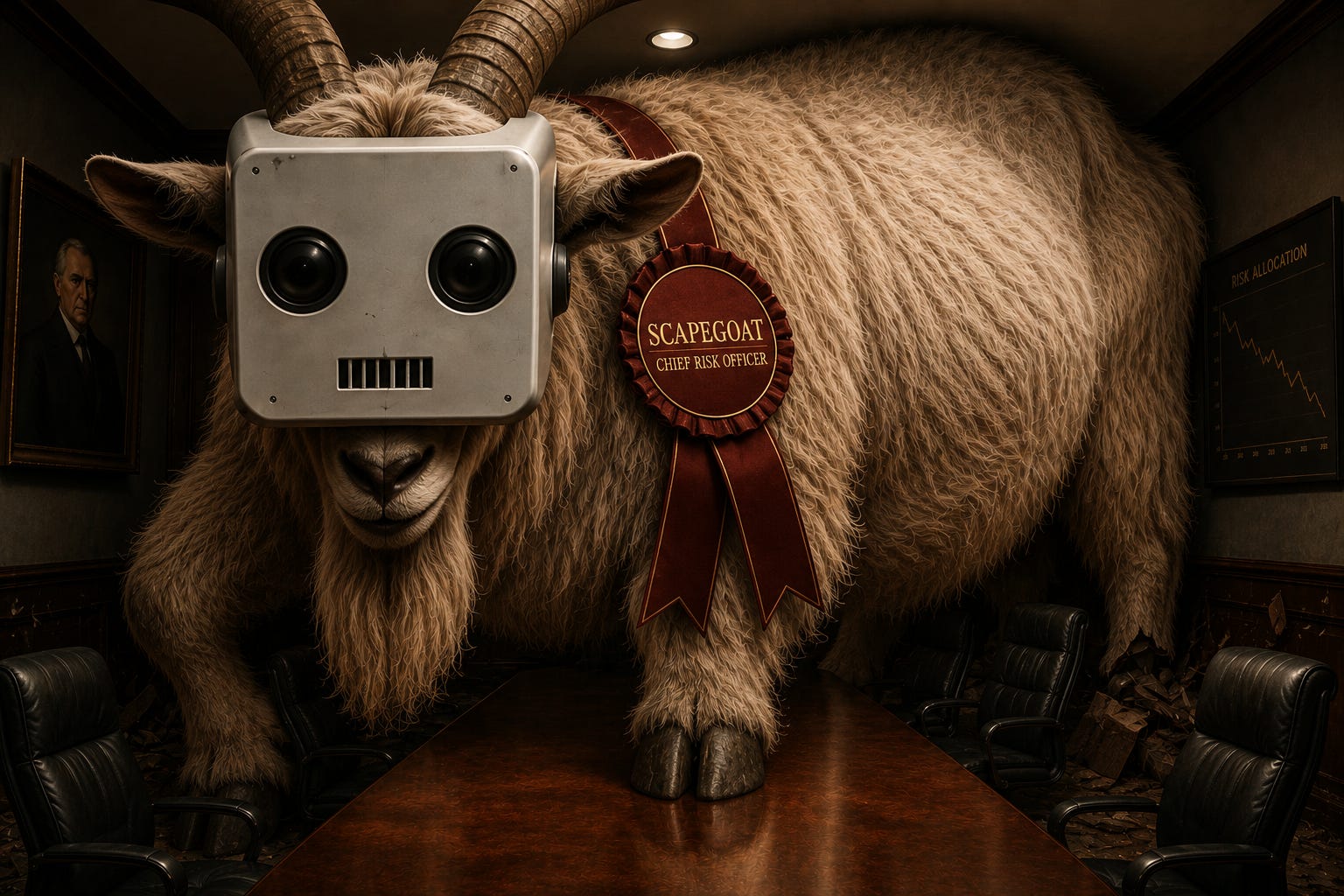
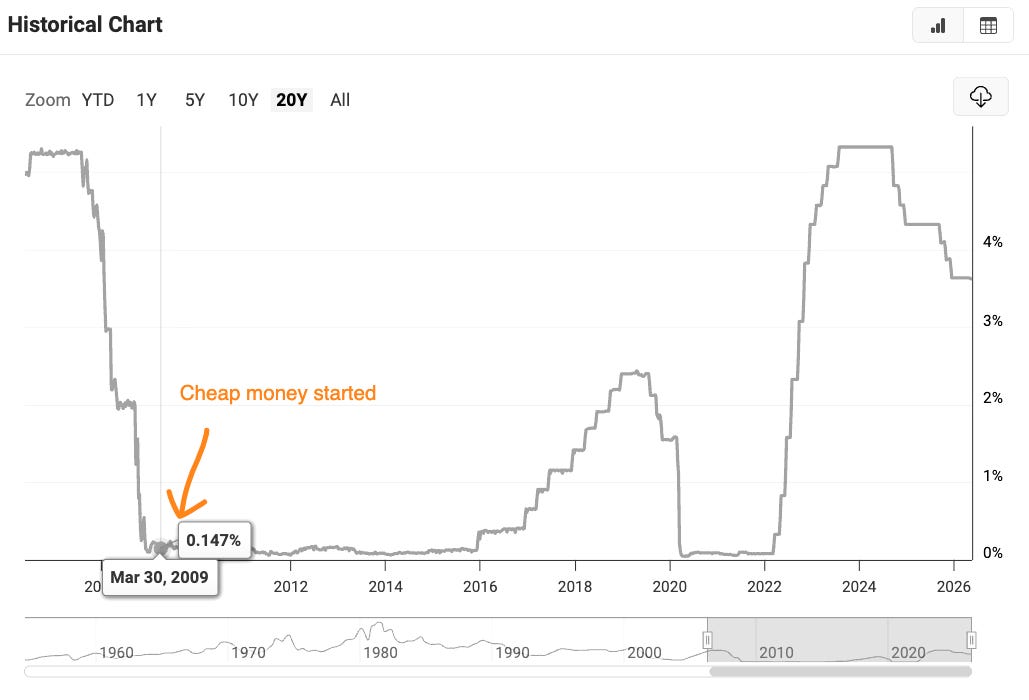
To do this, let’s rewind to a time most of us forgot: when money was nearly free.
This is the thing about pain: when we feel it, we feel it so deeply that we forget we’ve ever felt any other way.
If you’ve been suffering the pain of a slow economy since 2022, let me start by reminding you of better times.
Money was close to free ever since central banks slammed interest rates to the floor after 2009.
Even though the pandemic time was painful for its own reasons, it also gave white‑collar workers the loosest labor market of the generation.
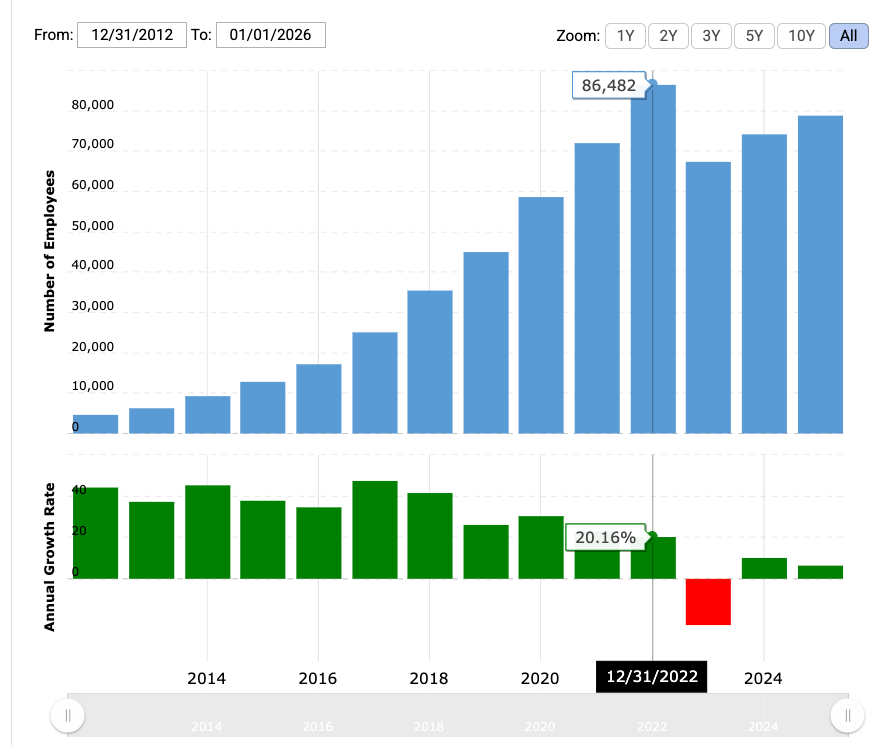
Between 2019 and 2022, Meta went from roughly 45,000 employees to about 87,000. Nearly doubled in three years.
Not just Meta, but every company with sufficient revenue to borrow saw the same thing: cheap capital, a pandemic that seemed permanent, an online-everything boom, and executives convinced that the surge in demand would stick around.
As office workers, we also got our cut of the pie. We worked from home, enjoying the greatest freedom and pocketing a generous pay raise and bonus.
Then the music stopped.
When the pandemic-era supply shortages met a sharp rebound in demand, while energy prices jumped after Russia’s invasion of Ukraine, causing inflation and forcing the Fed, the BoE, and many other central banks to act in the same way: a ~500 basis points hike within a year.
To put this in context, this is a much sharper climb than the one before the 2008 crisis.
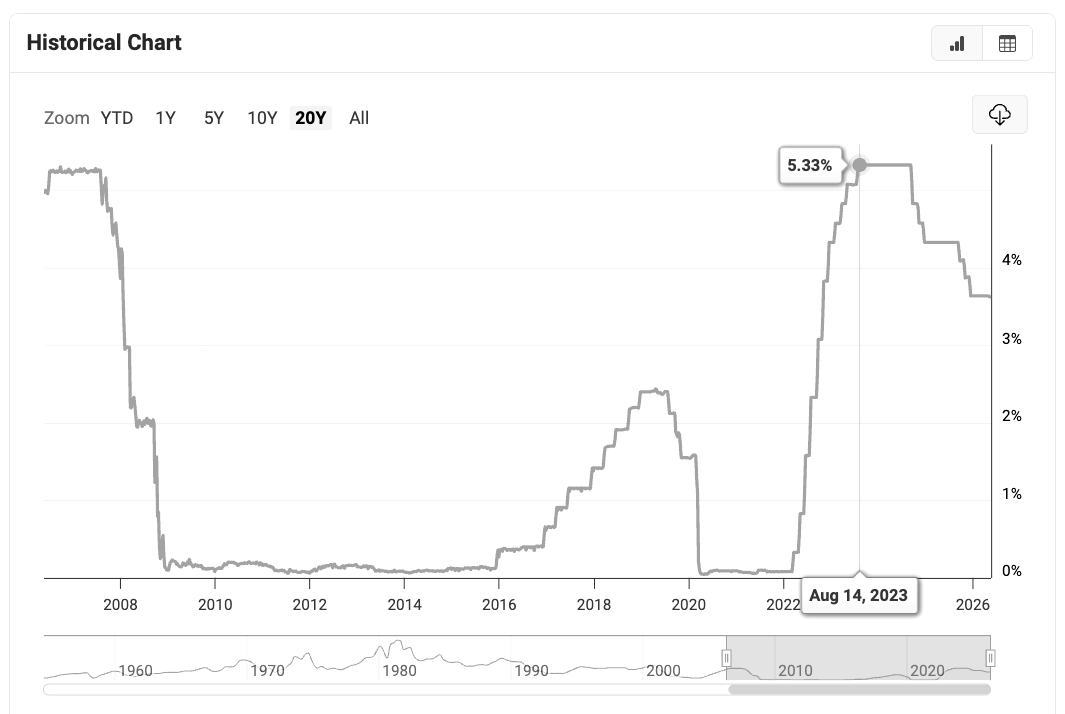
Shortly, CEOs could no longer afford the commitments they’d made to white-collar employees, as rising interest rates made the debt they owed more expensive than they had planned for; so they were forced to act.
The quickest way to cut costs is to cut personnel spending.
With this, they could either admit that “we over-hired and we got it wrong.”
For example, as Zuckerberg actually said in his late ‘22 message:
“At the start of Covid, the world rapidly moved online and the surge of e-commerce led to outsized revenue growth. Many people predicted this would be a permanent acceleration that would continue even after the pandemic ended. I did too, so I made the decision to significantly increase our investments…”
“We've cut costs”… and “We're restructuring teams to increase our efficiency. But these measures alone won't bring our expenses in line with our revenue growth, so I've also made the hard decision to let people go.”
Or the executives can go with this message: we’ve found AI can replace human workers, and now we're an AI-first company.
The first message tanks your share price; the latter gives your shareholders peace of mind.
You don’t need me to tell you which one most of them reached for.
The Disproportionate Claim
So now you know the motive. The question is, which direction does the evidence support?
4 years and counting, I’ve been tracking AI (especially LLM) adoptions. I’ve seen only a handful of successful implementations. And even then, they've mostly handled repetitive tasks, not replaced the jobs those tasks belong to.
How does a task differ from a full-time job?
List out a job you care about (like yours); e.g., a software engineer breaks down into 10, maybe 15, discrete tasks. Apart from ‘typing code’ (this is my favorite term from a CEO)… you need to groom tickets with product managers, pair-code with your teammates; if you are a lead, you need to review performance and have one-to-one meetings, and so on.
Yes, AI can speed up coding, but this is a task, not a job; hold this distinction because the whole question of whether AI takes your role comes down to it. AI can draft a basic legal contract or create marketing materials; all these are tasks.
The success of AI implementations is currently stuck at the task level. (Read my analysis of Stanford AI Index’s benchmarks on tasks vs. workflow.)
So if AI is only clearing tasks, not jobs, what explains the reasons for those disproportionate thousands or even tens of thousands of AI-attributed layoffs?
When questions get messy, the answer with the fewest assumptions is usually the answer (if you’re familiar with Occam’s razor).
So the simplest explanation here, when CEOs and the media say AI will replace engineers, the former are likely lying, and the latter are parrots.
Here are the three latest data points from micro to macro.
While most companies claim they lay off because of AI, as the chart shows:
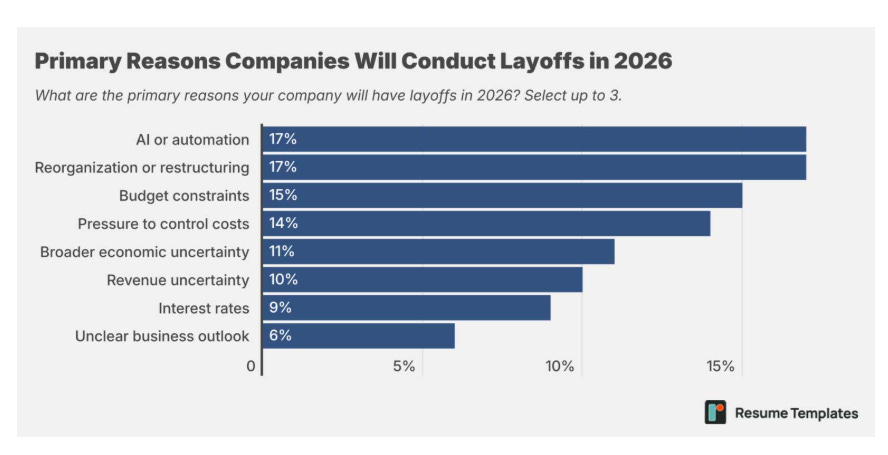
The untold truth is, in the same report, 59% also admitted they emphasize AI in their layoff announcements because it plays better with stakeholders than saying “we have a budget problem.” And only 9% said AI had genuinely, fully replaced roles.
Now, zoom out to the wider job market, the aggregate agrees.
Another firm that has counted American layoffs for decades logged about 1.2 million job cuts in 2025. The number of roles pinned on AI: only ~55,000. Under five percent, ranked behind government cuts, behind market conditions, and also behind plain restructuring.
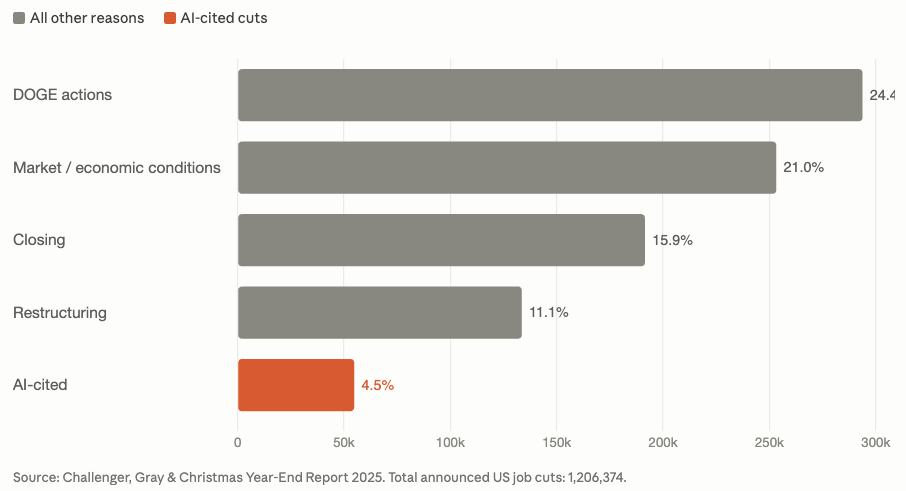
Let’s zoom out even further, shall we?
Guess what the unemployment rate was in April 2026?
Most economists would file this under “healthy, slightly tight labor market,” rather than “crisis” (see the image below, especially if you compare it with the period between 2008 and 2012; ignore the Covid peak, which was driven by service-sector job losses).
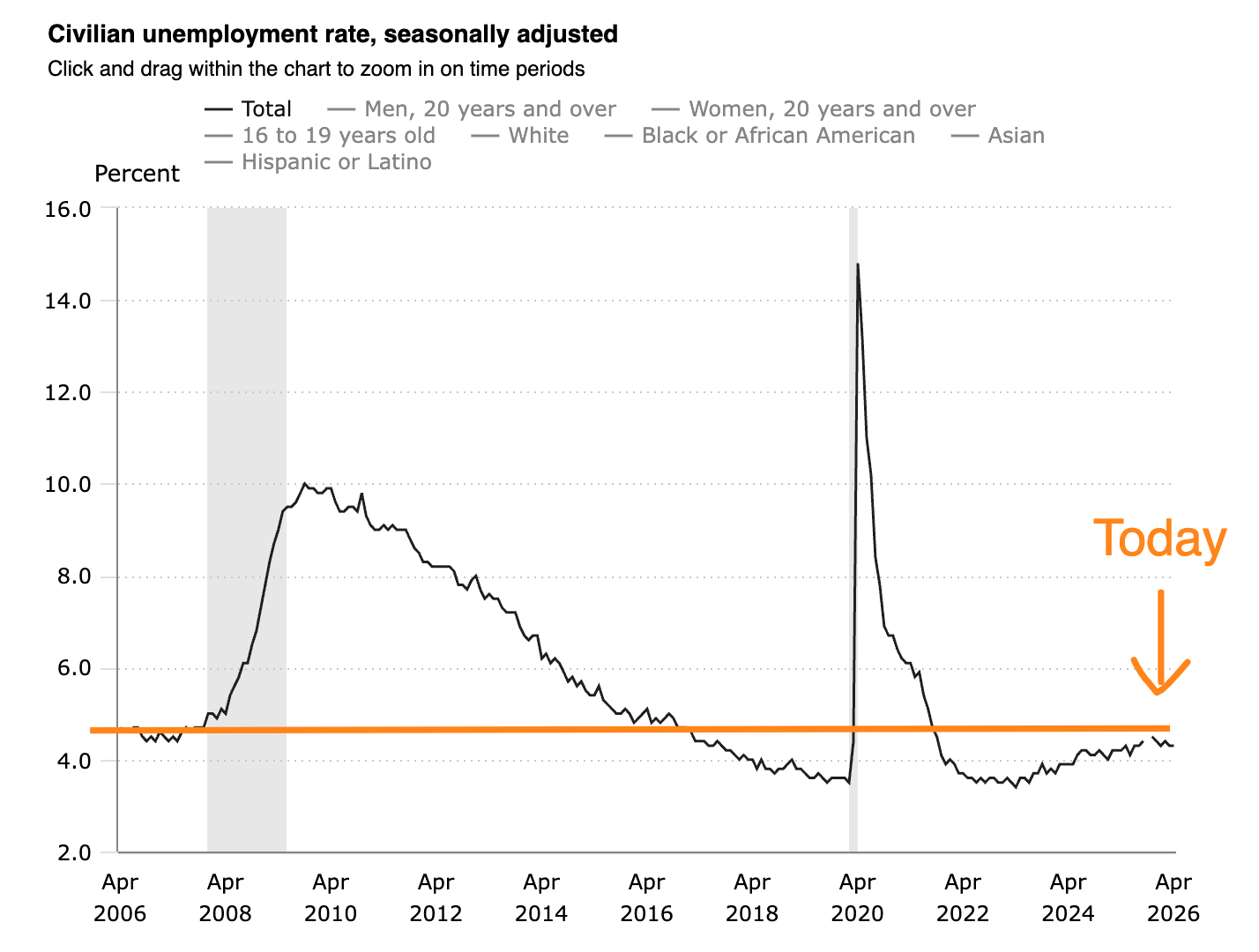
So across all levels (company level survey, the layoff count, the BLS official unemployment rate), no matter how reluctant, the data aligns:
AI shows up late, small, and overhyped.
Some well-known figures have started calling out the BS.
Take Marc Andreessen (cofounder of Netscape, then a venture capitalist), who called AI the “silver bullet excuse,” and reckoned most large companies are 25 to 75% overstaffed, left over from the COVID years.
Or the latest, from Andrew Ng:
“Businesses have a strong incentive to talk about layoffs as if they were caused by AI. Talking about how they’re using AI to be far more productive with fewer staff makes them look smart. This is a better message than admitting they overhired during the pandemic when capital was abundant due to low interest rates and a massive government financial stimulus.”
So the data is clear for now, i.e., AI isn't responsible for the firing. But 'not yet' is cold comfort if you don't know what to watch for.
If you want to know whether your own job is safe, you need something more durable that can hold up no matter how the conditions change.
The First Principle of Jobs
Here’s a cleaner way to think about all this jobpocalypse joke than the ATM story you've probably already heard.
In case you have never heard of the ATM story, here’s the short version: ATMs arrived in the 1970s, many declared the bank teller dead, but the opposite happened. Yes, there were fewer tellers per branch, but cheaper branches meant banks could open more of them in towns that had no previous footprint, and the total number of tellers actually grew.
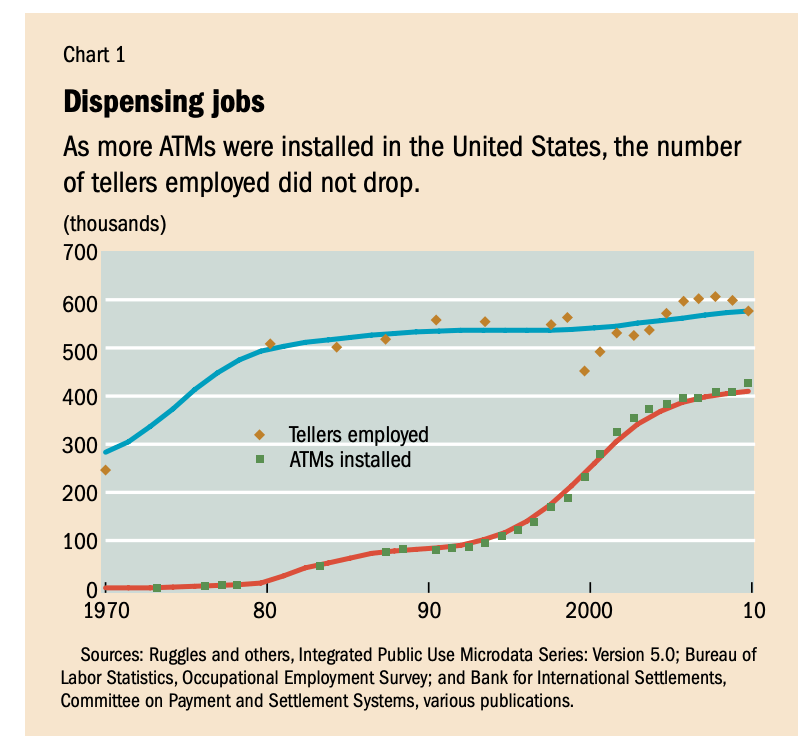
Here’s the twist, though. As mobile banking grew, tellers started disappearing. See this chart:
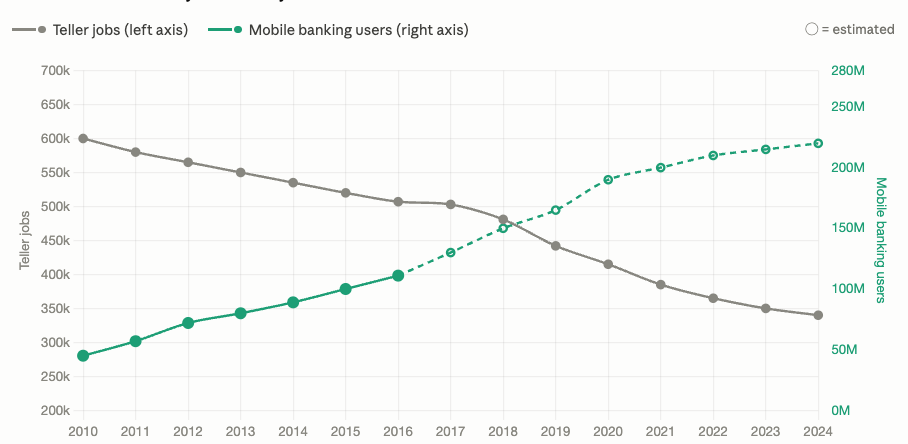
What does the story tell us? Nope, not the Jevons paradox, too academic. Instead, under the first principle, it’s just a simple supply and demand dynamic at the fundamental level.
We need to start by asking,
why does a job even exist?
A job isn’t granted to you so you can pay for your baby’s diapers or your own.
A job exists because someone, somewhere, feels a pain sharp enough to pay to make it go away. A company builds something to solve that pain. You're one of the screws holding that solution together.
So if we apply this thinking, and ask,
why a teller to begin with?
It’s because we want to make a transaction, or cancel one, or save money, or lend some.
The next question:
Then why didn’t ATMs replace tellers? Instead, they created more?
If we look back at the period between 1970 and 2000, apart from what we talked about, banks were experiencing growth; there was a significant technology gap, and ATMs only addressed part of the issues when moving money.
You could get cash at 11 pm, yes, but you still needed a branch to do almost everything else: transfer money, dispute a charge, open an account.
The pain couldn’t be fully resolved by this bulky machine. So teller numbers didn’t collapse. They shifted to more on-site banking.
Fast forward twenty years.
In the post-internet era, nearly everyone has access to the internet and a mobile phone; the US’s payment system is becoming more mature, so more features that were only on the screen in front of a teller are now also on your phone. Anywhere, anytime, no queue.
Once the full job moved to your phone, the branch became optional. That’s when teller numbers fell.
Therefore, what ended teller jobs wasn’t ATMs but something else that provides a complete solution: a much better experience, at a lower cost, more accessible, with software that can be updated easily.
Or, take myself for an example, I was an ops product lead, not because customers wanted a product leader; in fact, I don’t think many of them ever heard of this job. But simply because our customers get hangry (hungry + angry) and want food, the food delivery company needs someone to maintain the operational systems their admins use; hence, they paid me for it.
Just like if the world had no thieves, then what would the police be good for?
With this same principle, you can answer the questions for any jobs that are deemed at risk: why an engineer, why an accountant, why a customer service representative, why a lawyer?
So “will the job disappear?” was always the wrong one to ask, try “what did customers actually need? And will this new technology make the journey to satisfy the need smoother?”
Takeaway
I talked about this in “Why AI Shopping Isn’t Going To Work”; it’s the same principle. People won’t buy via AI shopping, no matter how fancy it sounds, because it has fundamentally ignored the needs when you shop.
So AI, in any case, will only kill a role when it finally satisfies the underlying need (or resolves a pain) well enough (smoother journey or much cheaper) that the role stops being needed at all. Which, with current AI capabilities, isn’t happening.
Run the following task to evaluate your own work.
Break down your job into tasks,
write down the pain your role exists to remove,
finally, look at where AI actually is in relation to that pain.
Ignore everything else around it; these are mostly noise.
Only the pain and the fundamental need matter. As long as AI is still running in circles, you have time. When it closes the gap, you'll know before any earnings call announces it.


