
Hey,
Final one of 2025.
I’ve been wanting to write this for a while, but kept putting it off because “ageism in AI hiring” is one bad paragraph away from sounding like a LinkedIn grievance post or ‘kids these days’.
Hopefully I’ve avoided both.
Oh, and the boring admin bit: price goes up January 1st ($75/year). If you’ve been hovering over the subscribe button for six months, this is your sign: $50/ year until the 31st.
Now, onto the goodie.

It’s December.
Performance review season.
You’re sitting there, just found out there’s a new section to evaluate ‘AI integration and implementation‘. So you’re trying to articulate your value in the AI era. Meanwhile, your younger colleagues are listing “prompt engineering” or “vibe coding experiments” on their self-assessments.
There’s a narrative floating around — in job postings, in LinkedIn hot takes, in the way some executives talk about their teams. Hinting that younger workers are “AI native.” They grew up with technology. They’ll lead the way.
It’s not subtle.
Cloudflare’s CEO Matthew Prince announced plans to hire over 1,000 interns in 2026 — a 2,000% increase from typical years — explaining:
“50-year-old CEOs like myself aren’t going to be the ones to teach companies how to take advantage of AI. We need to learn from the next generation.”
Watch the full interview below.
Nokia’s CEO Justin Hotard wrote that his most insightful AI conversations were with “early-career talents in their early 20s” who “began university when ChatGPT launched.”
And then there’s Fortune, with this headline: “Baby Boomers are making millennials their successors for CEO jobs instead [of Gen X] because they’re down with AI.”
“Down with AI.” I had to read that twice.
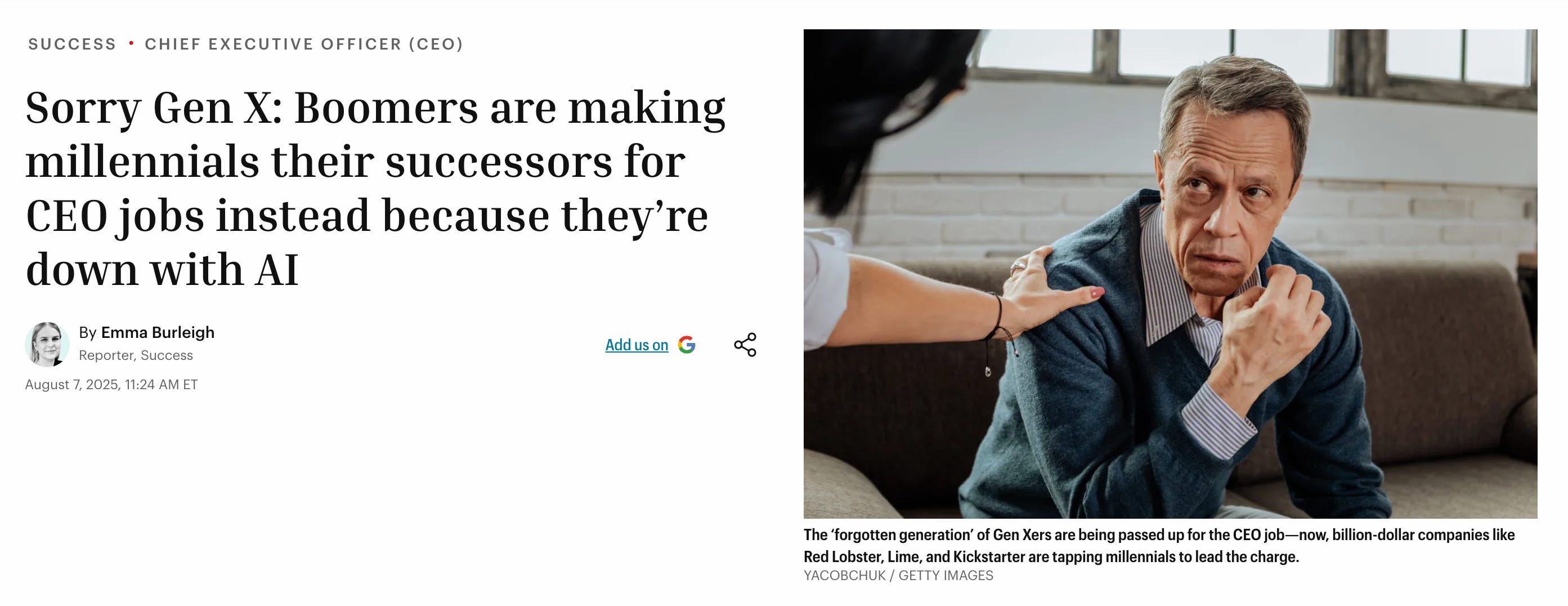
The article claims Gen X is being skipped over for promotions because — and I quote — it’s “linked back to AI’s rising prominence.” The supporting evidence? 50% of millennials use generative AI at work, compared to 34% of Gen X and 19% of baby boomers.
So we’re making promotion decisions based on who opens ChatGPT more often. Cool. Very rigorous.
Look, I’m not here to start a generational war. But using a tool a lot can’t be used as a universal indicator of your overall work capability. My godson uses TikTok 6 hours a day. I’m not making him head of marketing.
And yes, I’m a millennial saying this. The hype benefits some of my generation on paper. I still think it’s wrong.
That said, the assumption is clearly baked into hiring decisions now:
Digital native = better at AI.
And if we put age aside entirely, one thing is clear:
71% of business leaders say they’d rather hire someone with AI skills than someone with more experience.
TLDR
Question #1: Should I be hiring for “AI native” over experience?
The research says no.
Here’s how LSE Business Review put it:“There is little evidence that ‘tech native’ employees hold more positive attitudes towards technology than professionals from older generations or that their native tech experiences will help them to use technologies more productively.”
Growing up with ChatGPT doesn’t mean you can evaluate whether an AI-generated report is accurate for your specific business context.
Question #2: Who actually produces better work with AI?
Older workers produce better AI-assisted output.
A study had 150 people write arguments using AI, and it concluded that older participants consistently outperformed younger ones. The researchers attributed it to “cognitive maturity” — better self-regulation, less distracted by AI’s suggestions.
Question #3: What makes experience valuable in an AI workflow?
AI is a multiplier. It multiplies what you already have. So remember this:
2 years of knowledge × AI = wrong, but fluent15 years of knowledge × AI = knows which 80% to throw away.
Your value isn’t “I use AI.” It’s: I can evaluate AI output in seconds because I’ve seen wrong before. I direct AI strategically instead of accepting its first suggestion.Question #4: How do I know if my team is good at AI—or just using it a lot?
Stop measuring adoption!!
Don't trade it as Pokémon cards; using all the AI models doesn’t equal a better result.
Start measuring judgment.
You’re evaluating whether your team has something worth multiplying. Not how often they open ChatGPT.
In this article, I’m going to show you the evidence one after another of why your in-the-field experience is the best AI skill you've ever hoped for.
Before we start, note that
Ordering the same meal at the same restaurant for 20 years doesn’t make you a food critic. It makes you a regular with limited taste.
My point being, the number of years alone doesn’t indicate skill; it only matters if you’ve learned from your mistakes and continually grown.
In the end, I will also ask you some questions to help you better articulate your advantages.
Shall we?
The video version.


