2nd Order Thinkers
2nd Order Thinkers.
Why Your 20-Something Colleague Is Worse at AI Than You?
0:00
-19:13

Why Your 20-Something Colleague Is Worse at AI Than You?

The AI skill that takes 10 years to learn (and you might already have it).

Hey,

Final one of 2025.

I’ve been wanting to write this for a while, but kept putting it off because “ageism in AI hiring” is one bad paragraph away from sounding like a LinkedIn grievance post or ‘kids these days’.

Hopefully I’ve avoided both.

Oh, and the boring admin bit: price goes up January 1st ($75/year). If you’ve been hovering over the subscribe button for six months, this is your sign: $50/ year until the 31st.

Now, onto the goodie.


It’s December.

Performance review season.

You’re sitting there, just found out there’s a new section to evaluate ‘AI integration and implementation‘. So you’re trying to articulate your value in the AI era. Meanwhile, your younger colleagues are listing “prompt engineering” or “vibe coding experiments” on their self-assessments.

There’s a narrative floating around — in job postings, in LinkedIn hot takes, in the way some executives talk about their teams. Hinting that younger workers are “AI native.” They grew up with technology. They’ll lead the way.

It’s not subtle.

Cloudflare’s CEO Matthew Prince announced plans to hire over 1,000 interns in 2026 — a 2,000% increase from typical years — explaining:

“50-year-old CEOs like myself aren’t going to be the ones to teach companies how to take advantage of AI. We need to learn from the next generation.”

Watch the full interview below.

Nokia’s CEO Justin Hotard wrote that his most insightful AI conversations were with “early-career talents in their early 20s” who “began university when ChatGPT launched.”

And then there’s Fortune, with this headline: “Baby Boomers are making millennials their successors for CEO jobs instead [of Gen X] because they’re down with AI.”

Down with AI.” I had to read that twice.
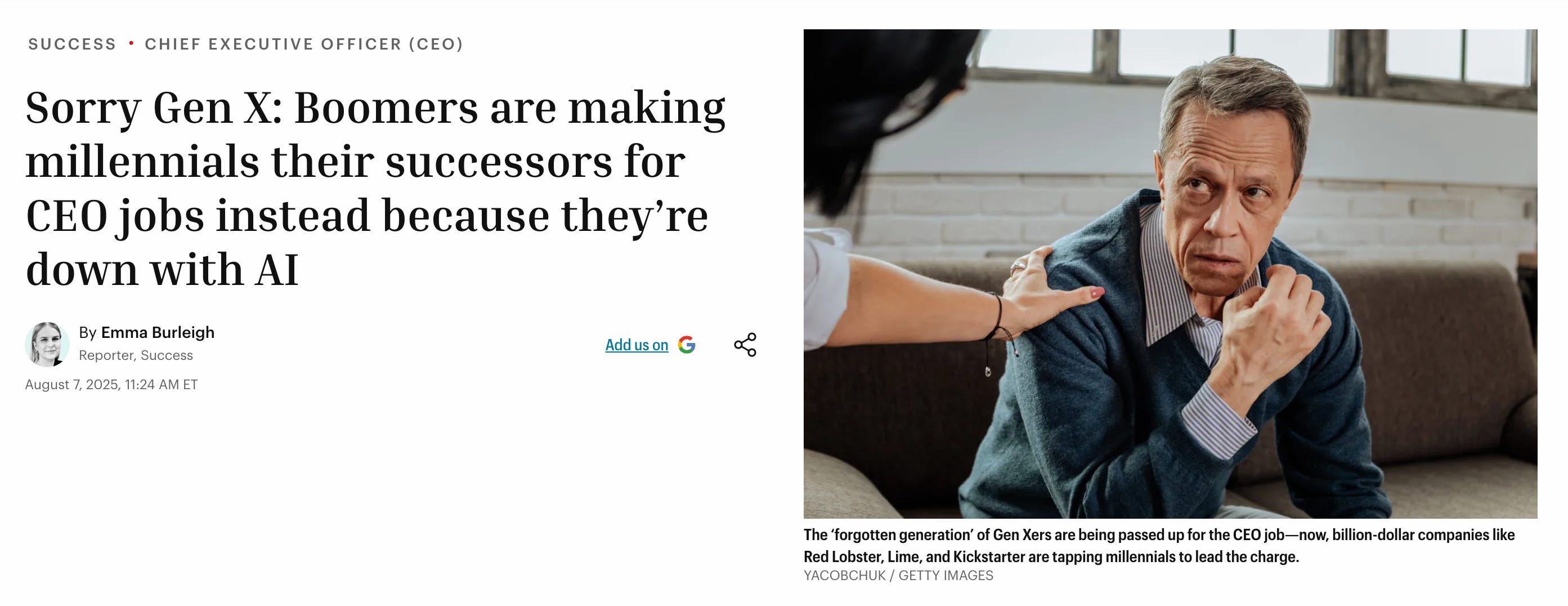
The article claims Gen X is being skipped over for promotions because — and I quote — it’s “linked back to AI’s rising prominence.” The supporting evidence? 50% of millennials use generative AI at work, compared to 34% of Gen X and 19% of baby boomers.

So we’re making promotion decisions based on who opens ChatGPT more often. Cool. Very rigorous.

Look, I’m not here to start a generational war. But using a tool a lot can’t be used as a universal indicator of your overall work capability. My godson uses TikTok 6 hours a day. I’m not making him head of marketing.

And yes, I’m a millennial saying this. The hype benefits some of my generation on paper. I still think it’s wrong.

That said, the assumption is clearly baked into hiring decisions now:

Digital native = better at AI.

And if we put age aside entirely, one thing is clear:

71% of business leaders say they’d rather hire someone with AI skills than someone with more experience.

TLDR

  • Question #1: Should I be hiring for “AI native” over experience?

    The research says no.
    Here’s how LSE Business Review put it:

    There is little evidence that ‘tech native’ employees hold more positive attitudes towards technology than professionals from older generations or that their native tech experiences will help them to use technologies more productively.

    Growing up with ChatGPT doesn’t mean you can evaluate whether an AI-generated report is accurate for your specific business context.

  • Question #2: Who actually produces better work with AI?

    Older workers produce better AI-assisted output.

    A study had 150 people write arguments using AI, and it concluded that older participants consistently outperformed younger ones. The researchers attributed it to “cognitive maturity” — better self-regulation, less distracted by AI’s suggestions.

  • Question #3: What makes experience valuable in an AI workflow?

    AI is a multiplier. It multiplies what you already have. So remember this:
    2 years of knowledge × AI = wrong, but fluent

    15 years of knowledge × AI = knows which 80% to throw away.
    Your value isn’t “I use AI.” It’s: I can evaluate AI output in seconds because I’ve seen wrong before. I direct AI strategically instead of accepting its first suggestion.

  • Question #4: How do I know if my team is good at AI—or just using it a lot?

    Stop measuring adoption!!

    Don't trade it as Pokémon cards; using all the AI models doesn’t equal a better result.
    Start measuring judgment.
    You’re evaluating whether your team has something worth multiplying. Not how often they open ChatGPT.

In this article, I’m going to show you the evidence one after another of why your in-the-field experience is the best AI skill you've ever hoped for.

Before we start, note that

Ordering the same meal at the same restaurant for 20 years doesn’t make you a food critic. It makes you a regular with limited taste.

My point being, the number of years alone doesn’t indicate skill; it only matters if you’ve learned from your mistakes and continually grown.

In the end, I will also ask you some questions to help you better articulate your advantages.

Shall we?

Do you say thank you to a waiter? If yes, why not to your writer? 🙂

The video version.


What Research Says About AI & Experience?

I gathered these from various research. Each one of them is not enough to be an individual article. But now I’ve collected enough of them, so I’m here to lay it all in front of you.

Are “Digital Natives” Actually Better at AI?

The “digital native” assumption itself has actually been studied.

And surprise, surprise, it doesn’t hold up.

An LSE Business Review analysis found:

There is little evidence that ‘tech native’ employees hold more positive attitudes towards technology than professionals from older generations or that their native tech experiences will help them to use technologies more productively.

Yes, there are a few percent differences in the chart, but they are tiny and statistically “noise” rather than evidence of a genuine tech advantage for the young.

Another plot twist here: a 2025 workplace tech survey found that 28% of Gen Z workers feel overlooked and unsupported when new technology is introduced. That’s a higher rate than Baby Boomers (22%).

Fluency with consumer apps doesn’t translate to comfort with enterprise systems.

And again, growing up using ChatGPT as their friend and mentor doesn’t mean they know how to evaluate whether an AI-generated report is accurate for a specific business context.

Who Produces Better AI-Assisted Work?

A study invited 150 people and split them into four groups. The task for everyone was the same. Write a solid, reasoned argument about the pros and cons of democracy.

  • Group One: They had to do it all on their own. No AI.

  • Group Two: could use ChatGPT however they wanted—a total free-for-all.

  • Group Three: also got to use ChatGPT, but they had to follow a very specific, structured method.

  • Group Four: was just the AI’s own output, which they used as a baseline.

One of the findings:

Older participants consistently wrote better arguments.

The researchers attributed this to “cognitive maturity” — better self-regulation, less distracted by flashy AI outputs. Here’s what the researcher said:

older participants consistently produced higher-quality arguments across all conditions

Education also mattered. Those with bachelor’s degrees or postgraduate qualifications outperformed those without.

Of course, there’s a catch; human insight only appeared when people used AI deliberately, not casually.

Deliberate, structured interaction with AI resulted in 17-30% improvement in argument quality. At the same time, casual use resulted in only 8-15% improvement, barely better than letting AI do the work entirely w/o humans.

But Aren’t Younger Workers Shipping Faster?

The Microsoft/Accenture study claims that junior developers benefit more (and are more open to using) from AI coding assistants than seniors do.

Figure 6 shows the productivity split clearly: junior developers saw 21-40% increases in pull requests, while senior engineers only saw 7-16% gains. The interpretation here is that younger developers are more open to new technology.

Except there’s a problem with this narrative and some conflict of interest from this group of authors. This is from researchers at Microsoft (the company selling Copilot and OpenAI partnership) and Accenture (the company selling AI implementation services like their GenWizard platform).

You’re telling me a study funded by people who profit from AI adoption found that AI is great and improving productivity? Shocking.

They measured speed. They measured completed tasks. They measured pull requests.

What didn’t they measure?

Whether the code actually worked correctly and safely.

Stanford researchers filled that gap. They ran an experiment asking developers to write code for security-related tasks - string encryption, SQL queries, and file path validation.

Half got AI assistance. Half didn’t. They found that those who used AI assistants to code made significantly more mistakes.

Ok, you might say,

This was a study from 2023! AI has improved since!

What about this…

AI-assisted teams didn’t just ship faster – they shipped 10× more security findings. And while findings soared, PR volume actually fell by nearly a third. That means more emergency hotfixes, more incident response, and a higher probability that issues slip into production before review catches them.

A 2025 analysis of JetBrains’ Developer Ecosystem survey (3380 developers) revealed the mental model gap:

  • Experienced developers view AI as a “junior colleague”— something that needs oversight

  • Less experienced developers view AI as a “teacher” — an authority figure to learn from

And here’s the real difference: When juniors see AI as their teacher, they don’t question its suggestions. When seniors see AI as an intern, they review everything.

Some other interesting findings in this one that’s not relevant to age, but I think worth mentioning, because this is the mistakes that many hiring managers make:

  • How much coding experience ≠ You’ve heard about many AI tools

  • AI experience ≠ Coding experience

The same Stanford study we talked about also mentioned that Developers who trusted AI less and questioned their prompts more had fewer security vulnerabilities.

They rephrased. They tested. They didn’t just accept the first suggestion.

That’s senior behavior, not strictly because of age, but the scar tissue from debugging production failures at 2 AM on Sunday or receiving calls on Thanksgiving when your family decided to start the turkey without you (sorry, mate).

One of the CTOs in our network once told me,

I asked an intern why did you code this.

The intern replied:

I don’t know. Copilot asked me to.

So yes, juniors may very possibly get “40% more productive” according to Microsoft and Accenture’s study. They’re shipping more code, faster.

But nobody’s asking: productive at what? Shipping bugs at 40% faster?

Sharing is caring. Especially in this holiday season :)

Share

Don’t We Need Fresh Perspectives For Innovation?

Fine, some people argue that juniors bring a fresh perspective.

Which is true, but this is again, only part of the story.

When it comes to truly original thinking, experience changes everything—even when everyone has access to the same AI tools.

A September 2025 study put this to the test. Researchers split 42 designers into two groups: novices (undergrads, zero real projects) and experienced designers (3+ years in the field).

Same creative task. Same AI tools. Same timeframe.

Look at Figure 6 from their study. AI dramatically boosted how supported novices felt creatively—a 133% gap reduction compared to experienced designers.

Great, right? Except…

When you measure other factors, that are equally, if not more, important when creating a piece of work—novelty, quality, refinement—the gap between novice and experienced designers didn’t shrink.

It widened.

Novelty: The gap grew by 55%. Number of ideas generated: the gap grew by 79%.

The researchers found that for novices, AI serves as “a source of inspiration, helping to break through cognitive barriers and stimulate idea generation.” But for experienced designers? AI “contributes more to the refinement stage, enhancing the detail and overall quality.

Translation: juniors use AI to get ideas. Seniors use AI to polish ideas they already have.

The pattern that many other studies have found is that novices embrace AI output. Experienced professionals filter it.

This connects directly to my earlier brainstorming research. Remember? Only 6% of ChatGPT-only ideas were unique. Human-only brainstorming? 100% unique ideas.

AI excels at incrementally creative. It fails at being radically novel.

AI regurgitates patterns. However, your industry knowledge—knowing what’s actually new versus what’s been tried—is what produces genuinely original ideas.

That “fresh perspective” juniors supposedly bring?

It’s often just not knowing what’s already been done.


Questions To Ask Yourself

Alright now. That was a lot of stats.

I hope you’re still with me.

It’s the end of the year (and 360 review season for some companies).

Does AI make you mostly happy or nervous in 2025?

Especially in your career. If you are in the C-level (I know a few of you are!!!) and think this article inspires you, then also go through the following questions.

I believe it will make it even clearer for you:

  • What do I know that took me years to learn, that I now use in 10 seconds to evaluate AI output?

  • What did I teach my team this year that they couldn’t have learned from an AI tool?

  • Where did my team avoid a costly mistake because of something I’d seen before?

  • What context did I provide that made the AI output actually useful for our situation?

  • Where did I recognize that an “AI-powered solution” wasn’t right for our problem?

  • How did I help other leaders understand what AI can and can’t do in our context?

  • What relationships and trust did I build this year that no AI could replicate?

  • How did I help the organization distinguish between AI hype and AI value?

In case you self-diagnose with a severe case of imposter syndrome, this is for you (wink):

  • Am I underselling my experience because I don’t have “AI” in my job title?

  • Did I defer to my colleague's AI output when I should have trusted my own judgment?

  • What would I be irreplaceable for even if we bought all the AI tools on earth?

I hope this helps you build your self-confidence and make it easier to articulate your value and worth in your end-of-the-year review.


The Decoration vs. The Foundation

In a time when everyone’s talking about AI tools, prompting techniques, and “AI-native workflows.”

I think I have made it clear that all of those are decorations.

The foundation? Domain knowledge. Pattern recognition. Judgment. The ability to look at AI output and know — in seconds — whether it’s gold or garbage.

You can’t buy that foundation over some open-access course. You can’t learn it in a weekend workshop. You build it over the years.

One Last Thing.

Here’s an EY & Microsoft report surveying 5,000+ Gen Z on AI literacy.

It found Gen Z is decent at identifying which products use AI, weaker at writing effective prompts, and worst at the skill that actually matters, evaluating whether AI output is accurate. For example, only 36% knew that AI systems can invent facts.

But here’s what the report doesn’t do: compare Gen Z to anyone older.

It’s 5,218 Gen Z respondents, no control group. And it’s online-only, which already skews toward the more digitally-engaged.

So you cannot use it to prove that experienced workers are better.

To be crystal clear, I’m not writing this to win a generational argument.

Every generation gets the “kids these days” treatment, and it’s usually lazy thinking.

The point isn’t that younger workers are bad at AI. The point is that experience compounds — and right now, that value is being systematically undercounted. The research says your years in the trenches aren’t a liability.

They’re the thing that makes AI actually useful.

Don’t let anyone tell you otherwise.

Next up, how to position this advantage in 2026. Subscribe if you don’t want to miss it.

Merry Christmas and Happy New Year,

Jing Hu

Discussion about this episode

User's avatar

Ready for more?